
Customisation, risk and new market structures (roundtable ‘AI & Blockchain’ part 2)
Customisation, risk and new market structures (roundtable ‘AI & Blockchain’ part 2)
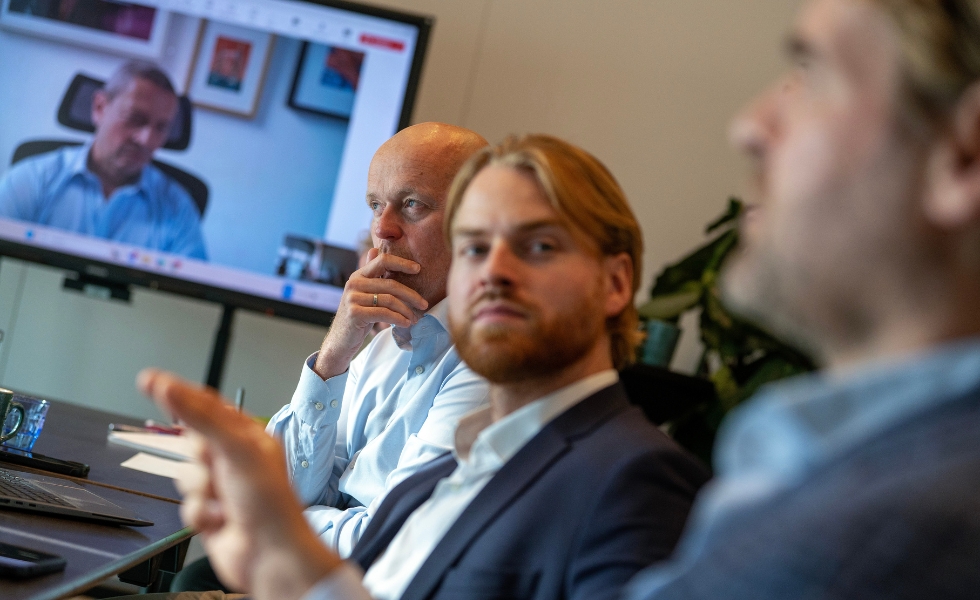
This report was originally written in Dutch. This is an English translation.
In part 2 of the roundtable report “AI & Blockchain”, the experts discuss how AI enables hyper-personalised customisation for customers, but also raises new risks and ethical questions. At the same time, they outline how tokenisation and blockchain will radically change the products, transparency and functioning of financial markets.
By Hans Amesz
This is part 2 of the report. You can read part 1 here, part 3 here, and part 4 here.
|
CHAIR Ralph Wessels, Chief Investment Strategist, ABN AMRO Bank
PARTICIPANTS Han Dieperink, Auréus Ruud Hendriks, Startupbootcamp & The Innoleaps Group Patrick Lemmens, Robeco Axel Maier, MDOTM Stefan Singor, a.s.r. vermogensbeheer Ruud Smets, Theta Blockchain Ventures Pim Swart, Maven 11 Frans Verhaar, bfinance |
How does AI enable greater customisation for clients?
Maier: ‘It enables asset managers to deliver efficient customisation on a scale and at a speed that humans can never match. Where you used to offer five portfolios, AI can translate this into tens of thousands of variants. AI also enables highly personalised reporting: controlled generative AI can generate real-time reports for each client, replacing the old quarterly reports. If the market collapses, AI can immediately provide explanations to clients and what this means for their portfolios.’
Verhaar: ‘Among institutional investors, we see that AI contributes to customised benchmarks. Providers such as MSCI, S&P and Qontigo, for example, have developed AI tools for climate-aligned indices. Among investors, AI is often used to tailor portfolios to specific sustainability preferences. Platforms such as Clarity AI and MSCI ESG link business activities to the SDGs. Arabesque uses AI for analysis and portfolio construction as part of its sustainable services.’
What are the main risks of AI in terms of technology, ethics, regulation and reputation?
Singor: ‘From a technological point of view, data quality is crucial. We rarely have complete data sets, only samples, which can lead to biases. Hallucinations by chatbots are another major problem. Model outcomes are uncertain and must be interpreted with caution. From a reputation point of view, we take ESG very seriously. Due to its high energy consumption, AI can have a negative impact in this area.’
Politics remains necessary for clear rules to protect people and prevent abuse. Not only with AI, but also with tokenisation and digital assets.
Maier: ‘Ethics is essential. Ethically responsible AI starts with explainability. If you can't explain it, you can't control it. Transparency and avoiding the ‘black box’ problem are crucial.’
Hendriks: ‘What worries me is that people don't understand exponential growth. The productivity gains may seem small now, but in ten or fifteen years” time, the impact will be enormous. However, the risks are just as great. People see me as an AI optimist, but in terms of potential, AI is just as dangerous as the atomic bomb. Big Tech is not using AI to improve the world, but to control it. Even within the sector itself, many people do not know exactly what is happening in their algorithms. That lack of insight should be a cause for concern.’
How do you see the role of politicians in the application of AI?
Hendriks: ‘There is a complete lack of urgency in The Hague, even though we are in the midst of the greatest revolution since the discovery of fire. No education minister has given schools or universities guidelines on how to deal with AI. Teachers say they lack both the time and the knowledge to teach it.’
Lemmens: ‘Younger generations are learning on their own, and universities are adapting. But politics remains necessary for clear rules to protect people and prevent abuse. Not only with AI, but also with tokenisation and digital assets. Regulation is essential, and governments are indeed lagging behind.’
Verhaar: ‘Governments can go in three directions: restrict AI, do nothing, or encourage it. At the moment, they don't know which direction to choose. The market is still figuring out where AI adds the most value. But do we really want politicians to decide to restrict its use?’
Hendriks: ‘I would be happy with some urgency in The Hague. At the moment, that is completely lacking. Politicians are not looking further than four years ahead.’
Swart: ‘To be honest, we've already missed the boat. Regulation will always lag behind.’
How can AI tools support ESG engagement, analysis and climate risk?
Dieperink: ‘AI has already fundamentally changed ESG analysis. Whereas companies used to fill in annual questionnaires, we can now track data in real time and in detail through machine reading and news scraping. The challenge is that data availability remains limited. If data is missing, there is a risk of greenwashing because AI will interpret things itself. And now there is also AI washing by companies that overestimate their AI capabilities because it increases their valuation.’
Singor: ‘ESG is one of our core principles and AI is playing an increasingly important role in this. We are collaborating with the University of Amsterdam on various AI themes, such as quantifying the actual impact of impact investing. With the explosion of available data, AI helps us to assess whether funds are delivering on their promises. AI also helps us detect greenwashing by comparing ESG scores from different providers. And in our mortgage and real estate portfolios, we use AI to assess physical climate risks – from flooding to land subsidence.’
Where companies used to fill out annual questionnaires, we can now track data in real time and in detail through machine reading and news scraping.
Hendriks: ‘ESG reporting remains difficult for smaller companies, but sustainability is central to our investments. AI and sustainability are increasingly going hand in hand. AI itself is indeed not very sustainable yet, but I am optimistic: ultimately, AI will even help to make its own processes greener.’
How will blockchain influence the financial markets in terms of products?
Swart: ‘Fundamentally and on virtually all fronts. Crypto has become a driver of financial innovation, giving rise to entirely new financial primitives. The automated market maker (AMM), which makes it possible to trade assets without intermediaries such as market makers and exchanges via a mathematical curve, was one of the first examples of this type of crypto-native mechanism. Ultimately, crypto will enable a completely new, permissionless financial system. And as tokenisation brings more traditional assets on-chain, we are increasingly connecting the old financial system with the new.’
Smets: ‘It will remove much of the friction and opacity of the old system. Blockchain offers a single internet-native infrastructure layer on which financial products are transparently recorded, easily combinable and accessible to everyone. And all this with built-in regulatory compliance.’
Lemmens: ‘As the CEO of Robinhood said, tokenisation is a freight train that cannot be stopped. It will completely transform the financial system over the next five to fifteen years. Regulation is crucial – both to enable adoption and to prevent abuse – but the direction is clear: tokenisation is coming and will fundamentally change the way financial markets operate.’
|
Ralph Wessels Ralph Wessels is Chief Investment Strategy at ABN AMRO, where he has been working since 2011. He is jointly responsible for investment policy and communicating this to clients. He regularly shares his insights via RTL Z, the FD and BNR Nieuwsradio. He has been actively following developments in the crypto world since 2017. He started his career at Robeco and studied Business Economics at Erasmus University Rotterdam. |
|
Han Dieperink Han Dieperink is an experienced investment professional with over 30 years of expertise in asset management, as Chief Investment Officer at Auréus (2020-present), Rabobank (2009-2019) and Schretlen & Co (1995-2009). He is also the owner of HD Capital & Advisory, a columnist, and an advisor to various financial organisations. |

|
Ruud Hendriks Ruud Hendriks is a versatile entrepreneur with a rich background in start-ups, innovation and media. He holds important positions within Startupbootcamp and the Innoleaps Group, has a wide range of advisory positions and gives many international speeches, including his annual forecast for the next 18 months in the tech industry: The State of Tech. |

|
Patrick Lemmens Patrick Lemmens is Lead Portfolio Manager and a member of Robeco's Thematic Investing team, where he has worked since 2008. He focuses on financial institutions and fintech. He began his career in the investment world in 1993. Lemmens holds a Master's degree in Business Economics from Erasmus University Rotterdam and is a certified European financial analyst. |

|
Axel Maier Axel Maier is Partner and Global Head of Business Development at MDOTM Ltd, a provider of AI-powered investment solutions. With over 30 years of experience in asset management, he has held senior positions at Macquarie Investment Management and Wellington Management, among others. He has extensive board experience in various markets and expertise in business development, team building and acquisitions. |

|
Stefan Singor Stefan Singor is a quantitative investment strategist with a PhD in Financial Mathematics and 15 years of experience in ALM for insurers. He specialises in strategic asset allocation, hedging strategies and scenario analysis, among other things. Within the Innovation Lab of a.s.r. asset management, he has senior responsibility for applying AI and data science to improve investment decisions. |

|
Ruud Smets Ruud Smets is Managing Partner and CIO at Theta Capital Management, an investor in blockchain venture capital. With master's degrees in information technology and investment theory, Smets combines financial insight with blockchain expertise. |

|
Pim Swart Pim Swart is an Associate Partner at venture capital fund and asset manager Maven 11. He has been active in the crypto sector since 2016. In 2020, he researched how arbitrage and market microstructure develop within blockchain networks during his MSc in Science and Business Management at Utrecht University. At Maven 11, he focuses on innovative investments in digital financial infrastructure. |

|
Frans Verhaar Frans Verhaar studied Business Administration and has been working at bfinance since 2007, an international consultancy firm specialising in investment issues for institutional investors. Verhaar has extensive experience in areas such as alternative investments, financial risk management, investment analysis and financial data science. |

Attachments
Share this post!
Related posts
-
 Read more about "etoro: SpaceX verrast met miljardenwinst, maar Musk legt de lat nog veel hoger"
etoro: SpaceX verrast met miljardenwinst, maar Musk legt de lat nog veel hoger
-
 Read more about "Nickel: AI is central to increasing digital asset allocations"
Nickel: AI is central to increasing digital asset allocations
-
 Read more about "Janus Henderson: Wereldwijde aandeleninkopen stijgen dankzij technologie en AI"
Janus Henderson: Wereldwijde aandeleninkopen stijgen dankzij technologie en AI
-
 Read more about "etoro: Energiesector verslaat de AI-rally"
etoro: Energiesector verslaat de AI-rally
-
 Read more about "Janus Henderson: Techreuzen voeren AI-investeringen verder op"
Janus Henderson: Techreuzen voeren AI-investeringen verder op
-
 Read more about "DWS: Optimisme over halfgeleiders grotendeels ingeprijsd"
DWS: Optimisme over halfgeleiders grotendeels ingeprijsd
-
 Read more about "CEIBS Forum: Europe and China must enter 'constructive engagement' on tech"
CEIBS Forum: Europe and China must enter 'constructive engagement' on tech
-
 Read more about "RS2: Could AI cybersecurity tools redefine control over banking infrastructure?"
RS2: Could AI cybersecurity tools redefine control over banking infrastructure?
-
 Read more about "eToro: Waarom de cijfers van Broadcom eigenlijk over Google gaan"
eToro: Waarom de cijfers van Broadcom eigenlijk over Google gaan
-
 Read more about "LFDE: Halfgeleiders, de geruisloze comeback van Europa"
LFDE: Halfgeleiders, de geruisloze comeback van Europa