
Harry Geels: How do we dismantle the polarisation industry?
This column was originally written in Dutch. This is an English translation.
By Harry Geels
Polarisation is often seen as an ideological problem. But for some, it is also a business model that thrives on a lack of personal depth.
Recent leading research indicates that polarisation is no longer a marginal phenomenon, but a structural feature of our society. A study in Nature (2024) demonstrates that ‘affective polarisation’ — the emotional distrust and aversion between groups — manifests itself not only along ideological lines, but becomes embedded within the networks themselves: the greater the social distance, the more extreme the emotions with which people react to one another and to the same information.
Polarisation thus appears not to be a matter of substantive disagreement, but of emotional synchronisation within groups, amplified by digital media and algorithms that reward outrage and engagement. At the same time, research in PNAS Nexus shows that people systematically underestimate how negatively their own group views ‘the other’, a cognitive bias that further fuels affective polarisation and is difficult to correct with mere facts or arguments.
Polarisation is a business model
In ‘Little Fires Everywhere’ by Allianz Research, polarisation is identified as an economic risk factor that undermines trust in institutions, increases social unrest, and heightens uncertainty for markets and investments. Conflict and framing yield returns at the micro level, but at the macro level they are actually a cost. The WEF extends this line of thinking in its Global Risks Report 2025: ‘Social polarisation hinders collective decision-making and cooperation in an increasingly complex world.’
In short, in the ‘attention economy’, polarisation pays off. Not because people are inherently bad, but because strong emotions simply attract more attention than nuance. For media platforms, this means: more clicks, more viewing time, higher advertising value. For political and activist movements, it means a sharper profile, loyal supporters, more donations. In our ecosystem, framing is not a side issue, but a structural incentive ingrained in algorithms, funding models and campaign logic.
How can this polarisation be countered? Below are three proposed solutions.
Solution 1: Intellectual exercises in shades of grey
Most social issues – from migration to market regulation, from climate change to technological innovation – inevitably involve shades of grey. Yet in public debate, they are often reduced to opposing camps (for and against), because this is easier to communicate and more effective at mobilising people. Such simplification is tempting, but intellectually impoverished. In the climate debate, for example, around two-thirds of people hold a nuanced view (see Figure 1).
Figure 1: Americans’ political stance on global warming
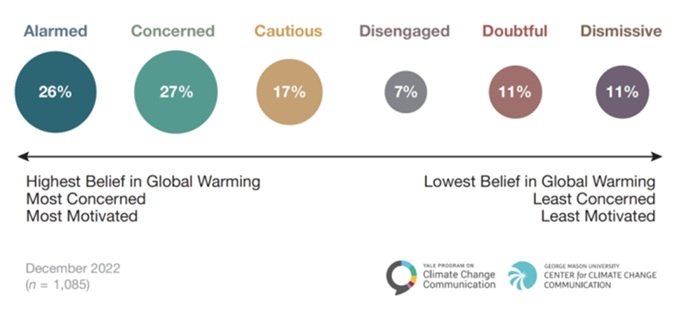
Source: Think Again, Adam Grant
In his book Think Again, Adam Grant shows that people who qualify their views and acknowledge uncertainty – think of phrases such as ‘as far as we know’ or ‘under these assumptions’ – are seen by others as more intelligent, more careful and more trustworthy. And vice versa: people who use polarising terms are (implicitly) seen as less intelligent. Activists therefore often achieve the opposite. Thinking in more shades of grey would therefore be helpful.
Solution 2: transcendental experiences
The tendency towards polarisation may also point to a deeper psychological problem. For centuries, whether religious or secular, there have been practices that helped people to temporarily put themselves into perspective: silence, contemplation, rituals, experiencing nature, wonder, gratitude. The ego is then not the focus; one’s perspective is broadened. In recent decades, society has focused on self-expression and identity, and far less on transcending them. People then become vulnerable and seek solace in extremes.
From a scientific perspective, transcendental experiences are not fanciful notions. Research into such experiences shows that they reduce emotional reactivity, soften ‘us versus them’ thinking and increase cognitive flexibility. People react less extremely, tolerate ambiguity better and are less inclined to demonise opponents. They are more likely to think in shades of grey. In other words, polarisation is not a problem of thought, but a problem of experience.
Solution 3: Respect for others and institutions
What is remarkable is that self-transcending experiences not only have a dampening effect on polarisation, but also build social and institutional trust. They increase the ability to tolerate differences without needing to resolve them immediately. Those who occasionally experience themselves as part of a larger whole need to expend less energy defending their own position and can listen more easily without losing autonomy.
This translates into respect: for the other as a moral agent and for institutions as collective constructs that are imperfect but supportive. In that sense, transcendental experiences are not an escape from the world, but a training in multiple perspectives, an inner exercise that stimulates paradoxical thinking and makes pluralism viable. They do not provide answers, but something more valuable: the inner space to be able to live with the answers of others.
In conclusion: nuance as a ‘business model’
This column is not an argument against engagement or conviction. Moral clarity has its place. Inequality and injustice sometimes call for strong language. But without practising perspective, we soon find ourselves facing harmful polarisation. In a world that thrives on framing, nuance becomes an act of resistance. Nuance can even become a business model. I have, for example, experienced first-hand that polarisers can become very uncomfortable with nuance.
If someone claims that capitalism is the root cause of all crises (inequality, climate change, etc.), then point out, for example, that there are as many as ten forms of capitalism, and that most of them – including our current system – do not even deserve that label. Or if someone labels people with a different political view from their own as far-right or fascist, point out that politics is not a left-right framework and that parties can be both socialist and conservative, or libertarian and social at the same time.
Finally, in Think Again, Adam Grant cites one of the most popular US presidents of all time, Franklin Roosevelt. He was so popular that he was re-elected three times, and US law was amended to limit a president to a maximum of two terms. He publicly and explicitly applied the leadership principle of uncertainty, experimentation and adjustment on numerous occasions (Grant now refers to ‘persistent experimentation’ as a ‘character skill’ used by many successful people).
‘The country needs and, unless I mistake its temper, the country demands bold, persistent experimentation. It is common sense to take a method and try it:
If it fails, admit it frankly and try another. But above all, try something.’
— Franklin D. Roosevelt, 1932
This article contains a personal opinion by Harry Geels