
Harry Geels: Polarisation over box 3 – take a breath and zoom out
This column was originally written in Dutch. This is an English translation.
By Harry Geels
In recent weeks, there has been much discussion on social media about the House of Commons' approval of the new Box 3 tax. The debate has been highly polarised. However, there are five broader perspectives that have hardly been discussed.
In recent weeks, I have written two columns about the new box 3 tax: one in which I calculated that the new plans would potentially lead to higher taxes, especially for volatile investment categories such as shares, and one in which I answered a frequently asked question about which country to emigrate to for tax purposes. Both columns received a lot of positive feedback, but there was also criticism. The criticism came mainly from people who believe that capital gains tax is necessary to combat inequality.
Some also believed that there is not much difference with the previous legislation, which was based on a flat rate, and that my analysis of the box 3 plans is therefore “superfluous”. It is striking that the debate about box 3, and in particular the suggestions for tax optimisation (via box 2 or emigration), provokes sharp criticism. This is remarkable, because tax optimisation is perfectly legal. Moreover, emigration within the EU is in line with the European idea of “free movement of labour and capital”.
1) Box 3 undermines the wealth accumulation of the middle class
Let us leave aside the calculations of the various “previous” situations for now. These have been discussed at length on social media. Both the old and the new systems are far from ideal. The fact that the Netherlands is still experimenting with the right regulations for wealth proves that our country is struggling with the question of how and why to tax wealth. In any case, a tax of 36% on (paper or realised) returns is high by international standards. In fact, it is the highest rate in the world.
A high tax rate further erodes the return-on-return principle. The new plan hits the middle class particularly hard, as they want to build up wealth but have few opportunities for tax optimisation. David Blitz of Robeco calculated that investors who manage to achieve 8% per annum over a period of 40 years will lose 70% of their returns to tax. They could have had three times as much (pension) wealth if there had been no tax on returns.
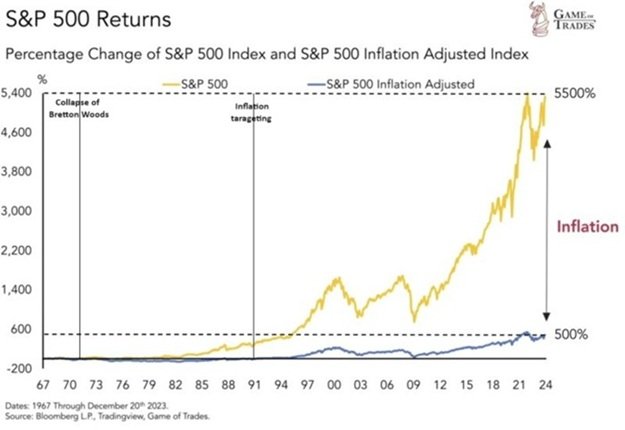
The return-on-return principle is an important way of compensating for inflation. As an example, the chart below shows the nominal versus real return on the S&P 500 since 1967. We can see that over time, a huge gap has developed between the nominal and real returns. Wealth taxes are therefore primarily taxes on inflation, which is precisely what investors want to protect themselves against! It would be fairer to tax real returns.
2) Redistribution does not lead to greater equality
The argument put forward by supporters of (current or new) wealth taxes is that we must combat inequality. This argument is flawed because it is based on two dubious assumptions. The first is that there is significant (wealth) inequality. This is not really the case in the Netherlands. If we look at the figures, we see that the Netherlands is relatively egalitarian by international standards. Of course, there is a small group (<1%) of ultra-wealthy individuals, but they are hardly affected by wealth taxes in any form.
The second questionable hypothesis is that (government) spending of the taxes received is better for the prosperity of the average Dutch citizen than investments by investors and entrepreneurs. I have previously argued that the ever-growing government of recent decades has not led to a “fairer” society, for example through lobbying. Moreover, the higher the taxes, the more tax evasion there is. Tax collection is not linear with a percentage.
3) Box 3 does not address the underlying causes of inequality
Redistribution with box 3 taxes does not necessarily lead to greater equality. In addition, this tax does nothing to address the real causes of inequality, such as monetary policy and the market power of large companies. If equality is your concern, it is better to tackle the underlying causes. Proponents of wealth tax often present a false dilemma: if you are against wealth tax, you are (apparently) against a “fairer” society.
This is a fallacy because you can be in favour of a fairer society, but at the same time believe that box 3 is the wrong instrument for achieving this.
4) New box 3 discourages risk-taking (which is detrimental to long-term prosperity)
A fourth objection to the new plans in particular is that risk-taking becomes less rewarding. For example, those who invest in private equity, due to its illiquid and riskier nature, quickly aim for 15% to 20% per year. A 36% tax then takes a very large bite out of their assets: 36% of 20%, for example, amounts to no less than 7.2% tax per year. Moreover, under the new plans, the unrealised return on private equity must simply be taxed annually, even though it is illiquid.
5) New box 3 is complex (and expensive)
Then there is the complication of loss compensation. Anyone who has suffered losses for a few years may offset them against later profits. This also leads to complex administration, especially if the costs (which ones exactly?) of investing are taken into account. And what if, for example due to a life event, someone suddenly no longer wants or is unable to invest, or it takes a long time to recoup losses? Investors who entered at the peak of the Nasdaq in 2000 had to wait fifteen years to recoup their losses.
In conclusion
It seems that the box 3 plans have become embroiled in the debate on equality. We see many calculations being used to prove a point. But in practice, things are usually more complicated than academic calculations suggest. That is precisely why it is essential to zoom out: not only to look at the figures, but above all to look at the principles of good tax policy. The current box 3 plan does not meet these principles. A proposal on how box 3 could be improved has already been shared.
This article contains the personal opinion of Harry Geels