Harry Geels: Does neoliberalism even exist anymore?

This column was originally written in Dutch. This is an English translation.
By Harry Geels
Many critics of the current political-economic system attribute its negative consequences to neoliberalism. However, this “system” does not exist, if it ever did. The critics are guilty of straw man reasoning.
Neoliberalism emerged in the mid-twentieth century, when economists such as Friedrich Hayek and later Milton Friedman responded to the dominance of Keynesianism and the increase in state intervention. Their ideas found an early institutional platform in the Mont Pèlerin Society (1947), where thinkers shaped the reinvention of classical liberalism at a time marked by economic instability and the threat of totalitarianism.
Nevertheless, neoliberalism remained primarily an intellectual movement for decades, until it experienced a political breakthrough around 1978–1980. World leaders such as Margaret Thatcher and Ronald Reagan seized on the ideas to implement large-scale reforms: privatisation, deregulation, austerity measures and the reduction of trade union power. During the same period, China also underwent a market shift under Deng Xiaoping, which created global momentum.
The old neoliberal foundations have almost completely collapsed
When neoliberalism was finally embraced by the general public, it ushered in a new economic policy. It enabled us to leave behind the disastrous period of the 1970s, with high unemployment, sky-high inflation, interest rates and high tax rates (the UK even had a top marginal income tax rate of 92%). Two decades of high economic growth and increasing prosperity followed. But at the beginning of this century, the cards were reshuffled.
Partly due to weak anti-competition rules and two stock market crises, neoliberalism gradually faded into the background. Broadly speaking, neoliberalism has six main principles: 1) free markets and mutual competition, 2) limited government role and fiscal discipline, 3) privatisation, 4) free trade, 5) flexible labour markets, and 6) individual responsibility. A major deviation concerns the emergence of oligopolies, which has put mutual competition under pressure.
The government in particular is growing and growing
Governments seized on the crises to seize power. A climate arose in which it was believed that everyone – and especially large companies – had to be rescued in every crisis. Fiscal government discipline disappeared. Free trade has come under pressure since 2014, especially after Corona. Individual responsibility has also been sacrificed. To paraphrase Professor Arnoud Boot, we have ended up with a sunflower society, in which everyone – like a sunflower growing towards the light – looks to the government.
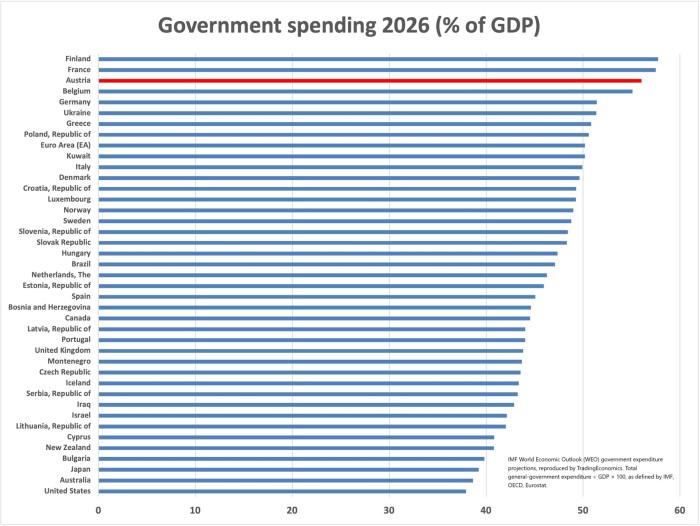
The size of the various governments, expressed as government expenditure as a percentage of GDP, can be seen in Figure 1. In several countries, the government already accounts for more than half of GDP. It is impossible to call these countries neoliberal anymore. Some libertarians refer to a government that is larger than 15% of GDP as a socialist system. Mark Rutte once (rightly) called the Netherlands a “deeply socialist country”. Incidentally, the US is also rapidly approaching the 40% mark.
Figure 1
Socialists use straw man arguments
In his book Bij het scheiden van de markt (Separating the market), published in 2019, former Minister of Defence and VVD party leader Frits Bolkestein writes that there is no good definition of neoliberalism: “The annoying thing is that no one can tell me exactly what neoliberalism is. I don't know anyone who calls themselves neoliberal either.” According to Bolkestein, neoliberalism is primarily a label used by opponents of current policy to express their dissatisfaction with, for example, inequality.
It is indeed a frequently used strategy to create an enemy in order to make your own point. Socialists and neo-communists do this by opposing the current system. Sometimes they target capitalism, sometimes they talk about neoliberalism. But this is the well-known straw man argument: a fictional, outdated or highly distorted opponent (a straw man) is created because it is easier to defeat than the real, current opponent.
However, the current opponent is not neoliberalism or capitalism, because neither of these exist anymore. The current system is an unhealthy mix of market power and excessive government. I would call this more socialist than capitalist, or Corporate Socialism. In short, neoliberalism mainly exists as political fiction, a straw man that is useful to critics but says little about the actual system in which we live.
This article contains the personal opinion of Harry Geels