
Danny Dieleman: Is Private Credit’s NAV the whole truth, or only half the truth?
Danny Dieleman: Is Private Credit’s NAV the whole truth, or only half the truth?

This column was originally written in Dutch. This is an English translation.
By Danny Dieleman, Founder of D-Squared Capital
Can the Net Asset Value (NAV) of a listed fund holding private loans differ from the market price? And if so, is the NAV incorrect, or is the market wrong?
This is certainly not a theoretical question, as in practice the shares of listed funds rarely trade at their NAV. But what does this mean for you as an investor? Does it say anything about the quality of the loans in the fund? Or does it say something about the irrationality of the market?
A fund’s NAV is the value of its assets minus the value of its liabilities. In the case of private credit, this is usually a model-based valuation and therefore an estimate of the fund’s value. In a previous column, I explained why it can be difficult to value illiquid loans accurately.
In the case of a listed fund, on the other hand, the market price is the price at which investors trade the fund’s shares on the stock exchange. It is the price investors are willing to pay for the fund’s equity.
The NAV per share and the market price of a share should therefore, in principle, be close to one another. After all, both are based on the same underlying portfolio of illiquid loans with the same borrowers and cash flows. Yet in practice, there are often prolonged periods of substantial over- and undervaluation of the NAV.
There are, of course, differences in timing: the NAV is generally calculated once a quarter, whilst shares are traded on a daily basis. There will therefore always be a lag in a fund’s NAV.
However, the chart below for Blue Owl’s OBDC fund shows that this lag does not explain the difference between the NAV and the market price. This fund invests primarily in senior secured loans to US mid-cap companies. The loans themselves are not publicly traded. The fund’s shares are listed on the NYSE.
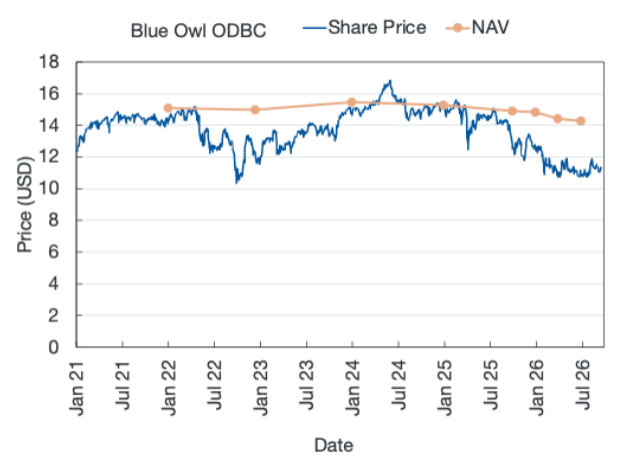
What is immediately striking is that the NAV is much less volatile than the market price, which makes sense, as the NAV is not calculated on a daily basis and, generally speaking, the parameters used in the valuation models – such as the credit quality of the loans, cash flows and discount rates – are reasonably stable. In itself, this is not an indication that the NAV is incorrect.
The chart also shows that the market price fluctuates between 0.69x and 1.07x NAV. The market price reflects a forward-looking view of expected losses, costs, dividends and so on. These need not be the same as the assumptions the asset manager has used in the models to determine the NAV. For example, the shares will trade above NAV if future dividend payments are expected to be attractive. To illustrate, the dividend yield of Blue Owl ODBC was approximately 10 per cent in Q4 2025.
The market price may be below NAV if investors do not trust the reported NAV, expect future losses, or believe that the portfolio is not well diversified. Investors will then demand a risk premium.
Furthermore, the market price also depends on market sentiment, as well as supply and demand, which means the price can fluctuate both upwards and downwards. In itself, therefore, a discrepancy between NAV and market value is no cause for immediate concern.
What is important, however, is that exiting a publicly traded fund differs significantly from exiting a private fund. If investors wish to divest their investment in a listed fund, they will have to sell the shares on the stock exchange. There is no mechanism allowing them to exit at the NAV value.
With funds that are not listed on the stock exchange, you can exit at the NAV, but this is subject to restrictive conditions. For example, there is a cap of 5 per cent of the total outstanding shares on the volume of redemptions. If more investors wish to redeem their shares than this limit allows, redemptions are allocated on a pro-rata basis. This means that not all requests will be met. Investments in private funds therefore entail liquidity risks, whilst an investment in a listed fund entails price risk.
The fact that there is a difference between the NAV and the market price is not necessarily a cause for concern, as they measure slightly different things. For private funds, investors must therefore gain a clear understanding of how the NAV is determined and whether the liquidity risk is acceptable. When investing in a listed fund, it is important to take the volatility of the market price into account in the investment decision.
Share this post!
Related posts
-
 Read more about "Impact in private debt: the closer, the more powerful"
Impact in private debt: the closer, the more powerful
-
 Read more about "Savills IM: European real estate debt finds its moment"
Savills IM: European real estate debt finds its moment
-
 Read more about "PIMCO: What BDC markets are signaling about private credit valuations"
PIMCO: What BDC markets are signaling about private credit valuations
-
 Read more about "BNP Paribas AM Alts: Revitalising European securitisation by re-establishing a strategic funding channel"
BNP Paribas AM Alts: Revitalising European securitisation by re-establishing a strategic funding channel
-
 Read more about "AllianzGI: Momentum builds for Europe’s private credit, but structure still matters"
AllianzGI: Momentum builds for Europe’s private credit, but structure still matters
-
 Read more about "M&G: At what point does private credit stop trading and start its transformation?"
M&G: At what point does private credit stop trading and start its transformation?
-
 Read more about "Symbiotics: Private debt in emerging markets is mature, scalable, and relevant for Dutch institutional investors"
Symbiotics: Private debt in emerging markets is mature, scalable, and relevant for Dutch institutional investors
-
 Read more about "Aegon AM: De-banking and the growing influence of Dutch private lending"
Aegon AM: De-banking and the growing influence of Dutch private lending
-
 Read more about "Mirova: De grote schoonmaak in private credit is begonnen"
Mirova: De grote schoonmaak in private credit is begonnen
-
 Read more about "Danny Dieleman: The invaluable value of a reliable valuation"
Danny Dieleman: The invaluable value of a reliable valuation