
Danny Dieleman: The invaluable value of a reliable valuation
Danny Dieleman: The invaluable value of a reliable valuation

This column was originally written in Dutch. This is an English translation.
By Danny Dieleman, Wholesale Banking Director, Capital Treasury, ING
Private debt is playing an increasingly significant role in institutional portfolios, but its valuation is often less transparent than that of listed investments. How do you determine what a private loan is actually worth?
Recently, valuations of a private loan to Medallia have varied widely. Medallia is a software company specialising in ‘experience software’ that was acquired by a private equity firm in 2021. It is financed by private debt and ran into difficulties in 2022, partly due to rising financing costs and fierce competition. In the final quarter of 2025, Apollo valued the loan at $0.77, whilst Blackstone valued the same loan at $0.82 and KKR at $0.91. KKR has since written down this loan to $0.60 in April 2026.
The US Department of Justice is currently investigating the valuation of Blackrock’s TCP Capital fund. The fund reported a 19% decline in Net Asset Value due to the write-down of several private loans that, until recently, had been valued at par*.
As long as there are no concerns regarding a borrower’s credit quality and all interest and repayments are made on time, the valuation of a private loan is relatively straightforward and a formality. Valuation is also relatively straightforward when there is sufficient market liquidity and adequate data is available. In such cases, the valuations provided by various parties will usually be close to one another.
Nevertheless, the examples mentioned above show that the valuation of private loans can vary, or that there may be doubt as to the accuracy of the valuation. So how do you know if a private loan has been correctly valued?
Why a correct valuation is important
The valuation of financial assets is more than just an accounting formality. It directly influences the profit and loss account, the capital position, and also the leverage of banks and insurers. For pension funds, it influences the level of payout the fund can make to its members. A valuation must therefore be correct to accurately reflect the financial health of an institution or a fund.
IFRS is clear about what a valuation is: ‘fair value is the price at which a loan could be sold in an orderly transaction between market participants’. IFRS distinguishes between three different levels of valuation. Level 1 consists of quoted prices in active markets. These include, for example, listed shares or bonds. At Level 2, the value is derived from comparable assets. An example is deriving the valuation of a private loan via a bond issued by the same company. Level 3, finally, consists of valuations based on models and unobservable inputs. Due to the illiquidity of private loans, valuations will at best be classified as Level 2, but most valuations will be Level 3.
IFRS does not prescribe in detail how Level 3 valuations should be carried out.
This provides flexibility, allowing valuations to be tailored and based on all available and relevant information. However, this also makes it difficult to assess the quality of a valuation.
Why a good valuation is difficult
Every loan is bespoke between the borrower and the lender. This makes loans inherently more complex than bonds. To give a few examples: loan repayments may follow an irregular schedule, the interest margin on loans may vary over time and may depend on the borrower’s performance. In addition to interest, there may also be one-off or recurring fees. Loans also often have embedded options, such as early repayment, or the term may be extended by the borrower. Finally, loans may also have covenants and security such as guarantees or collateral. All these elements result in a complex series of cash flows.
In addition to these complex cash flows, the data required to value a private loan is also difficult to obtain on the financial market. The bar chart at the top left of the figure shows the number of observations of valuations of CDS contracts, bonds and loans with an external valuation. Each observation represents a unique contract. It is clear that the number of loans with an external valuation is significantly lower than the number of CDSs or bonds. Furthermore, the loan data is also skewed: there are few or no observations for investment-grade loans, and a closer look at the data reveals gaps in terms of loan type, seniority, maturity, country and sector. The matrix in the top right of the figure illustrates this. For the green fields, sufficient information is available for a sound valuation; for the red fields, little or no data is available, meaning that a valuation must be based on interpolation and extrapolation techniques.
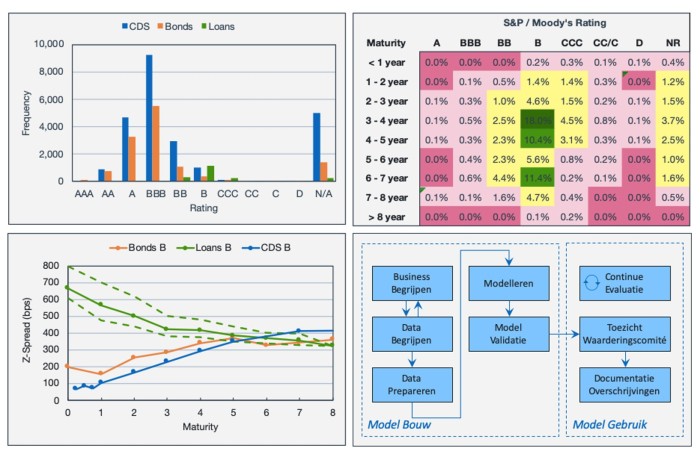
The combination of complex cash flows and the lack of data therefore makes it difficult to value a private loan, but it is certainly not impossible. Based on the characteristics of private loans, it is possible to construct yield curves from the available data. This is analogous to the process for bonds, but requires more advanced interpolation and extrapolation techniques due to the scarcity of data.
The chart at the bottom left shows, as an example, the spread curves for CDSs, bonds and loans for credit quality B. What is striking is that the loan curve lies above those of CDSs and bonds. This difference is the illiquidity premium. Furthermore, the loan curve exhibits an inverse structure, whilst the CDS and bond term structures show an upward-sloping pattern. This difference can be explained by repayments and the embedded options in loans. For loan spread curves, the spread (25% and 75% confidence interval) is also indicated. Here it is clear that there is a considerable amount of variation in the valuation of private loans. For bonds and CDSs, the spread is significantly smaller than for loans and is therefore not shown in the graph.
Why divergent valuations are not necessarily wrong
The above analysis for a private loan without credit issues shows that there are various reasons why valuing private loans is difficult. It is therefore not surprising that different parties sometimes arrive at different valuations.
In addition, the exit strategy is an important element in the valuation of the private loan, especially if there are concerns regarding credit quality, as is the case with Medallia. Relevant factors that play a role here include the assessment of the likelihood of a successful restructuring, and what a successful restructuring will yield, but also the value at which any collateral might be sold if the restructuring is unsuccessful. These are all elements that cause valuations of distressed loans to diverge even more widely than for loans without credit issues.
It is therefore more important to ask whether a different valuation can be justified than to simply note that the valuation differs.
How do you maintain control over the valuations in your portfolio?
Precisely because valuing private loans can be difficult, the governance surrounding the valuation of private loans is of essential importance. This is certainly also the case because the valuations directly influence the financial position of an institution or a fund, and stakeholders have conflicting interests regarding stability, the timing of write-downs and remuneration.
The diagram at the bottom right provides a schematic representation of the governance framework.
It starts with a clear and systematic valuation methodology. This methodology is not prescribed by regulators or auditors and must therefore be justified, substantiated and documented by the institution or the manager.
It is important that the methodology or any input data are independently tested, for example through model validation or by another independent party. This is not a one-off exercise, as the valuation methodology must also be periodically reviewed. During such a review, it must be assessed whether the assumptions made are still relevant, whether the calibration is still correct, and whether the model requires updating.
The valuation method must be applied consistently to avoid the suggestion of ‘cherry-picking’. A valuation committee must oversee this and assess whether the valuations are correct. The outcome of the methodology used will not always be correct, and an ‘expert opinion’ will be required. This may be due to data quality issues or because certain characteristics of the loan are not taken into account by the model. In such cases, it is important that the valuation and the assumptions are challenged by various experts and the valuation committee on objective and sound grounds. In some cases, a second opinion from an independent external party may be an option. It should be noted, however, that a third party also faces all the challenges mentioned above. Naturally, decision-making regarding the determination of the price must be accurately documented.
If valuations are adjusted excessively often, this may indicate the selective application of the valuation methodology, or a methodology that is incorrect, though this is not necessarily the case. This will then need to be examined further.
Conclusion
Valuing private loans can be difficult due to a lack of transparent pricing. Furthermore, private loans contain complex elements and available market data is not always complete. When valuing non-performing loans, the exit from the restructuring process is a key factor. It is therefore possible that different parties arrive at different valuations. It is therefore important to know what the underlying assumptions are in a valuation.
Governance is essential to maintain control over valuations and the valuation process. The valuation methodology must be well-designed and documented, independently tested, periodically reviewed, and a committee must oversee the correct application of the methodology.
(*) No criminal cases have been identified at this time.
Want to read more?
For further background on the valuation of private and illiquid loans:
Valuation-of-Illiquid-Loans-Beyond-Gut-and-Guesswork-with-AI
|
Disclaimer The ideas and opinions in this article are my own and not those of my current or former employer(s). I am writing this column purely for information purposes, as I find the subject interesting and hope to inspire others. It is therefore not investment advice. Always do your own research before deciding whether or not to invest in anything. |
Share this post!
Related posts
-
 Read more about "Danny Dieleman: Is Private Credit’s NAV the whole truth, or only half the truth?"
Danny Dieleman: Is Private Credit’s NAV the whole truth, or only half the truth?
-
 Read more about "Impact in private debt: the closer, the more powerful"
Impact in private debt: the closer, the more powerful
-
 Read more about "Savills IM: European real estate debt finds its moment"
Savills IM: European real estate debt finds its moment
-
 Read more about "PIMCO: What BDC markets are signaling about private credit valuations"
PIMCO: What BDC markets are signaling about private credit valuations
-
 Read more about "BNP Paribas AM Alts: Revitalising European securitisation by re-establishing a strategic funding channel"
BNP Paribas AM Alts: Revitalising European securitisation by re-establishing a strategic funding channel
-
 Read more about "AllianzGI: Momentum builds for Europe’s private credit, but structure still matters"
AllianzGI: Momentum builds for Europe’s private credit, but structure still matters
-
 Read more about "M&G: At what point does private credit stop trading and start its transformation?"
M&G: At what point does private credit stop trading and start its transformation?
-
 Read more about "Symbiotics: Private debt in emerging markets is mature, scalable, and relevant for Dutch institutional investors"
Symbiotics: Private debt in emerging markets is mature, scalable, and relevant for Dutch institutional investors
-
 Read more about "Aegon AM: De-banking and the growing influence of Dutch private lending"
Aegon AM: De-banking and the growing influence of Dutch private lending
-
 Read more about "Mirova: De grote schoonmaak in private credit is begonnen"
Mirova: De grote schoonmaak in private credit is begonnen