
Harry Geels: Three hard-hitting final conclusions on the Box 3 debacle
Harry Geels: Three hard-hitting final conclusions on the Box 3 debacle

This column was originally written in Dutch. This is an English translation.
By Harry Geels
The debate surrounding Box 3 reveals a country that is highly polarised, is struggling enormously with an outdated and overly complicated tax system, and is collectively suffering from the ‘money illusion’.
When the Supreme Court struck down the existing Box 3 system, it initially appeared to be a legal issue. The government was taxing notional returns that many taxpayers had not actually realised at all. But as the years went by, it became clear that something bigger was at play. In particular, the recent debate on reforming Box 3 exposes three weaknesses: our political framing, our tax system itself, and our persistent illusion about money. That is why I am taking a step back and leaving aside the details of the (constantly amended) bill.
1) The debate has long since ceased to be about taxation
In theory, the discussion centres on a simple question: how do you tax wealth in a fair, workable and minimally disruptive way? In practice, however, the debate has degenerated into an ideological battle between two camps. On the one hand are those who view wealth as a source of inequality that should be taxed more heavily. On the other hand are those who, on the contrary, wish to encourage ownership and wealth accumulation. What is striking here is that both camps are increasingly using frames that have little to do with the technical reality of Box 3.
For example, reference is made to ‘equality’ and to the difference between taxation on labour and taxation on wealth. But Box 3 does not solve those ‘problems’. Even substantial increases in Box 3 would yield only a few billion, whilst income tax on labour generates tens of billions of euros. The idea that Box 3 can contribute to a possible reduction in income tax is a political frame. The argument ‘we simply need the money’ is also a fallacy. What if a tax causes more damage (in administrative costs, tax avoidance, etc.) than it yields?
Wealth and income taxes are like apples and oranges. Income taxes mainly affect spending, whilst wealth taxes have a much deeper impact: on risk-based remuneration, entrepreneurship and the willingness to make (risky) investments. Furthermore, wealth taxes operate on a ‘global playing field’ to a greater extent than income taxes. Wealth is internationally mobile, and so we cannot view wealth taxes in isolation from what is happening elsewhere. The question that lingers is why the Netherlands wishes to opt for one of the highest capital gains taxes in the world.
2) The real problem is our tax system
The second lesson goes much deeper. Virtually every proposal for Box 3 appears to cause problems elsewhere. If you tax notional returns, you face legal objections. If you tax actual returns, it creates an administrative nightmare. If you only tax capital gains upon sale, it creates incentives to defer. If you tax the increase in value annually, people have to pay tax on money they have not yet received. Every solution creates new exceptions. Every exception requires fixes. And every fix, in turn, creates new problems.
The Box 3 dossier thus demonstrates that the Dutch tax system has increasingly become a collection of historical compromises. New rules are rarely designed with a clear overall picture in mind, but are almost always added to an existing structure. We need a simpler, more transparent and clearer new system. But that is precisely what we are failing to achieve. There are now too many political, bureaucratic and economic interests tied to the existing structure. Think of the whole benefits circus. As a result, we remain stuck within the same narrow framework of thinking.
3) The forgotten role of inflation
The third conclusion is the most underestimated. We are going to tax nominal profits to a greater extent than under the old system. These are therefore not the actual (real) profits (taking into account all costs, of which inflation is by far the largest). If an investor achieves a return of 6 per cent whilst inflation stands at 4 per cent, the real capital growth is only 2 per cent. A 36 per cent tax on the nominal profit therefore means that the entire real gain in purchasing power goes to the tax authorities, and even slightly more. The graph below illustrates once again just how significant the difference between nominal and real returns is in practice.
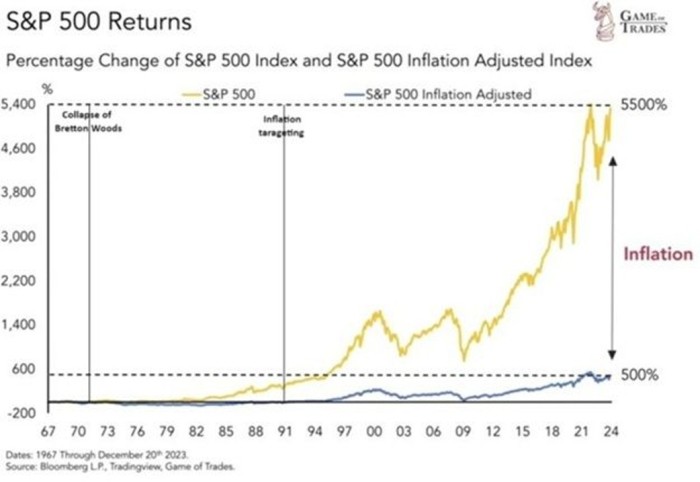
Anyone who had invested in the S&P 500 from 1967 to the end of 2023 would have achieved a nominal capital return of 5,500 per cent (excluding dividends). Only 500 per cent represents the real reward for taking risks. The rest is inflation – in other words, hot air. The value of the assets has increased 56-fold in nominal terms, but we can only buy six times as much with them. Box 3 therefore largely taxes inflation, whilst inflation is in fact already a hidden tax. And who stands to gain from inflation and even contributes to it? The government! There is therefore a scandalous conflict of interest on the part of the government when it comes to capital gains tax. Most people, even the policymakers themselves, fail to see this: they suffer from the ‘money illusion’.
Final thoughts
The Box 3 debacle is ultimately about much more than savings and investments. It shows how political frames can dominate a tax debate. How an overly complicated tax system becomes increasingly bogged down in exceptions and stopgap measures. And how policymakers systematically confuse nominal amounts with real purchasing power. The problem with Box 3 is not that we haven’t yet found a perfect solution. The problem is that we keep searching within the very same patterns of thinking that caused the problem in the first place.
This article contains the personal opinion of Harry Geels
Share this post!
Related posts
-
 Read more about "IVBN: Prinsjesdagpakket herstelt investeringsklimaat niet"
IVBN: Prinsjesdagpakket herstelt investeringsklimaat niet
-
 Read more about "Copy_Harry Geels: A new, fair and simple tax system"
Copy_Harry Geels: A new, fair and simple tax system
-
Read more about "Harry Geels: A new, fair and simple tax system"
Harry Geels: A new, fair and simple tax system
-
Read more about "Harry Geels: The Homeownership Windfall: Myth or Reality?"
Harry Geels: The Homeownership Windfall: Myth or Reality?
-
Read more about "Harry Geels: The Myth of Easy Profits from Homeownership"
Harry Geels: The Myth of Easy Profits from Homeownership
-
 Read more about "DeVere Group: Burnham’s tax comments alarm investors"
DeVere Group: Burnham’s tax comments alarm investors
-
 Read more about "DGBC en Platform Woonopgave: Regels schrappen zonder systeemvisie is symptoombestrijding"
DGBC en Platform Woonopgave: Regels schrappen zonder systeemvisie is symptoombestrijding
-
 Read more about "EIB Group: EU Finance Ministers back strategy for a more secure Europe"
EIB Group: EU Finance Ministers back strategy for a more secure Europe
-
 Read more about "DeVere: Next Labour leader could trigger massive wealth exodus"
DeVere: Next Labour leader could trigger massive wealth exodus
-
 Read more about "IVBN: Sustainability, between ambition and reality"
IVBN: Sustainability, between ambition and reality