
Harry Geels: The Myth of Easy Profits from Homeownership
Harry Geels: The Myth of Easy Profits from Homeownership

This column was originally written in Dutch. This is an English translation.
By Harry Geels
The core problem in these debates about additional taxes—whether inheritance taxes or windfall taxes—is that they often fail to present an accurate picture of the actual profit made on a house. This is a significant omission. When those gains are calculated in full, they often turn out to be considerably smaller than is commonly suggested.
Opponents of high inheritance taxes often argue that people have worked hard to build up their wealth. One commentator even described those making this argument as "liars." According to this view, most of that wealth was not earned through work at all, but instead resulted from the substantial appreciation in residential property values. The media also frequently refer to the enormous stock of wealth—particularly in housing—that is expected to be passed on to younger generations in the coming years. This inherited wealth, it is argued, should be taxed to prevent growing inequality.
Similarly, a number of economists speak of taxable "windfalls" or "windfall gains": profits that arise from fortunate circumstances rather than individual effort, and which therefore deserve to be taxed. However, before such gains can serve as a basis for taxation, it is essential to establish how large they actually are. This is precisely where the public debate often goes astray. I decided to put this assumption to the test, and the results were surprising.
Case Study
I asked a number of homeowners to calculate everything they had spent on their homes since purchase, including taxes, financing costs, renovations, and maintenance. I then analysed the data using Excel. In the cases examined, the real financial gain—after adjusting for inflation—was minimal or even negative, with one exception: a house in Amsterdam, where property prices have risen much more rapidly than in most other parts of the Netherlands. The figure below presents an actual case, adjusted for inflation, showing a real loss of more than €9,500.
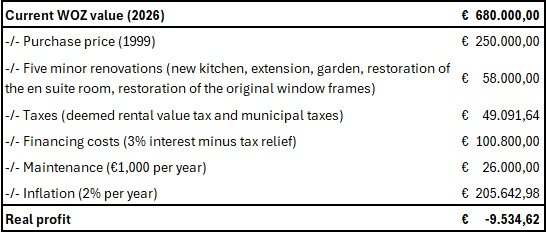
In this particular case, the property was initially financed with an investment-linked mortgage, which was converted into a savings mortgage during the stock market downturn of 2001. In all calculations, only the interest component of the mortgage has been included; repayments of principal and savings contributions have been excluded. Naturally, a calculation such as the one presented above is influenced to some extent by the financing method, the level of local property taxes (this case concerns a municipality with roughly average-to-high local taxes), and the amount of effort and money the homeowner invests in improving and maintaining the property.
Inflation: the Largest Cost Factor
The single most important factor reducing the apparent profit on a home is inflation. Strictly speaking, inflation is not an expense paid directly by the homeowner, as maintenance costs or municipal taxes are. Nevertheless, it is essential for determining the real increase in the value of a property. Money tied up in a house cannot simultaneously be invested or spent elsewhere. Ignoring inflation means confusing nominal gains with real gains, thereby overstating the true economic return on homeownership. For that reason, adjusting for inflation is not merely defensible—it is indispensable.
Anyone wishing to understand why inflation is such a crucial part of this discussion should become familiar with the concept of money illusion. In this analysis, annual inflation has been conservatively estimated at 2 percent. This is a cautious assumption, given that the period under consideration includes two episodes of relatively high inflation—following the introduction of the euro and after the COVID-19 pandemic—as well as years of comparatively low inflation. Inflation estimates can always be debated, which is why this analysis ultimately adopts the European Central Bank's long-term inflation target.
Points for Discussion
Calculations of this kind inevitably involve assumptions that can be debated. Some may argue that improvements to the house and garden are not always strictly necessary and also provide enjoyment while living in the property. Consequently, only part of those expenditures might reasonably be treated as investment costs. On the other hand, this analysis excludes insurance premiums, while annual maintenance has been estimated at only €1,000—a conservative figure, particularly for an older property requiring above-average upkeep. One could also argue that the many hours of unpaid labour homeowners invest in maintaining and improving their homes should be taken into account.
A fair counterargument is that some groups have indeed realized substantial real gains. This applies, for example, to people who purchased property in Amsterdam or Utrecht roughly between 1982 and the late 1990s, owners of multiple rental properties on which little maintenance is performed, and investors holding valuable land. However, that is very different from claiming that the average homeowner has effortlessly earned hundreds of thousands of euros and that these gains should simply be taxed because they are supposedly unearned. In most cases, homeowners have worked hard and made significant financial sacrifices to acquire and maintain their homes.
Conclusion
The myth of the taxable housing windfall begins with an optical illusion. Someone who buys a house for €250,000 and sells it years later for €650,000 appears to have become €400,000 richer. Yet once inflation, maintenance, renovations, financing costs, and taxes are taken into account, that apparent goldmine is often worth far less than the nominal selling price suggests. Politicians who focus exclusively on the sale price confuse money illusion with genuine wealth.
Those who dismiss opponents of higher taxes as "liars" because they supposedly benefit from effortless housing windfalls overlook a crucial part of the story. Behind almost every home lie years of saving, maintenance, renovation, financial risk-taking, and personal sacrifice. On closer examination, the supposedly "free" profit is often far less free than it first appears.
This article contains the personal opinion of Harry Geels.
Share this post!
Related posts
-
 Read more about "Harry Geels: Three hard-hitting final conclusions on the Box 3 debacle"
Harry Geels: Three hard-hitting final conclusions on the Box 3 debacle
-
 Read more about "IVBN: Prinsjesdagpakket herstelt investeringsklimaat niet"
IVBN: Prinsjesdagpakket herstelt investeringsklimaat niet
-
 Read more about "Copy_Harry Geels: A new, fair and simple tax system"
Copy_Harry Geels: A new, fair and simple tax system
-
Read more about "Harry Geels: A new, fair and simple tax system"
Harry Geels: A new, fair and simple tax system
-
Read more about "Harry Geels: The Homeownership Windfall: Myth or Reality?"
Harry Geels: The Homeownership Windfall: Myth or Reality?
-
 Read more about "DeVere Group: Burnham’s tax comments alarm investors"
DeVere Group: Burnham’s tax comments alarm investors
-
 Read more about "DGBC en Platform Woonopgave: Regels schrappen zonder systeemvisie is symptoombestrijding"
DGBC en Platform Woonopgave: Regels schrappen zonder systeemvisie is symptoombestrijding
-
 Read more about "EIB Group: EU Finance Ministers back strategy for a more secure Europe"
EIB Group: EU Finance Ministers back strategy for a more secure Europe
-
 Read more about "DeVere: Next Labour leader could trigger massive wealth exodus"
DeVere: Next Labour leader could trigger massive wealth exodus
-
 Read more about "IVBN: Sustainability, between ambition and reality"
IVBN: Sustainability, between ambition and reality