Harry Geels: A new, fair and simple tax system
Harry Geels: A new, fair and simple tax system
This column was originally written in Dutch. This is an English translation.
By Harry Geels
There is currently much debate about reforming the tax system. On the one hand, because it has become too complex; on the other, because the government wants to collect more tax. I propose an alternative system that scores considerably better on the so-called ‘canons of taxation’, the classic principles of sound taxation.
By now, virtually everyone agrees that our tax system has become a monstrosity. It is too complex, partly due to the tangle of tax schemes, subsidies and allowances. Many taxpayers need professional help to complete their tax returns correctly. Moreover, the various tax rates and tax brackets lead to arbitrage and tax avoidance. One of the biggest problems is the poverty trap: at certain income levels, it is hardly worth working any extra hours. Finally, many Dutch people perceive the current system as unfair, mainly because of the high tax burden on labour.
When a system no longer functions properly, we sometimes need to go back to the drawing board. I therefore propose a fundamentally simpler system, based on four core principles:
- A flat tax on all income from the four factors of production: labour, entrepreneurship, natural resources and capital.
- A negative income tax (NIT) below a set minimum subsistence level.
- The abolition of tax brackets and allowances.
- Taxes on consumption and use via VAT and excise duties, with these being used primarily to better price social costs and benefits (externalities).
Let us first elaborate on these four principles, then discuss a few points for debate, and conclude with a comparison between the current and the proposed system based on the well-known principles of good taxation.
1) A flat tax on all sources of income
A flat tax on income from the four factors of production has various advantages. Such a system is simple, with a single tax base and a single rate. It prevents arbitrage between tax boxes and ensures that only income is taxed, not the factors of production themselves.
Whether someone receives income from labour, dividends, business profits, leasehold rent, property rent or royalties no longer matters for tax purposes. All income is taxed at the same rate. A rate of, for example, 25 per cent could serve as a starting point, depending on the desired size of the public sector. It is important that only income is taxed. Assets, businesses, land or other factors of production do not need to be sold in order to pay taxes. This promotes legal certainty and stimulates entrepreneurship and investment.
2) Negative income tax (NIB)
Under a negative income tax scheme, politicians set a minimum subsistence level sufficient for full participation in society. Anyone whose income falls below this level due to illness, incapacity for work, unemployment or reduced labour participation automatically receives a top-up from the Tax and Customs Administration to bring their income up to that level. I have previously written a column on the advantages of a NIT compared to a universal basic income (UBI). One of the greatest advantages is that many existing benefits and administering bodies can be phased out, leading to significant simplification and lower administrative costs.
3) Abolition of tax brackets and benefits
If we operate a flat tax and a NIB, the current tax brackets will largely lose their purpose. At most, they will serve as a simple framework for tax returns. The various benefits can also be phased out. This will significantly reduce the poverty trap. Every adult knows what the guaranteed minimum subsistence level is. Anyone who works more will then retain the same net percentage of every extra euro earned. This makes working structurally more attractive.
Furthermore, allowances – both on the provider’s side and on the recipient’s – have been shown to be prone to errors, inefficiency, abuse and fraud. That problem is also resolved.
4) VAT and excise duties
VAT and excise duties will remain in place. They are relatively efficient to collect and can be used to better incorporate social costs into prices. Excise duties, for example, can be used to price in negative externalities, such as pollution, healthcare costs or congestion. In doing so, they fulfil a different function to income tax. Their primary aim is not to generate tax revenue, but to improve economic incentives.
Proceeds from games of chance and inheritances received could be regarded as income and therefore taxed at the same flat rate. The latter is, incidentally, a philosophical concession: personally, I regard an inheritance more as income that has already been taxed than as new income, and I believe the testator should be free to determine what happens to their assets (giving them away, spending them during their lifetime or bequeathing them).
Some caveats
The four principles described seem straightforward, but of course every tax reform presents practical challenges. A first challenge concerns assets that do not generate direct income, such as raw materials, precious metals or crypto-assets. Any increases in value could be taxed at the same flat rate as soon as they are realised.
A second point of consideration concerns companies that use profits to buy back shares rather than pay out dividends. This problem can be resolved by treating share buy-backs in the same way as dividend payments for tax purposes. A third challenge is the special status of the owner-occupied home. The government currently encourages home ownership through mortgage interest relief, whilst the notional rental value provides only limited adjustment for the enjoyment derived from living in the property.
Personally, I am opposed to mortgage interest relief, whilst naturally respecting existing rights and transitional arrangements. One solution is to tax the owner-occupied home at a flat rate based on a notional rental value (‘imputed rent’), for example 5 per cent of the WOZ value. An alternative is to tax the economic yield from the underlying land separately at a flat rate. Politically, these are sensitive issues, but from an economic perspective they are consistent with the principles of the proposed system.
An assessment of the old and new systems
Taxes should always be assessed against the criteria of a sound tax system. Adam Smith once formulated his famous ‘canons of taxation’, which economists have subsequently expanded into a broader set of principles. These principles are summarised in the figure below. The current system scores moderately on several aspects. The administrative costs are high, the system is highly complex, and the economic distortions are considerable.
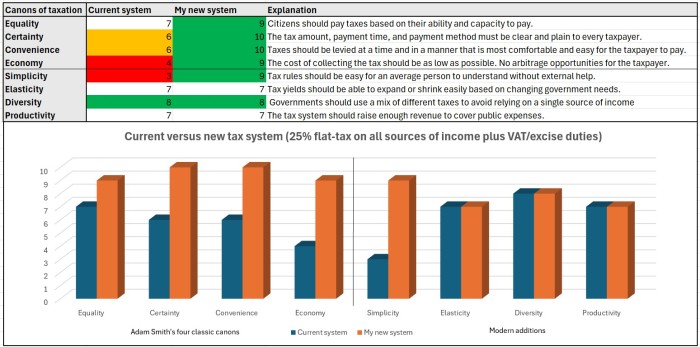
My proposal scores better on virtually all criteria: simplicity, transparency, neutrality, predictability and labour force participation. Naturally, this assessment based on scores involves a certain degree of subjectivity. After all, the butcher is, in part, judging his own meat here. Nevertheless, I believe that a flat tax combined with a negative income tax deserves serious consideration in the debate on the future of the Dutch tax system.
This article contains the personal opinion of Harry Geels
Share this post!
Related posts
-
 Read more about "Harry Geels: Three hard-hitting final conclusions on the Box 3 debacle"
Harry Geels: Three hard-hitting final conclusions on the Box 3 debacle
-
 Read more about "IVBN: Prinsjesdagpakket herstelt investeringsklimaat niet"
IVBN: Prinsjesdagpakket herstelt investeringsklimaat niet
-
 Read more about "Copy_Harry Geels: A new, fair and simple tax system"
Copy_Harry Geels: A new, fair and simple tax system
-
Read more about "Harry Geels: The Homeownership Windfall: Myth or Reality?"
Harry Geels: The Homeownership Windfall: Myth or Reality?
-
Read more about "Harry Geels: The Myth of Easy Profits from Homeownership"
Harry Geels: The Myth of Easy Profits from Homeownership
-
 Read more about "DeVere Group: Burnham’s tax comments alarm investors"
DeVere Group: Burnham’s tax comments alarm investors
-
 Read more about "DGBC en Platform Woonopgave: Regels schrappen zonder systeemvisie is symptoombestrijding"
DGBC en Platform Woonopgave: Regels schrappen zonder systeemvisie is symptoombestrijding
-
 Read more about "EIB Group: EU Finance Ministers back strategy for a more secure Europe"
EIB Group: EU Finance Ministers back strategy for a more secure Europe
-
 Read more about "DeVere: Next Labour leader could trigger massive wealth exodus"
DeVere: Next Labour leader could trigger massive wealth exodus
-
 Read more about "IVBN: Sustainability, between ambition and reality"
IVBN: Sustainability, between ambition and reality