
Harry Geels: Conventional wisdoms about housing are outdated
Harry Geels: Conventional wisdoms about housing are outdated

This column was originally written in Dutch. This is an English translation.
By Harry Geels
‘Renting is unwise.’ ‘Owning your own home is the best investment.’ ‘House prices always rise.’ ‘As you get older, you downsize.’ Very little of the familiar clichés about housing is actually true. But why, then, do they persist so stubbornly?
Last month I wrote a column entitled ‘The myth of easy profits from homeownership’, in which I demonstrated that there is no such thing as a ‘free (taxable) profit on your own home’. If we take all the costs into account (inflation, taxes, maintenance, financing costs, renovations), a house does not yield a free profit. This column caused quite a stir, because it struck a nerve. A commonly heard narrative – perhaps even a piece of popular wisdom – was rewritten. There are two other issues to consider. Are there any other such misleading narratives about housing? And if so – and this is also interesting – why do they exist?
Buying versus renting and investing
The advantage of owning your own home is that it encourages saving. Usually, a mortgage is taken out. Owning a home therefore entails an ingrained sense of financial self-discipline. After all, the money you are obliged to pay off each month cannot be spent during the term of the mortgage. In a sense, the homeowner defers their consumption until the house is paid off and, potentially, sold. The fact that some politicians or ‘economists’ wish to tax that self-discipline is an outrage. We can also demonstrate that a home is not necessarily the best investment by comparing it with investing in the stock market.
Figure 1: Shares versus house prices (US, 1987–2026)
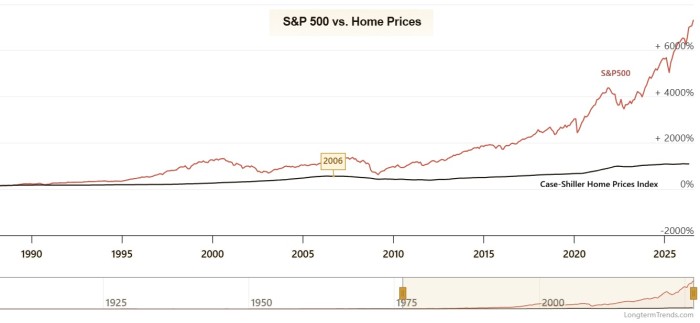
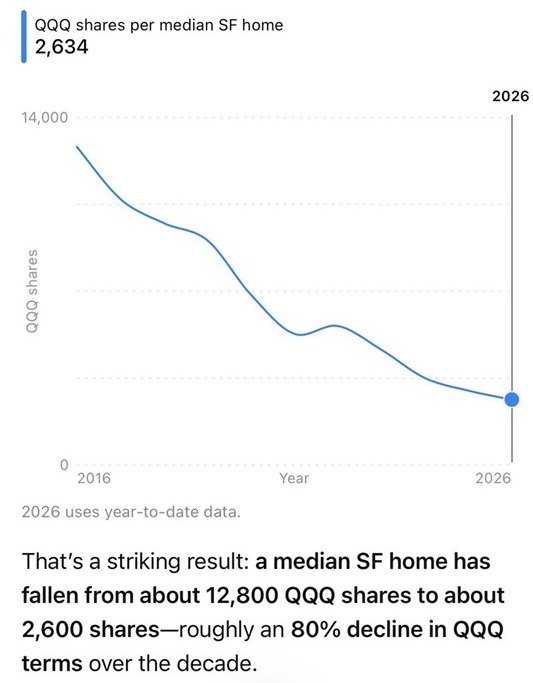
Figure 1 shows how shares, as represented by the S&P 500, have performed compared with house prices in the US. The US is quite comparable to the Netherlands, which has also had an overheated housing market for years. It is clear that, over this period, shares have yielded significantly more than a house. This can also be illustrated in a slightly different way as a ratio, as in Figure 2, where house prices in San Francisco (SF) are divided by the Nasdaq-100. In terms of share prices, house prices in SF – which has experienced a booming housing market over the past decade – have fallen sharply.
Figure 2: Number of QQQ shares needed to buy a median-priced home in San Francisco (2016–2026)
The myth of ever-rising house prices
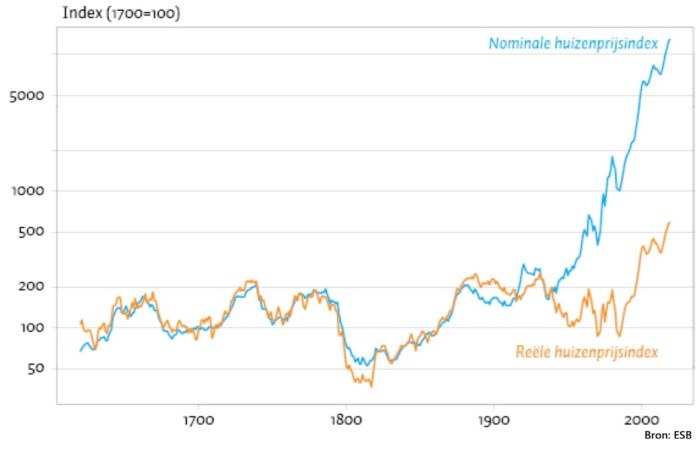
Another myth about owner-occupied homes is that house prices always rise. Looking at recent decades, this does indeed appear to be the case. In nominal terms (see blue line, Figure 3) – i.e. disregarding inflation for the moment – house prices have risen mainly in the well-known major cities, such as Amsterdam, since the early 1980s. The figure also highlights the significant difference between nominal and real house prices. Furthermore, it shows that house prices can also fall over the centuries. Those who wish to tax ‘capital gains on property’ are counting their chickens before they hatch, relying on a short-term history and inflated gains.
Figure 3: House prices in Amsterdam
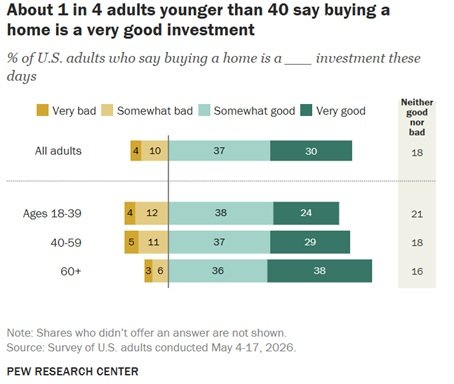
Recent research by the Pew Research Centre also shows that by no means every American believes that a house is a ‘very good investment’. Only 25 per cent of adults under 40 believe this, whilst those aged 60 and over are slightly more positive (38 per cent). But here too, the question is whether this positive attitude towards home ownership is really based on actual gains, taking into account all the costs of owning a home, or whether they are primarily looking at nominal price rises (presumably the latter). It is striking that roughly a third of Americans view houses as a poor or neutral investment.
Figure 4: Americans take a nuanced view of home ownership
Boomers aren’t downsizing – they’re upscaling
The final myth that needs to be debunked is that older generations want to downsize. The Wall Street Journal recently published a major article claiming that ‘boomers’ actually have no desire to do so. Either they stay put in their old, familiar home – which they even regularly extend – or they move into an even larger property, because the ‘nominal profit’ on their old home allows them to do so. This issue is also prevalent in most Western countries. It is a problem because there is no movement in the housing market. The fact that young families cannot buy a home is therefore not necessarily down to the available housing stock.
Why myths persist
Societies are characterised by ‘narrative inertia’. Stories persist because they are told frequently, adopted by institutions and reported on by the media. They become part of our collective identity. It is not uncommon for them to perpetuate certain interests as well. For instance, mortgage lenders, estate agents, property developers and so on are keen to protect their business, often by even forcing through subsidies. In effect, the mortgage interest relief and the NHG guarantee are not only a subsidy for the homebuyer, but also for everyone who benefits from the owner-occupied housing market.
This article contains a personal opinion by Harry Geels
Share this post!
Related posts
-
 Read more about "Re:sustain: European real estate investors need faster payback certainty"
Re:sustain: European real estate investors need faster payback certainty
-
 Read more about "PGIM: Actieve vastgoedbeleggers profiteren van versnipperde Europese markt"
PGIM: Actieve vastgoedbeleggers profiteren van versnipperde Europese markt
-
 Read more about "PGIM: Europese vastgoedmarkt heeft meer tijd nodig om te herstellen"
PGIM: Europese vastgoedmarkt heeft meer tijd nodig om te herstellen
-
 Read more about "AEW: Fysieke klimaatrisico’s verdubbelen risicopremie Europees vastgoed"
AEW: Fysieke klimaatrisico’s verdubbelen risicopremie Europees vastgoed
-
 Read more about "Nuveen: Herstel Europees vastgoed kan doorzetten ondanks hoge rente"
Nuveen: Herstel Europees vastgoed kan doorzetten ondanks hoge rente
-
 Read more about "IVBN: Prinsjesdagpakket herstelt investeringsklimaat niet"
IVBN: Prinsjesdagpakket herstelt investeringsklimaat niet
-
 Read more about "Savills IM: European real estate debt finds its moment"
Savills IM: European real estate debt finds its moment
-
 Read more about "Schroders: Vastgoed steeds belangrijker voor 'AI-boom'"
Schroders: Vastgoed steeds belangrijker voor 'AI-boom'
-
 Read more about "Savills AM: European residential - looking beyond yields"
Savills AM: European residential - looking beyond yields
-
 Read more about "Drooms: Signs of recovery in the real estate transaction market"
Drooms: Signs of recovery in the real estate transaction market