
Harry Geels: Europe is saving itself into poverty
Harry Geels: Europe is saving itself into poverty

This column was originally written in Dutch. This is an English translation.
By Harry Geels,
There is now more than €14 trillion in savings held at European banks. In doing so, households are eroding their purchasing power, boosting banks’ profit margins and limiting the investment capacity needed for Europe to catch up with the US. The culture of saving has become too institutionalised in Europe.
Europe is not struggling with a lack of money, but with a lack of ways to spend it. European households consistently save more than their American counterparts, whilst businesses are struggling with a shortage of investment capital. As an analysis by the Financial Times shows, cash and savings have now risen to around €14 trillion. The average savings rate among Europeans is more than twice that of Americans (see below).
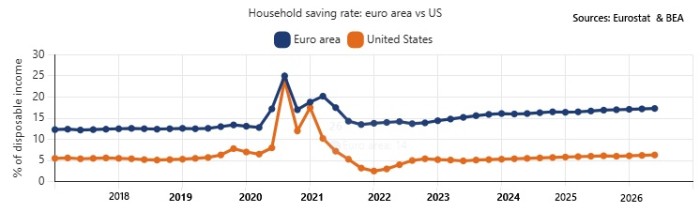
European politicians and regulators increasingly view this growing gap between savings and productive investment as a brake on economic growth and innovation. It is no coincidence that both the British and Dutch regulators – the FCA and the AFM respectively – have recently launched campaigns to encourage investment, through tools, education and appeals to households. The AFM is particularly keen to lower the barriers to starting to invest.
Households bear the brunt, banks reap the benefits
As inflation is currently at least twice as high as the interest rate on savings (let alone the interest rate on current accounts), the propensity to save is costing Europeans a great deal of purchasing power. The aforementioned regulators are therefore right to point out that, in the long term, this could put pressure on a decent pension.
Banks are reaping the benefits of this saving frenzy. This provides them with a large ‘pool’ of funds which they can park with the ECB at a higher interest rate, or lend out at higher rates using leverage. This effectively results in a ‘wealth transfer’ from savers to the financial sector. Because the European urge to save is so strong and many countries are characterised by national banking oligopolies, banks have long been able to get by with relatively low savings rates.
Another consequence of this propensity to save is that a large proportion of capital remains outside the productive economy. And this at a time when Europe actually needs more investment – in defence, for the energy transition, and to strengthen its competitive position in the world of AI.
Institutional barriers
For households, saving is simple, familiar and virtually frictionless: opening an account costs nothing and feels safe. Investing, on the other hand, requires knowledge and time and involves all sorts of barriers, from risk profiles and documentation to costs and uncertainty. Regulation reinforces this difference. European rules are strongly focused on investor protection, with extensive disclosure requirements and warnings, making investing appear more complex and riskier than it actually is.
On top of that, deeper institutional structures reinforce this propensity to save. Firstly, Europe has a bank-driven financial system in which savings are mainly channelled into mortgages and relatively safe loans, rather than into risk-bearing capital for businesses and innovation, particularly in countries where banks are dominant, such as Germany. Secondly, tax incentives favour saving and property over investment, which is subject to more complex and heavier taxation (the new Box 3 taxes in the Netherlands are not helpful in this regard either).
Thirdly, pension schemes in various countries take over a significant part of the investment function, as a result of which households (unjustifiably) feel less need to take risks themselves. Finally, European capital markets are fragmented: investing across borders is relatively complicated and expensive. The result is a self-reinforcing pattern: households keep their money in the bank, see little return from investing, and thus repeatedly confirm the belief that caution is the rational choice.
Added to all this are a number of fundamental factors, of which demographics is the most important. Europe is ageing faster than the US, and older households save relatively more and take fewer financial risks. The composition of wealth also plays a role: a large proportion of European household wealth is tied up in property, meaning that liquid assets are more often held as savings.
Finally: the wrong reflex
One consequence of the structures mentioned above is that Europe is increasingly resorting to industrial policy. Mario Draghi also points out that Europe’s lag behind the US can only be made up through large-scale investment, supported by public policy. But this risks Europe going from bad to worse. Whilst the real problem lies in the underutilisation of private savings, Europe is choosing to compensate for the shortfall in investment capital with more public intervention, subsidies and funds.
However, a greater government role will not solve the underlying problems. The risk is that capital will be deployed not more efficiently, but less efficiently, through politics rather than through markets. Europe does not have a shortage of capital, but rather a lack of a system capable of mobilising that capital productively. This calls for a deeper capital markets and banking union: less fragmentation, more competition and better access to risk-bearing capital for businesses.
Equally important is a cultural shift, starting with financial education: teach citizens not only to save, but also to invest. Teach people that saving also costs money, rather than merely pointing out the risks of investing. After all, the greatest risk in investing is ‘not investing’. Why don’t children start investing straight away, alongside saving? That way, we kill two birds with one stone: greater purchasing power for households and a more competitive Europe.
This article contains a personal opinion by Harry Geels
Share this post!
Related posts
-
 Read more about "Clearwater Analytics: AI will generate higher alpha"
Clearwater Analytics: AI will generate higher alpha
-
 Read more about "Clearwater Analytics: Asset managers are concerned about AI risks"
Clearwater Analytics: Asset managers are concerned about AI risks
-
 Read more about "Clearwater Analytics: AI will transform asset management operations within a year"
Clearwater Analytics: AI will transform asset management operations within a year
-
 Read more about "bfinance: Investment management fees enter new downward phase"
bfinance: Investment management fees enter new downward phase
-
 Read more about "WTW: Vermogensbeheerders riskeren achterop te raken"
WTW: Vermogensbeheerders riskeren achterop te raken
-
 Read more about "DNB: Aandachtspunten kapitaalbeheersing"
DNB: Aandachtspunten kapitaalbeheersing
-
 Read more about "Ocorian: Family offices are becoming increasingly professionalised"
Ocorian: Family offices are becoming increasingly professionalised
-
 Read more about "Bob Homan: AI makes analysts more human"
Bob Homan: AI makes analysts more human
-
 Read more about "Ocorian: Family office strategies shift due to younger generations"
Ocorian: Family office strategies shift due to younger generations
-
 Read more about "Natixis IM: Bijna helft adviseurs ziet 'Great Wealth Transfer' als bedreiging"
Natixis IM: Bijna helft adviseurs ziet 'Great Wealth Transfer' als bedreiging