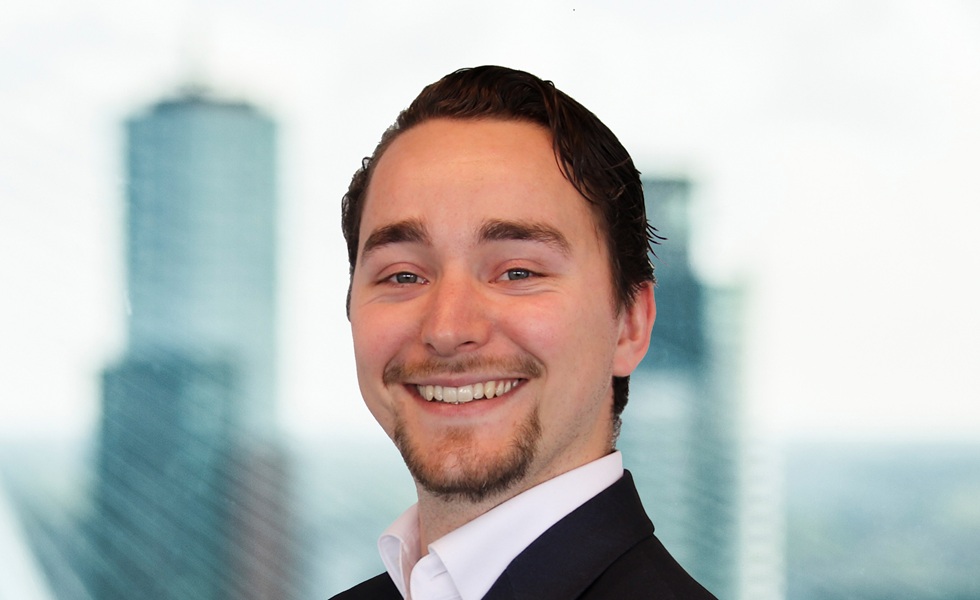
Young Professionals: Tijmen Janssen (Ortec Finance)
Young Professionals: Tijmen Janssen (Ortec Finance)
This special was originally written in Dutch. This is an English translation.
The world in which investors operate has become more complex and unpredictable in a short space of time. Geopolitical tensions, technological developments and structural transitions are increasingly setting the agenda. Financial Investigator asked Tijmen Janssen, a young professional and Consultant in Climate Scenarios & Sustainability at Ortec Finance, how he experiences these developments in his day-to-day work.
By Daan Nijssen
To what extent has increased geopolitical complexity affected your profession?
‘In 2026, geopolitical tensions will be central to the financial world. Policy choices can change from day to day, meaning that traditional, stable assumptions may no longer suffice. For investors, this means lower (real) growth, higher inflation and rising risk premiums.
The increasing uncertainty is mainly causing higher volatility, a world where markets are under stress, correlations are rising and diversification is less effective. This has major consequences for the strategic decisions of institutional investors and requires extra attention in risk management.
We are increasingly focusing on the importance of multi-crisis scenarios, in which geopolitical and climate risks are considered in conjunction with one another.
Geopolitical conflicts are also multidisciplinary in nature: they affect macroeconomics, energy security, international trade, technological rivalry, institutional risk management and security policy. At the same time, economic fragmentation, climate risks, migration flows and security shocks reinforce these dynamics. The result is a so-called polycrisis. Think of the coincidence of high inflation, geopolitical trade tensions and extreme weather conditions. Each effect is complex on its own, but in combination they are potentially disruptive. In this context, there is a greater need to combine traditional risk models with narrative-driven stress scenarios to make portfolios resilient. Scenarios should not only include quantitative parameters, but also describe the specific characteristics of geopolitical tensions.
In my work at Ortec Finance, we are increasingly focusing on the importance of polycrisis scenarios, in which geopolitical and climate risks are considered in conjunction. Building robust scenario architectures and explicitly quantifying these risks is necessary for the current risk management of institutional investors. Only through this integrated approach can investors prepare for a world in which uncertainty is increasing and resilience is essential.’
Read the original special in Financial Investigator magazine
Share this post!
Related posts
-
 Read more about "BLI: Wereldeconomie blijft veerkrachtig genoeg om recessie te vermijden"
BLI: Wereldeconomie blijft veerkrachtig genoeg om recessie te vermijden
-
 Read more about "PIMCO: Energy shocks, rising yields, and the case for bonds"
PIMCO: Energy shocks, rising yields, and the case for bonds
-
 Read more about "Schroders: Verstoring energievoorziening kan langer aanhouden dan aanvankelijk gedacht"
Schroders: Verstoring energievoorziening kan langer aanhouden dan aanvankelijk gedacht
-
 Read more about "RBC BlueBay AM: Opluchtingsrally maskeert groeiende economische risico’s"
RBC BlueBay AM: Opluchtingsrally maskeert groeiende economische risico’s
-
 Read more about "Young Professionals: Robert Prins"
Young Professionals: Robert Prins
-
 Read more about "Young Professionals: Investing in a world without certainties"
Young Professionals: Investing in a world without certainties
-
 Read more about "Young Professionals: Paul van Kempen (MN)"
Young Professionals: Paul van Kempen (MN)
-
 Read more about "Bob Homan: Turmoil on stock market does not necessarily mean more action"
Bob Homan: Turmoil on stock market does not necessarily mean more action
-
 Read more about "Young Professionals: Koen Lamers (Probability & Partners)"
Young Professionals: Koen Lamers (Probability & Partners)
-
 Read more about "Young Professionals: Daniël Asselbergs (APG AM)"
Young Professionals: Daniël Asselbergs (APG AM)