
Harry Geels: A case for an inflation index
Harry Geels: A case for an inflation index

This column was originally written in Dutch. This is an English translation.
Inflation is normally measured in percentages, but it makes more sense to track it using an index, just as we do with stock market indices. An index provides a much clearer picture of the long-term effects of inflation, avoids interpretation issues and yields more interesting insights.
By Harry Geels
Inflation is a difficult concept for many people to grasp. Official bodies express it as a percentage: the rise in prices compared to twelve months ago. In doing so, they use various definitions, such as headline inflation and core inflation (excluding energy and food, as these are considered too volatile). However, many people find percentage changes difficult to interpret. In particular, the compounding effect – the accumulation of inflation over the years – is completely lost from view. That is why it is better to work with inflation indices.
1) An inflation index tackles the cognitive problem
Presenting inflation figures as percentages creates all sorts of problems because many people struggle to understand such ratios. ‘€20 more expensive’ is intuitively much easier to understand than ‘+8%’. Regulators therefore require asset managers to report costs in both percentages and absolute amounts. In behavioural science, this is known as the Exponential Growth Bias: people think linearly, whilst inflation works exponentially. As a result, they systematically underestimate the actual impact of inflation.
2) An inflation index shows the compounding effect
The biggest mistake in communicating about inflation is that we act as if it is relevant solely on a year-on-year basis. But in reality, inflation accumulates over time. An inflation index makes this visible: 3% + 4% + 6% is not ‘13%’, but an increase of nearly 14% in the price level. Since the coronavirus crisis, the inflation index has risen by more than 30%. Anyone who has not seen this offset through wages or a pension has, in real terms, lost out.
3) An inflation index makes inflation tangible over time
A third advantage is that an index makes inflation visual and evolutionary. Just as with stock market charts, we can track and compare the erosion of purchasing power over time. This makes it possible to look back at specific periods — for example, since the pandemic or since the collapse of Bretton Woods — and to assess policy not on the basis of snapshots, but on cumulative effects. An index shows the total damage, not just the rate of it. Let us discuss a detailed example of this third advantage.
Long-term analysis of inflation indices
The case for using inflation indices more widely is aimed primarily at official bodies and the media. They are occasionally used in the financial world. A recent example of a long-term analysis of an inflation index comes from Jim Reid of Deutsche Bank. He presented not only a rich historical overview, but also three interesting observations on how inflation has developed over the centuries.
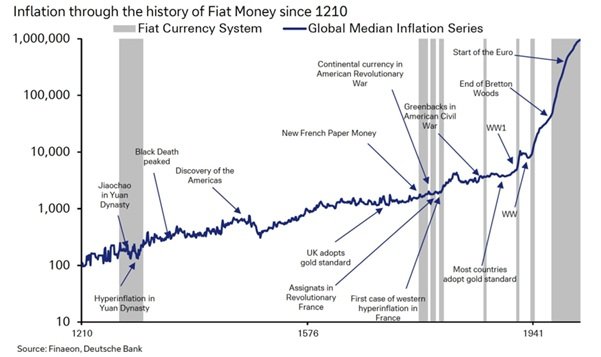
Two preliminary remarks. Firstly, a ‘global median’ spanning over eight hundred years inevitably combines heterogeneous country-level data and indirect measures. It should therefore be viewed as a stylised historical reconstruction rather than a single precise inflation figure. Secondly, this is a logarithmic graph: a nominal graph would show price rises to be even steeper.
Observation 1 – Fiat systems are inflationary
Reid’s long-term series shows that price levels under fiat systems rise structurally, whilst precious metal systems (such as the gold standard or Bretton Woods) have historically tended to show stability or mean reversion. In fiat systems (money without material backing, based purely on trust in the government), there is therefore a strong temptation to create extra money or keep interest rates too low, particularly in times of crisis. Often, combating the crisis is considered more important than preserving purchasing power. Particularly since the end of Bretton Woods (1971), the global rate of inflation has become higher and more persistent.
Observation 2 – Wars are inflationary
Major surges in price levels almost always coincide with war or acute fiscal distress. The French Assignats, the American War of Independence and the Civil War: in each case, the war was financed with paper, unbacked currencies that fell sharply in value. In the twentieth century, the world wars once again caused sharp price rises. The lesson is consistent: large budget deficits almost always lead to monetary easing and ultimately to inflation. Incidentally, Milton Friedman also refers to inflation caused by government spending as ‘hidden taxation’.
Observation 3 – Deflationary technologies are often neutralised by policy
New technologies and globalisation in themselves already put downward pressure on prices: greater productivity, economies of scale, increased competition. But in fiat systems, these deflationary forces are often offset by low(er) interest rates, balance sheet expansion and expansionary fiscal policy, particularly following crises. As a result, consumer price inflation falls less than technological progress would suggest, whilst part of the monetary stimulus spreads out into assets or seeps into them.
Rising house and share prices also exacerbate wealth inequality. The BIS therefore refers to a ‘distributional footprint’ of monetary policy. Technological deflation is thus partly neutralised, whilst price levels of goods, services and investments actually rise.
Conclusion: why an inflation index is indispensable
When we combine the cognitive benefits of an inflation index – eliminating percentage bias, making compounding visible and rendering purchasing power tangible over time – with Reid’s long-term observations, a coherent and convincing picture emerges. An inflation index forces us to acknowledge what the history of money has been showing us for centuries: that fiat systems are structurally inflationary, that wars and fiscal crises trigger waves of inflation, and that technological deflation is often drowned out by monetary and fiscal policies that actually generate inflation and asset inflation.
By capturing inflation in an index, we see not only how significant the shift in purchasing power really is, but also how policy regimes determine that shift. It is precisely this combination – clear measurement and historical perspective – that is needed to strip the inflation debate of noise and thus finally provide citizens, investors and policymakers with a fairer purchasing power compass.
This article contains the personal opinion of Harry Geels
Share this post!
Related posts
-
 Read more about "Crédit Mutuel AM: Central Banks under pressure as inflation risks re-emerge"
Crédit Mutuel AM: Central Banks under pressure as inflation risks re-emerge
-
 Read more about "Han Dieperink: Greedflation 2.0"
Han Dieperink: Greedflation 2.0
-
 Read more about "Harry Geels: Inflation isn’t just about the money supply"
Harry Geels: Inflation isn’t just about the money supply
-
 Read more about "Schroders: Hormuz-crisis zet inkomensbelegger voor nieuw inflatietijdperk"
Schroders: Hormuz-crisis zet inkomensbelegger voor nieuw inflatietijdperk
-
 Read more about "Aberdeen: UK has not yet overcome its inflation problems"
Aberdeen: UK has not yet overcome its inflation problems
-
 Read more about "Payden & Rygel: AI token costs are falling, potentially deflationary"
Payden & Rygel: AI token costs are falling, potentially deflationary
-
 Read more about "RBC BlueBay AM: Inflatie kan nog jaren hoog blijven"
RBC BlueBay AM: Inflatie kan nog jaren hoog blijven
-
 Read more about "PIMCO: U.S. inflation measures tell two different stories"
PIMCO: U.S. inflation measures tell two different stories
-
 Read more about "Ostrum: China gaat inflatie exporteren"
Ostrum: China gaat inflatie exporteren
-
 Read more about "BLI: Economische groei nog niet ontspoord door scherpe stijging energieprijzen"
BLI: Economische groei nog niet ontspoord door scherpe stijging energieprijzen