
PGIM: Six reasons to invest in emerging markets

Emerging market assets are rallying on a weaker dollar and growth upgrades, with equities set for their best year in years. Yet valuations remain compellingly undervalued.
By Denis Cole, Head of Portfolio Specialists, PGIM Fixed Income, Jeffrey Young, Head of Investment Strategy, PGIM Quantitative Solutions, Sara Moreno, Emerging Markets Equity Portfolio Manager, Jennison Associates, and Albert Kwok, Emerging Markets Equity Portfolio Manager, Jennison Associates
Emerging markets (EM) are showing renewed resilience, supported by easing inflation and structural reforms that foster investment-led growth. The IMF has raised its outlook for EM and developing economies to 4.1% this year and expects growth to outpace developed markets (DM). Crucially, the EM-DM growth differential is widening again, expected to exceed 2%: a threshold historically linked to outperformance of EM debt (EMD) over DM credit.
Institutional strengthening is enhancing policy credibility and sovereign resilience, reflected in recent credit rating upgrades, even as some DM economies face challenges. While not all EMs are improving – China’s growth is slowing, some countries still run wide fiscal deficits, and geopolitics remain a source of dispersion – the quality of growth is improving. It is less credit-fuelled and increasingly driven by exports and investment.
Central banks and finance ministries are gravitating towards orthodox policies, adopting inflation-targeting frameworks, fiscal rules, and medium-term debt strategies. These measures create a more predictable policy mix and support domestic stability, reinforcing confidence in EM fundamentals.
Attractive yields
The fixed income backdrop remains broadly supportive, particularly for EMD. All-in yields are historically high, and while spreads are near the tighter end of their range, they still offer relative value compared to other fixed income sectors. In a stable growth environment and with the Fed beginning to cut rates, spreads are likely to remain rangebound or tighten modestly. High carry alone can absorb up to 100 basis points of spread widening without impacting core rates.
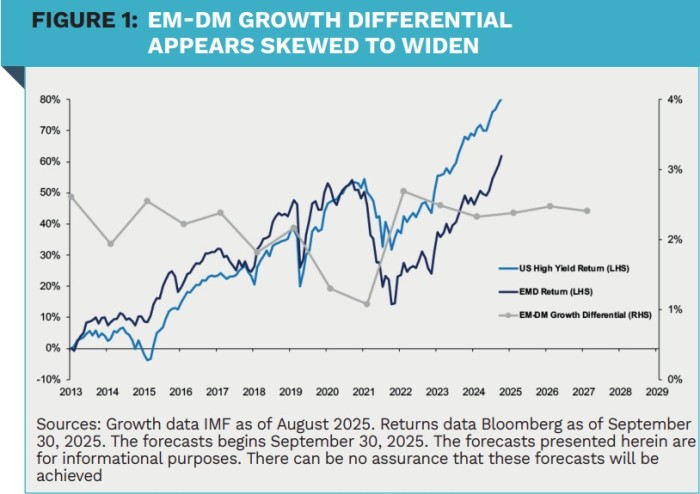
Fundamentals underpin this stability. EM sovereigns have shifted from pandemic-era stimulus to fiscal consolidation, narrowing deficits through tax and subsidy reforms. Central banks acted early to combat inflation, pushing inflationadjusted interest rates into positive territory and anchoring expectations. As disinflation progresses, interest burdens are likely to ease as growth becomes more durable. External positions have improved, with stronger current accounts, rising foreign exchange reserves, and reduced reliance on foreign currency debt. Longer-term, yield-to-worst dynamics remain the best predictor of total returns. After bond yields surged in 2021–2022, higher yields are once again delivering higher returns. Sovereigns have smoothed amortisation profiles, bolstered quasisovereign balance sheets, and tapped IMF or multilateral programs to lock in reforms. EM corporates also look resilient, with high-yield defaults expected to stay within the historical average of 1.5–3%. While tariff risks linger, supply chain realignment and inventory adjustments have mitigated much of the impact, though margin pressures warrant monitoring.
Weaker dollar
The Fed’s rate cuts to address labour market weakness are likely to cap further US dollar strength. Historically, a weaker dollar benefits EM assets, given the strong inverse correlation between the trade-weighted dollar and EM/DM relative performance. Exports have surged to record highs in South Korea and Taiwan, and the current 15-year cycle of dollar strength may have peaked.
A softer dollar eases EM debt burdens – most of which are dollardenominated – creating room for fiscal expansion. Monetary easing by other major central banks adds further support to EM growth and stability. High carry alone makes EM currencies attractive relative to low-yielding DM peers, and as US growth slows, the dollar’s cyclical behaviour should limit EM currency downside during shocks while enhancing their appeal amid improving global risk sentiment.
Emerging markets are showing renewed resilience, supported by easing inflation and structural reforms that foster investment-led growth.
Local borrowing
EMs are reducing reliance on US exports and increasing intra-EM trade, aided by new agreements across Asia and renewed BRIC collaboration. This trend is most evident in local debt markets, where EMs are shifting towards domestic issuance and away from hard currency borrowing. Domestic debt now exceeds 20% of GDP in many lower-income countries – double the level of the early 1990s – reflecting stronger institutions, rising incomes, and deeper financial markets.
Greater domestic ownership of local currency debt reduces sensitivity to global shocks. An IMF analysis shows that in a risk-off scenario, local currency yield spreads rise by 19 basis points, but higher domestic bank ownership can cut that to 11 basis points. Increased non-bank financial institutions’ ownership also plays a stabilising role. This structural shift creates new opportunities in both local and hard currency EM markets.
Robust equities
EM equities have rallied for nine consecutive months, buoyed by strong earnings, AI optimism, and robust foreign inflows. EM corporate earnings are expected to grow strongly in 2026, with tech-heavy markets like South Korea, Taiwan, and China benefiting from AI-driven demand.
Structural trends amplify this momentum. EM consumers’ embrace of digital platforms has enabled companies to leapfrog costly physical infrastructure and disrupt traditional players. Fintech and e-commerce are prime examples: large segments of EM populations remain underbanked, creating opportunities for digitalfirst firms to deliver basic financial services. In Mexico, for instance, only half of the 90 million eligible adults have access to a bank account – a gap fintechs are rapidly filling. E-commerce platforms have also launched fintech offerings, unlocking new revenue streams adjacent to their core businesses.
Quick commerce is the next evolution of e-commerce, focused on ultra-fast delivery of daily essentials within 10–30 minutes. Driven by urbanisation and consumer demand for convenience, companies are leveraging digital expertise to meet this high-frequency, time-sensitive trend.
AI: a global opportunity
While US firms dominate headlines, AI innovation is global. In early 2025, Chinese startup DeepSeek unveiled its R1 model, which runs on less powerful chips and is highly costefficient compared to US competitors. This underscores that AI’s next phase – applications rather than capex – will involve players worldwide. China remains deeply invested in AI, developing advanced language models and expanding its ecosystem through hyperscalers like Alibaba and Tencent.
The infrastructure supporting AI is vast and global. Semiconductor manufacturing, critical to AI’s backbone, is concentrated in Asia, particularly Taiwan and South Korea. These firms are essential to building out everything from foundries and chip components to cooling systems. As node sizes shrink, complexity rises, expanding the supply chain and reinforcing Asia’s strategic role.