Panel discussion: 'How can pension funds work together?'
Panel discussion: 'How can pension funds work together?'
This report was originally written in Dutch. This is an English translation.
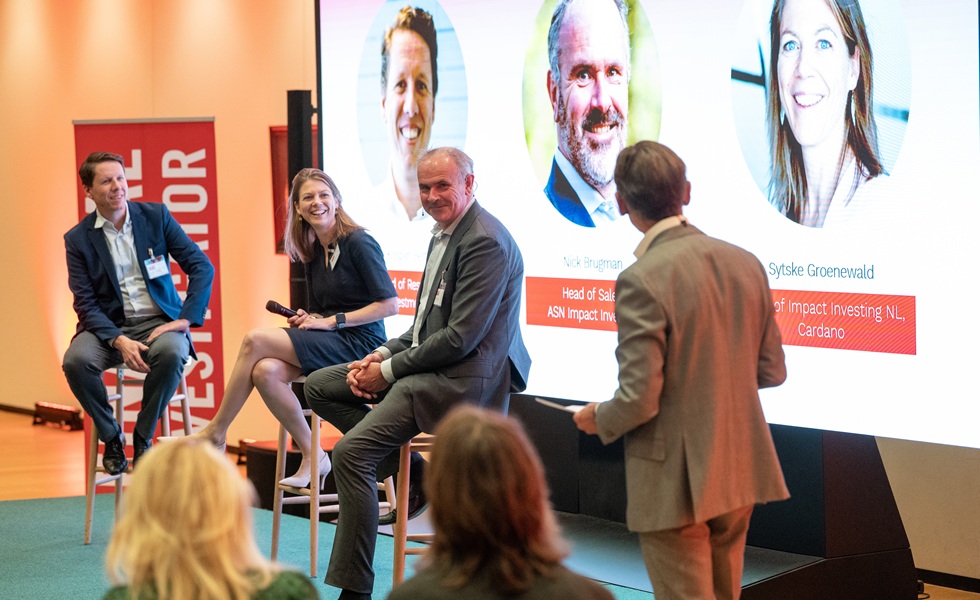
During the second panel discussion at Financial Investigator's seminar “From Impact Investing to a Climate-Neutral and Circular Economy”, three experts discuss the need to scale up, collaborate more effectively and invest in a more impact-oriented manner. What stands out is that the transition requires not only capital, but also consistent policy, knowledge sharing and the courage to act together.
By Baart Koster
|
CHAIR Alfred Kool, Non-Executive Director, ABP PARTICIPANTS Krispijn Bertoen, Head of Responsible Investment, MN Nick Brugman, Head of Sales, ASN Impact Investors Sytske Groenewald, Head of Impact Investing NL, Cardano |
Immediately after the panellists take the stage, the urgency of energy security becomes the focus of attention. The question of how the Netherlands can reduce its energy dependence forms the starting point for the discussion. ‘We must ensure that we are no longer dependent on fossil fuels,’ Nick Brugman opens. He points to the vulnerable energy position of the Netherlands and Europe. ‘In the Netherlands, 82.5% of energy consumption is still fossil-based, 36.5% of which is gas. That used to come partly from Groningen and partly from Russia, but now we import 70% of our LNG from the US. That may seem safe, but it makes us dependent on external suppliers once again. The urgency of becoming climate neutral is not only an environmental issue, but also a strategic necessity.’
This brings the discussion to a much broader reality in the institutional investment world, namely that the energy transition is no longer just a sustainability issue, but has now become part of the core of economic strategy formation. For many pension funds, this means a shift in mindset: from ‘climate as a risk’ to ‘energy security as a strategic necessity’. The panellists recognise this change. Increasingly, funds have to make choices that are not only focused on the future-proofing of their portfolios, but also on social stability.
Brugman emphasises that geopolitics is now an accelerator of sustainability. ‘Whereas we used to invest primarily on the basis of climate goals, there is now a new motive: energy security. That realisation can actually accelerate the transition.’ Sytske Groenewald adds that circular companies in particular are currently struggling. ‘They have to invest heavily in new technologies and find it difficult to compete with cheap, non-sustainable products. As a result, investment capital is often lacking. Yet it is precisely these companies that hold the key to structurally changing our economy.’
Making choices in a rapidly changing landscape
As the discussion led by chair Alfred Kool continues, the focus shifts from urgency to implementation. The panellists emphasise that practice is often more unpredictable than policy or models suggest. Every investment requires careful consideration: how mature is the technology, how fast is the market growing, and are the regulations sufficiently aligned with this? This is precisely why collaboration is becoming increasingly important. By pooling insights and experiences, it becomes easier to identify which solutions can truly be scaled up and which still need further development. This shared knowledge helps funds make more informed choices in a rapidly changing landscape.
By sharing research results, we can strengthen each other's work and make it possible to invest in smaller, impactful investments.
Krispijn Bertoen sees investments in industrial sustainability as offering the greatest leverage. ‘We need to finance interventions that not only make a difference locally, but also have a global impact. Think of innovations that make industrial processes less polluting. If such solutions are scalable, they increase their impact exponentially.’
The audience asks whether the market needs a ‘market master’ – a government that provides direction. Brugman is clear on this. ‘In recent years, the government has not pursued a consistent long-term policy. In ten years’ time, we have had more caretaker cabinets than sitting cabinets. This undermines the predictability that investors need. We need a government that sets clear rules that all market parties can adhere to. And preferably at European level, because the transition does not stop at the border.’
Bertoen also advocates for greater coherence between the government and the market. ‘The government expects a lot from pension funds, but often does not sufficiently understand how investment decisions are made. We do not speak the same language enough. You see this with issues such as defence: there are calls to invest, but without stable regulations and long-term government contracts with defence companies, that is not realistic.
We need a new common language between the government, asset owners and asset managers. Otherwise, we will remain stuck in semantic discussions and will not arrive at solutions.’
Kool sums it up aptly: ‘Political shifts and short-term horizons make it difficult for pension funds to continue investing consistently. But we cannot afford to wait and see; we must keep moving forward.’
Cooperation is essential
The next question elicits broad recognition: is cooperation between pension funds necessary to expand the market for circular and climate-neutral investments? ‘But I would like to turn the question around,’ says Bertoen. ‘What forms of cooperation do we already see, and which ones would we like to see more of?’ Groenewald offers two practical suggestions. ‘Firstly, share knowledge and research. Pension funds can increase their impact by working together more, for example in the due diligence process. ‘By drawing on each other’s expertise, pension funds can invest more efficiently in smaller, more impactful funds that would otherwise be too time-consuming. By sharing research results, we can strengthen each other’s work and make it possible to invest in smaller, impactful investments. Second, work with joint mandates. This allows small funds to pool their allocations and invest jointly. ‘This takes time and coordination, but it increases effectiveness and reduces costs, Groenewald emphasises. There are inspiring examples, she continues. 'Take Christian Brothers Investment Services, or CBIS for short, an investment vehicle set up by Catholic communities. They invest in a mission-aligned way, share risks and increase their impact together.’
As a pension fund, take a good look at the themes where you can really make a difference. That way, you can build a credible impact policy and get others on board.
Brugman also cites practical evidence that it works. ‘There are already small impact managers in the Netherlands making concrete investments in the energy transition. Pension funds with smaller allocations can easily participate in this. By using the due diligence efforts of larger parties, smaller funds can piggyback and still contribute to scalable projects. This lowers barriers and accelerates the flow of capital towards circular initiatives.’ Bertoen confirms that such a first step is crucial. ‘Someone has to take the lead in getting a proposition completely in order for institutional investors. That takes time and a lot of work, but once it is in place, others can come on board as cornerstone investors. That is how you build new markets together.’ According to Bertoen, it is important to stay true to your identity. ‘As a pension fund, take a good look at the themes where you can really make a difference. That way, you build a credible impact policy and get others on board.’
Working together, but from your own strength
A discussion then ensues in the room about how exactly cooperation between pension funds should take shape. There is a misconception that cooperation only works if funds compromise on their own investment identity. Bertoen corrects that image. ‘The opposite is true. If one fund chooses a specific impact theme that fits well with its identity, it can take on the role of pioneer: gaining full control of a proposition, carrying out due diligence and doing the groundwork that will help others to get involved later on.
This allows other funds to jump on the bandwagon and benefit from the insights, research and lessons that have already been gained. This accelerates knowledge sharing and collaboration across the entire sector.’ He believes that there is more potential for information exchange than is often thought. ‘We don't just share full due diligence reports for reasons of confidentiality, although in some cases we can. However, there is an informal exchange of insights: about risks, initial findings and operational lessons. This knowledge sharing creates trust and helps the sector move forward more quickly.’
Groenewald emphasises that cooperation also sends a signal to politicians. ‘When pension funds act together, the government takes them more seriously. A united sector is more likely to be heard than a single party trying to achieve something on its own. Moreover, it gives participants greater certainty that stable, long-term decisions will be taken that are in line with social policy.’ Kool sums it up: ‘Trust does not come from rules, but from cooperation. If the sector informs each other more openly, the government will follow suit.’
We need a government that sets clear rules that all market parties can adhere to. And preferably at European level, because the transition does not stop at the border.
Convincing the doubters
Kool then raises the question of how pension funds that are still unsure about impact investing can be persuaded. ‘Results speak loudest,’ responds Groenewald. ‘But knowledge sharing is also crucial. Funds that already have experience with impact can help other funds strengthen their policies. That increases confidence, not only among funds, but also among participants. People want to know that their pensions are being invested in something that both yields a return and contributes to a liveable future.’
Bertoen points out the importance of communication with the rank and file. ‘The conversation with participants is complicated enough in itself. Nevertheless, we must engage in it as much as possible. Focus groups with participants provide valuable insights. People appreciate transparency, even when it comes to dilemmas. That increases support for impact investing.’ A participant in the audience notes that pension funds should not underestimate their social licence to operate. ‘If we show that returns and responsibility go hand in hand, we will gain the trust we need to finance the transition.’
Impact-oriented investment in decarbonisation
To conclude, a final question from the audience: what does investing in decarbonisation mean in concrete terms? Bertoen explains that it is all about technology that helps make industrial processes more sustainable. ‘Our pension fund clients, for example, invest heavily in technology that structurally reduces emissions. That is the essence of impact investing: helping companies get from A to Better, rather than excluding them. Only by guiding companies in their transition can we achieve real emissions reductions.’ Kool concludes: ‘Impact is not about what you exclude, but what you make possible. And cooperation determines the difference between intention and result.’
The discussion makes it clear that the market for circular and climate-neutral investments is developing rapidly, but that cooperation and consistency still leave something to be desired. The substantive emphases differ – from the why of the transition to the how of collaboration and implementation – but the underlying conviction is widely shared: pension funds are not only capital providers, but also leaders in the economy of tomorrow. By sharing knowledge, pooling risks and making clear choices, they can accelerate the transition. Not despite, but thanks to their scale. It is becoming increasingly clear that the big steps do not come from individual initiatives, but from coordinated choices and long-term joint efforts. Impact, it turns out, is not a buzzword but a joint mission. One that starts with trust, is supported by cooperation and proves its value for the climate, economy and society in the long term.
|
SUMMARY The energy transition is not only about sustainability, but also about energy security and strategic necessity. Consistent government policy, knowledge sharing and cooperation are crucial to scaling up investments. Circular and industrial sustainability companies need capital and joint due diligence. Pension funds can increase their impact through joint mandates and by utilising each other's preliminary work. Results, transparency and good communication increase support among participants. Real impact is achieved by guiding companies in their transition, not by exclusion. |
Attachments
Share this post!
Related posts
-
 Read more about "Achmea IM en ILX bundelen krachten voor impactbeleggen in opkomende markten"
Achmea IM en ILX bundelen krachten voor impactbeleggen in opkomende markten
-
 Read more about "Roundtable 'Impact Investing in Private Equity'"
Roundtable 'Impact Investing in Private Equity'
-
 Read more about "OFP BP transfers EUR 1.3 bn of pension liabilities to Zwitserleven"
OFP BP transfers EUR 1.3 bn of pension liabilities to Zwitserleven
-
 Read more about "Dick Kamp: Towards an agile, relevant pensions sector"
Dick Kamp: Towards an agile, relevant pensions sector
-
 Read more about "GE European Pension Fund OFP draagt verplichtingen NL-sectie over aan Achmea"
GE European Pension Fund OFP draagt verplichtingen NL-sectie over aan Achmea
-
 Read more about "Impact in private debt: the closer, the more powerful"
Impact in private debt: the closer, the more powerful
-
 Read more about "SSPF and Athora Netherlands sign cooperation agreement"
SSPF and Athora Netherlands sign cooperation agreement
-
 Read more about "BlackRock: Zonder schaalbare projecten blijft Nederlands pensioengeld aan de zijlijn"
BlackRock: Zonder schaalbare projecten blijft Nederlands pensioengeld aan de zijlijn
-
 Read more about "Jori Arts: Why impact investing needs the stock market"
Jori Arts: Why impact investing needs the stock market
-
 Read more about "Van Lanschot Kempen: 34% deelnemers bereid pensioen in te leveren voor impact"
Van Lanschot Kempen: 34% deelnemers bereid pensioen in te leveren voor impact