
Harry Geels: Why trade barriers keep failing
Harry Geels: Why trade barriers keep failing

This column was originally written in Dutch. This is an English translation.
By Harry Geels
China recorded a record trade surplus of approximately $1.2 trillion in 2025, despite a 20% decline in exports to the US due to Donald Trump's trade war. Trade barriers – such as tariffs, import restrictions and sanctions – do not work and are usually counterproductive.
The Chinese authorities issued a special announcement last week. The trade surplus had reached a new record of no less than $1.2 trillion. Despite exports to the US falling by 20% due to the trade war, China managed to increase its exports to Africa by 26%, to South-East Asia by 13%, to the EU by 8% and to Latin America by 7%. It cannot be ruled out that these regions were partly used as diversion routes, and that Chinese products still found their way to the US via these countries.
Figure 1: China's trade surplus reaches record high
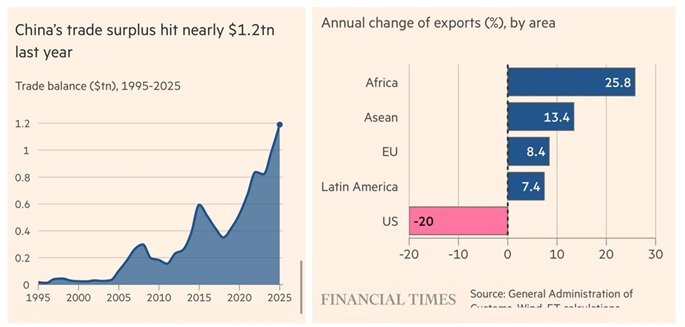
Source: Financial Times
In economics, there is sometimes talk of the “waterbed effect”: if you press down at one point, the volume shifts elsewhere. Incidentally, we see this not only in global trade flows. A classic application is in price regulation: if you push down or cap one price, another price rises elsewhere. For example, rent caps in the private sector in the Netherlands have led to higher initial rents and less maintenance of rental properties by owners.
Same game, different players
The EU sanctions against Russia show exactly the same dynamic. It has now been widely documented (by the OECD, the IMF and various think tanks, among others) that Russian oil, LNG, metals and chemicals are finding their way to the EU via Turkey, Kazakhstan, India, China and the Gulf states. European companies were also often able to unknowingly export “prohibited products” to Russia via these countries. In addition, Iran has been circumventing sanctions for years by rebranding petrochemical products or exporting them via neighbouring countries.
Side effect 1: “be careful what you wish for”
There are two other side effects of trade barriers. And we are not talking about the aforementioned circumvention or evasion routes, but about two “legal” effects. Firstly, countries that are subject to tariffs usually become more innovative. When products are made more expensive, companies lower their own prices through cost-cutting, productivity improvements or product enhancements. For example, partly due to Western opposition, China has built up a competitive automotive industry.
Side effect 2: Undesirable “wealth transfers”
A second effect of tariffs (and sanctions) is that they actually protect local businesses from higher costs for consumers. Making Chinese electric cars more expensive (by both the US and the EU) makes buying sustainable cars more expensive for Western consumers. Both sustainability and purchasing power suffer as a result. Nobel Prize winner Milton Friedman calls this the problem of the (powerful) “visible” (local companies) versus (powerless) “invisible” consumers.
Economists against sanctions
In this YouTube video, American economist Milton Friedman explains that even price dumping by other countries (such as by the Japanese steel industry at the time) should not be countered with import tariffs. Were he still alive, he would probably have called the alleged state aid to the Chinese car industry a “welcome subsidy for Western consumers”. Friedman, who also refers to Adam Smith in the above-mentioned video, is not the only well-known economist to argue against sanctions.
The Indian-born economist Jagdish Bhagwati described the phenomenon of “trade diversion” as early as the 1980s: trade shifts to alternative countries when barriers are erected. Tariffs do not bring the world to a standstill; they merely change the route. In his “New Trade Theory”, Nobel Prize winner Paul Krugman also pointed out that trade flows adapt through economies of scale, networks and diversion routes. His work shows how even heavy restrictions only result in substitution effects.
Professor of International Economics Richard Baldwin also wrote in The Great Convergence that today's value chains are so intricate that barriers at a single border have little effect. Production and distribution reorganise quickly, often faster than policymakers realise. Finally, Gary Hufbauer and Jeffrey Schott of the Peterson Institute proved that only a minority of all sanctions regimes actually work. The rest mainly lead to adaptation behaviour via third countries.
Conclusion: barriers are poor tools
Trade barriers only work on paper. In practice, they lead to the conversion of direct trade into indirect trade, the shift of value chains to third countries, a loss of transparency in trade flows, higher costs for consumers in the sanctioning country itself, and even to increased globalisation outside the West. Put simply, the world is too integrated and too inventive. China's record surplus in 2025 is a perfect example of this. Trump is fighting a losing battle with his tariffs.
This article contains the personal opinion of Harry Geels
Share this post!
Related posts
-
 Read more about "Allianz Trade: Export EU duurder en supply chains verschuiven"
Allianz Trade: Export EU duurder en supply chains verschuiven
-
 Read more about "Ossiam: VS en China keren terug naar mercantilistische strategie"
Ossiam: VS en China keren terug naar mercantilistische strategie
-
 Read more about "BNP Paribas: EU verlegt handel van China naar buurlanden"
BNP Paribas: EU verlegt handel van China naar buurlanden
-
Read more about "DNB: Wat betekenen tarieven voor de economie?"
DNB: Wat betekenen tarieven voor de economie?
-
Read more about "Allianz Trade: Vooral China profiteert van uitspraak Amerikaans Hooggerechtshof"
Allianz Trade: Vooral China profiteert van uitspraak Amerikaans Hooggerechtshof
-
Read more about "SSIM: Supreme court tariff decision spill over into the economy and markets"
SSIM: Supreme court tariff decision spill over into the economy and markets
-
 Read more about "Invesco: Uitspraak Hooggerechtshof zet geen rem op Amerikaanse importheffingen"
Invesco: Uitspraak Hooggerechtshof zet geen rem op Amerikaanse importheffingen
-
 Read more about "Payden & Rygel: US annual trade balance compared to change in import composition"
Payden & Rygel: US annual trade balance compared to change in import composition
-
 Read more about "Allianz Trade: Ondanks wereldwijde onrust verbetert risico-score van veel landen"
Allianz Trade: Ondanks wereldwijde onrust verbetert risico-score van veel landen
-
 Read more about "Richard Thaler: High time to take a stand against Trump"
Richard Thaler: High time to take a stand against Trump