Richard Thaler: High time to take a stand against Trump
Richard Thaler: High time to take a stand against Trump
This interview was originally written in Dutch. This is an English translation.
The import tariffs introduced by President Trump are completely illogical from an economic point of view, and the negative consequences are exacerbated by the almost daily changes to the tariff plans. It is therefore high time that European countries took a stand against the American president.
By Joost van Mierlo
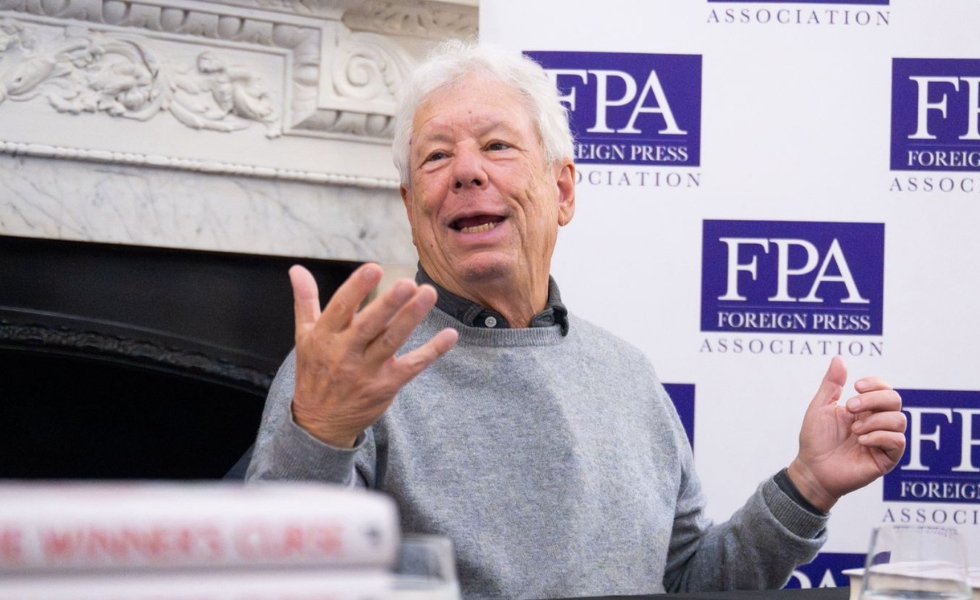
These are the words of American economist Richard Thaler, winner of the Nobel Prize in Economics in 2017. He received this award primarily for his work in the field of behavioural economics, a branch of economic science that questions the assumption that all people act rationally and are constantly seeking to maximise utility and money.
He recently explained his findings on the current state of affairs in the world to a group of foreign correspondents in London. The occasion was the publication of a new edition of his book The Winner's Curse, which brought him fame in 1992. But it turned out to be a good opportunity to express his concerns about the lack of economic awareness among contemporary politicians, particularly Donald Trump. 'It wouldn't hurt if Trump and his administration took a beginner's course in economics.'
Is Trump a good negotiator?
'It depends largely on the reactions of the people he is negotiating with. It reminds me of a cartoon I once saw in The New Yorker magazine. It shows a man selling pens. But that's not all. In one of his hands he has a whip. He also has a sign next to him with the word 'Irrational”.
This is similar to the situation countries face when negotiating with Trump. These are not normal negotiations. You may not be interested in the salesman's pens, but your behaviour changes when a whip comes into play and you know that the person in question is acting irrationally. When it comes to Trump's tariffs, it is difficult to find an economist who says that they are smart. We all, or almost all, endorse economist David Ricardo's theory of comparative advantage. It is better not to grow cocoa in Europe. Focus on the things where you have a comparative advantage.
Tariffs disrupt that. They create uncertainty. That is especially true if you change those tariffs on an almost daily basis. No one benefits from this unrest. There is no way you can call Trump a good negotiator. I can't make chocolate out of it. Maybe he needs to see a psychiatrist.'
Yet he seems to be getting away with it.
'Most people act according to the age-old principle that you should treat other people as you would like to be treated yourself. Trump does not adhere to this. In the book, we use a theory that says you should treat others as you would like to be treated, except when you are dealing with a villain. Leave villains to each other.
China is ruled by engineers, which means a lot of construction is taking place. The US is ruled by lawyers, who prevent anything from being built.
In his negotiations, Trump behaves towards friendly countries as if they were his enemies. These countries can respond by working together and punishing Trump, or the United States, for their behaviour. I don't know why that doesn't happen, or rather, why it doesn't happen yet. It seems inevitable to me.
In the new economic theory, the importance of the ability to impose penalties is seen as an important condition for the success of negotiations. This also applies to negotiations with the United States. Although it may not be rational for each country individually to impose reprisals, countries need to realise that it is in everyone's interest to present a united front against a country that does not play by the rules.'
How does that work with regard to an issue such as climate change, more specifically the Paris Climate Agreement?
'Trump may be seen as the most urgent problem facing the world today, but the problem of climate change is, of course, more far-reaching. There was a lot of criticism of the Paris Climate Agreement. It was said to be far too non-committal and no measures were announced against countries that do not comply with the agreements.
That criticism is, of course, justified. But the agreement was not entirely worthless. The wording chosen was that countries “promise” to take certain measures. It works better if penalties can be imposed, but making the promise is not entirely worthless. Random samples show that half of the people adhere to behaviour that leads to a socially desirable situation. When they “promise” to adhere to an agreement, this figure rises to 60%. It may not be a significant change, but it is at least something. However, penalties work better.'
Inequality in Western countries has increased in recent years. How do you view this?
'As an economist, you can imagine that you have a kind of tax screw that you can turn. When you tighten the screws, money is transferred from richer people to the less fortunate.
Theoretically, it is possible to tighten this screw so far that everyone has the same amount of money. Of course, you don't want that, because then there would be no incentive to take initiative, as there would be no reward.
Most people act according to the age-old principle that you should treat other people as you would like to be treated yourself. Trump does not adhere to this.
That is, of course, a situation we are not currently facing. On the one hand, we will soon have “trillionaires”, while there is a great deal of poverty. The problem is that these trillionaires wield a great deal of power.
In a democracy, and it is questionable whether we can still speak of that in the US, there are limited opportunities to tighten the screws. We now have a socialist mayor in New York, but he will soon discover that he is unable to tighten the screws.
Xi Jinping has more opportunities to exert influence than most leaders in other countries. In the US, the Supreme Court is currently engaged in a discussion about the limits of presidential power. We will have to wait and see what the outcome of that is.'
If you had that lever at your disposal, how far would you tighten it?
'I would tighten it, but I really wouldn't know by how much. There is currently talk of a ‘wealth tax’, a capital gains tax. However, that is easier said than done. Donald Trump has dismissed half of the tax inspectors from the US Internal Revenue Service. There are simply no people available to determine the value of the jewellery, art and yachts owned by wealthy Americans.
Determining the value of these types of goods is difficult anyway. After all, it is virtually impossible to find a price for something that is not traded on a large scale. I think that if something like a wealth tax is ever chosen, the number of listed companies will decrease significantly. OpenAI is preparing for an initial public offering. The likelihood of such an IPO will be 0% if a wealth tax is introduced, and many other companies will be delisted.'
If you could implement changes, what would change?
'There is an abundance of regulations that I would eliminate. About fifteen years ago, I co-authored the book Nudge with Cass Sustein, in which Nudge stands for ways in which things can be made easier. The opposite is Sludge, which makes things more difficult.
Countries need to realise that it is in everyone's interest to take a united stand against a country that does not play by the rules.
This applies to many regulations. California needs a high-speed network. The entire project is being made impossible by regulations. As things stand now, in ten years' time there will be an extremely expensive train between two cities where hardly anyone lives.
The list of absurd examples is endless. A friend of mine has a house in the mountains around Tahoe in California. He wanted to sell it and had to provide a statement that there were no pests (termites) present. There are no termites at an altitude of a few kilometres. The inspector who came by had been doing this work in the region for thirty years. Of course, he had never encountered termites.
Instead of standard inspections, you could opt for a system where you inspect one in a hundred houses. If the rules are not complied with, you impose a heavy fine. Then you can scrap 99% of the inspections. It would make it much easier to build houses, one of the major challenges in most countries.'
Should we copy China, where there seem to be few obstacles?
'It is said that China is ruled by engineers, which is why so much is being built. The United States, on the other hand, is ruled by lawyers, who are good at preventing anything from being built.
Of course, on the other hand, China pays little attention to human rights, whether it concerns the one-child policy or the total lockdown during the Covid epidemic. I remember the shock I felt years ago when I was on holiday with my wife and we came to the area where the Three Gorges Dam was to be built on the Yangtze River. In the hills, there was a line showing how high the water would rise when the dam was completed. Millions of people lived below that line and were told they had to move.
What I mean to say is that there is a lot wrong with democracy, but it is still the best political system there is. We are waiting for the politician, or the political party, who is capable of realising things like new construction and the building of high-speed trains and who is popular at the same time.'
|
Richard Thaler Richard Thaler (1945) studied Economics at the University of Rochester, where he obtained his PhD in 1974. Together with his colleagues Daniel Kahneman and Amos Tversky, he is considered the founder of Behavioural Economics, a branch of economic science that assumes that people are not rational thinking computers. In 2017, Thaler was awarded the Nobel Prize in Economics. His most important books are A Winner's Curse (1992, a rewritten new edition was published this year), Nudge (2008, with Cass Sustein), and Misbehaving (2015). |
Attachments
Share this post!
Related posts
-
 Read more about "Allianz Trade: Ondanks wereldwijde onrust verbetert risico-score van veel landen"
Allianz Trade: Ondanks wereldwijde onrust verbetert risico-score van veel landen
-
 Read more about "InvestorsObserver: How Europe’s economic leverage forced Trump’s Greenland tariff retreat"
InvestorsObserver: How Europe’s economic leverage forced Trump’s Greenland tariff retreat
-
Read more about "BLI: Wereldeconomie handhaaft matige groei in 2025 ondanks tarieven"
BLI: Wereldeconomie handhaaft matige groei in 2025 ondanks tarieven
-
 Read more about "Ko Colijn: Between European autonomy and dependence on the US"
Ko Colijn: Between European autonomy and dependence on the US
-
 Read more about "LFDE: Een uppercut van de opperrechters?"
LFDE: Een uppercut van de opperrechters?
-
 Read more about "Columbia Threadneedle: Herstel olieaanvoer brengt dieselprijs niet omlaag"
Columbia Threadneedle: Herstel olieaanvoer brengt dieselprijs niet omlaag
-
Read more about "BLI: Wereldeconomie houdt stand ondanks druk op energie- en rentemarkt"
BLI: Wereldeconomie houdt stand ondanks druk op energie- en rentemarkt
-
 Read more about "RBC BlueBay AM: Opkomende markten tonen opvallende veerkracht"
RBC BlueBay AM: Opkomende markten tonen opvallende veerkracht
-
 Read more about "DNB: Wat betekenen geopolitieke spanningen voor inflatie?"
DNB: Wat betekenen geopolitieke spanningen voor inflatie?
-
 Read more about "AllianzGI: China blijft veerkrachtig en biedt kansen voor beleggers"
AllianzGI: China blijft veerkrachtig en biedt kansen voor beleggers