Panel discussion: 'How do impact investing and the climate transition relate to each other?'
Panel discussion: 'How do impact investing and the climate transition relate to each other?'
This report was originally written in Dutch. This is an English translation.
During the first of two panel discussions at Financial Investigator's pension seminar 'From Impact Investing to a Climate-Neutral and Circular Economy', experts shared their views on the role of impact in investment portfolios, the balance between return and risk, and the importance of long-term thinking. The discussion made it clear that impact investing takes many forms and that clear goals are more important than the label.
By Baart Koster
|
CHAIR Alfred Kool, Non-Executive Board Member, ABP PARTICIPANTS Leticia Ferreras Astorqui, Lead Portfolio Manager, Development Finance & Impact Credit, Allianz Global Investors Mies Ligtenberg, Responsible Investments, Impact Lead, a.s.r. asset management Jeroen van der Put, Director, Advisor, various pension funds |
How do impact investing and the transition to a climate-neutral and circular economy relate to each other within investment policy? That is the central question in the discussion taking place during the seminar for pension fund directors at the a.s.r. headquarters in Utrecht.
The discussion begins with the question of whether impact investing should be embedded in existing strategies or treated as a separate asset class. Independent pension fund director and advisor Jeroen van der Put opts for a pragmatic approach. ‘Start with existing investment categories,’ he says. ‘Then draw up an impact policy in which you look at which categories can have the most impact. Private equity offers the most opportunities. Infrastructure allows you to respond to the energy transition and real estate to social housing for the elderly. Impact is less possible with liquid investments,' says Van der Put, referring to the lack of direct social impact with listed investments.
Leticia Ferreras Astorqui, Lead Portfolio Manager, Development Finance & Impact Credit at Allianz Global Investors, agrees, but emphasises that clear definitions are crucial. ‘It depends very much on how you define impact. There is still a need for standardisation. You can create impact in both public and private markets, but not every investment is an impact investment. If we call everything impact, the concept becomes diluted.’ According to her, a robust definition of impact investing means that only part of the portfolio can actually be classified as impact. However, this does not alter the fact that ESG and sustainability criteria can be applied more broadly to other investment instruments, says Ferreras Astorqui
With an eye for more difficult investment themes
Mies Ligtenberg, Responsible Investments and Impact Lead at a.s.r. asset management, adds that her organisation uses a clear structure within its responsible investment policy. ‘We combine reducing negative impact with creating positive impact. A concrete impact goal can help to focus investment strategies and strengthen ambition,’ she says. ‘It also encourages investment in more difficult themes such as biodiversity, rather than just the more tangible climate domain.’
Impact measurements should challenge us to make better decisions, not to present impressive but unrealistic figures.
Chair Alfred Kool brings up the relationship between impact investing and risk management. According to Ferreras Astorqui, the difference lies mainly in the intention. ‘For me, ESG is mainly about limiting risks through thorough due diligence and developing, implementing and monitoring action plans to prevent serious damage to people and the environment. Impact investing, on the other hand, is about actively achieving a measurable positive effect,’ she explains.
Ligtenberg agrees: ‘You have to set clear goals. These can be both qualitative and quantitative. That helps in selecting investments and measuring results. Only then can you know whether an investment really contributes to what you want to achieve.’
Van der Put notes that impact investing does not necessarily reduce risk. ‘You quickly take more risk for additionality,’ he says. ‘In an agricultural fund focused on environmental innovation, we have set up project locations worldwide with ESG plans. That was challenging, but necessary to prevent greenwashing and deliver real added value.’
Impact investing is not philanthropy
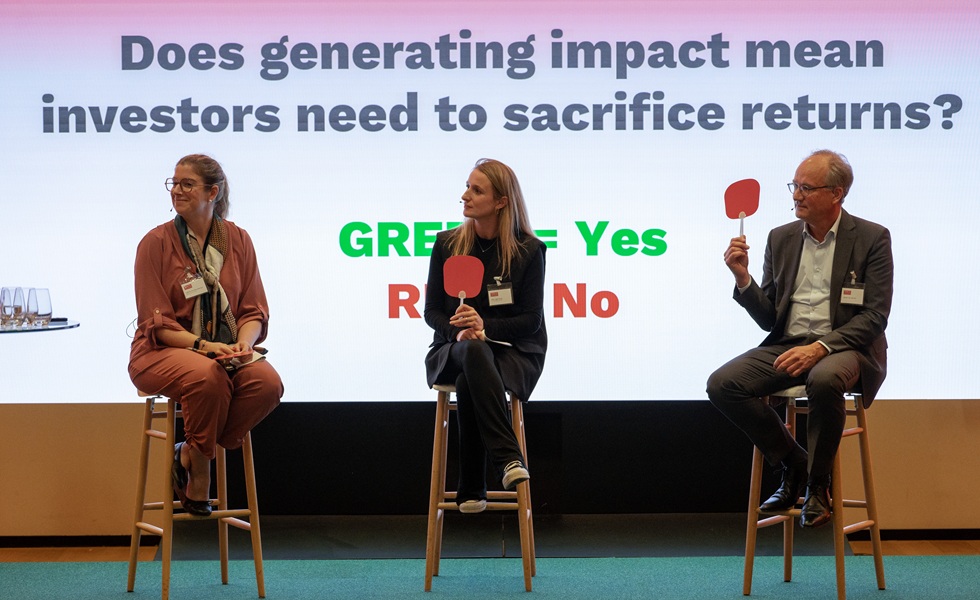
The question of whether impact investing yields lower returns causes the most commotion in the room. Kool asks the audience to show their colours, and the majority raise a red card: no, impact should not come at the expense of returns.
One participant in the audience nuances that position: ‘Impact requires extra due diligence and reporting. That costs money. But you can't claim impact without measuring and reporting.’
Ferreras Astorqui responds: ‘Some impact investments, for example in conflict areas or vaccination programmes, are by definition not intended for commercial investors. They usually yield lower or even no financial returns. But those are not the projects we are talking about when we discuss impact investing with private parties.
The idea that impact always means lower returns is incorrect. Impact investing is not philanthropy. It is about investments that create social or environmental value and are financially sustainable.’
Investments always have an impact, whether consciously or unconsciously. It is therefore necessary to steer consciously with a clear impact policy.
Ligtenberg then points out that measuring impact itself also has its limitations. ‘Measuring climate impact will never be 100% accurate, and we have to accept that. The goal is not perfect figures, but financing solutions that accelerate the energy transition. Nevertheless, measurability remains important in impact investments.
Current climate impact figures are often inflated, and traditional CO₂ calculations do not provide a complete picture of the impact potential. Avoided emissions seem attractive, but are based on many assumptions and scenarios that rarely reflect reality. This leads to overestimation and sometimes even double counting. Transparency is therefore crucial: clearly indicate whether the impact is potential or realised, whether the figures are cumulative or annual, and use pro-rata data where possible. Impact measurements should challenge us to make better decisions, not to present impressive but unrealistic figures.
This call for realism ties in with another dimension of the debate: it is not only the measurement of impact that counts, but also how investors and participants value that impact. Van der Put refers to his experience with pension funds. ‘Surveys among participants show that about a third believe that impact is important, even if it comes at a cost. A third want impact, but without a loss of return. And of the rest, half are against and the other half don't know. That distribution says a lot about the support and complexity of this debate,’ he says.
Van der Put adds that sustainability has become a megatrend. ‘Whether you like it or not, it influences the economy. This offers opportunities to make profitable investments that also have an impact. It does not have to be at the expense of returns.’
Gap between short and long term
One of the seminar participants in the room believes that discussions on the subject are often too short-sighted. ‘We also need to talk about the long term. The market is still not pricing climate risks sufficiently,’ he says.
Impact investing is not philanthropy. It is about investments that create social or ecological value and are financially sustainable.
Kool picks up on that idea. ‘Perhaps the biggest challenge is getting pension participants on board,’ he says. ‘We don’t want to take any risks now, but together we won’t be able to foot the bill in 2050. As a board, how do you take responsibility for that gap between the short and long term?’
Ligtenberg acknowledges this dilemma. ‘A portfolio must be in line with long-term trends and offer diversification across both technologies and regions. Wind and solar are now mature markets, but we also see opportunities in battery storage, green hydrogen and circular materials. By adding new technologies in a controlled manner, you can balance returns and impact.’
Ferreras Astorqui adds that practical experience in emerging markets provides valuable lessons. ‘There, we see that thorough ESG and impact analyses actually lead to better performance. In some cases, that costs money, but it pays off. Looking back at the data from the past 25 years, you can see that investments with a strong sustainability analysis perform better. That helps investors look ahead: what was true then will probably also be true for the coming decades.’
Van der Put adds: ‘Investments always have an impact, whether consciously or unconsciously. Investors have long been free riders, but are increasingly having to take responsibility for their impact. Conscious management with a clear impact policy is therefore necessary. This also offers opportunities to involve participants more in their pension fund.’
Don't get bogged down in checklists
Finally, Van der Put makes a reflective comment. ‘Sustainable investment mechanisms are still in their infancy,’ he says. ‘We need to be modest about the extent of the impact and not get bogged down in administration and checklists, but instead focus on environmental storytelling: explaining why it matters. Younger generations in particular are sensitive to this. Improve the world and start with yourself. Ignite the fire with the motto: yes, it is possible.’
Kool agrees. ‘The key lies in conversation. By talking about it, you make it clear that impact investing is not just about figures, but about future value – about a world in which you want to live.’
This does not conclude the discussion, but rather opens it up: impact investing is not a niche or a buzzword, but a way of thinking that is gradually changing the investment world.
|
SUMMARY Impact investing requires clear definitions and sharp choices. Not every investment has an impact. Private markets offer the most opportunities. In liquid markets, the direct impact is more limited. Intention distinguishes ESG (risk reduction) from impact (achieving a positive effect). Impact requires measurability, but figures are often inaccurate. Transparency is crucial. Return and impact can go hand in hand: impact investing is not philanthropy. A long-term vision, realism and clear communication are essential for support and success. |
Attachments
Share this post!
Related posts
-
 Read more about "Webinar 'Impact & Green Bonds'"
Webinar 'Impact & Green Bonds'
-
 Read more about "EDHEC: Can climate equity investors cope with oil price volatility?"
EDHEC: Can climate equity investors cope with oil price volatility?
-
 Read more about "Rick van der Ploeg: Climate transition still being undermined by misguided incentives"
Rick van der Ploeg: Climate transition still being undermined by misguided incentives
-
 Read more about "Bain & Company: Klimaatdoelen buiten bereik door stijgende energievraag"
Bain & Company: Klimaatdoelen buiten bereik door stijgende energievraag
-
 Read more about "Guido Veul (AF Advisors): Fewer options for PAB investors"
Guido Veul (AF Advisors): Fewer options for PAB investors
-
 Read more about "San Lie: Where do you fit into the innovation curve that is making Europe autonomous?"
San Lie: Where do you fit into the innovation curve that is making Europe autonomous?
-
 Read more about "GRI: Closer connections for better climate disclosure"
GRI: Closer connections for better climate disclosure
-
 Read more about "Schroders: Amerikaanse energietransitie groeit door ondanks weerstand overheid"
Schroders: Amerikaanse energietransitie groeit door ondanks weerstand overheid
-
 Read more about "Roundtable 'Impact Investing in Private Equity'"
Roundtable 'Impact Investing in Private Equity'
-
 Read more about "Schroders: Europa’s zoektocht naar eigen energie biedt kansen voor biomethaan"
Schroders: Europa’s zoektocht naar eigen energie biedt kansen voor biomethaan