
Panel discussion 'How to position your portfolio for 2026 and beyond'
Panel discussion 'How to position your portfolio for 2026 and beyond'
This report was originally written in Dutch. This is an English translation.
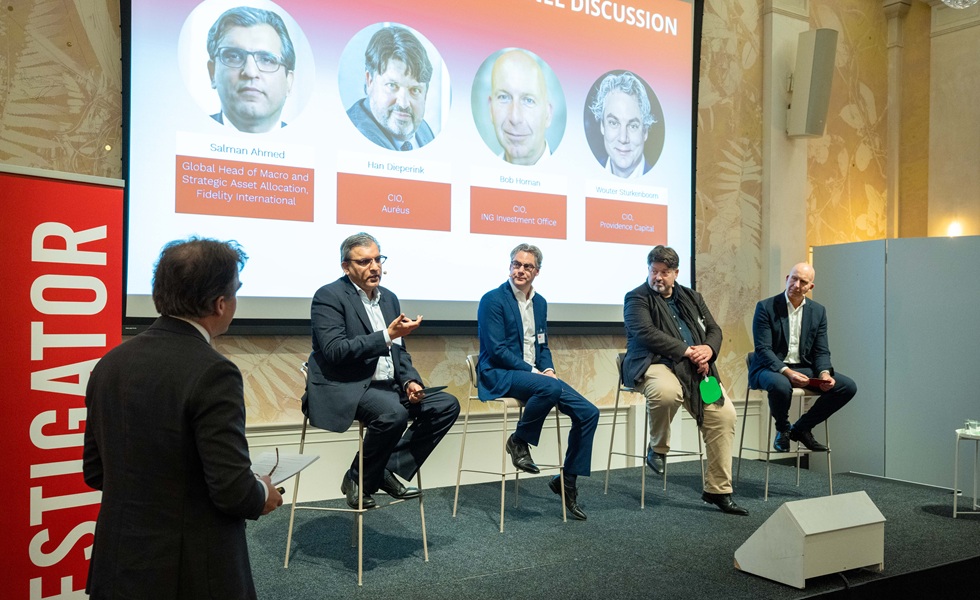
The investment outlook for 2026 appears favourable, but the CIO panel at Financial Investigator's Outlook seminar warns that significant risks lurk beneath the AI-driven rally. High valuations, synchronised markets and geopolitical tensions make sentiment vulnerable. The debate is therefore shifting from opportunities to the question: how do you protect portfolios in 2026?
By Michiel Pekelharing
|
CHAIR Olaf van den Heuvel, CIO, Achmea Investment Management PARTICIPANTS Salman Ahmed, Global Head of Macro and Strategic Asset Allocation, Fidelity International Han Dieperink, CIO, Auréus Bob Homan, CIO, ING Investment Office Wouter Sturkenboom, CIO, Providence Capital |
For investors, 2025 is shaping up to be a good year, with solid equity and bond returns on both sides of the Atlantic. In the run-up to the new year, moderator Olaf van den Heuvel chooses to focus on the risks rather than the opportunities. In this regard, the rally in shares linked to artificial intelligence quickly attracts attention.
Salman Ahmed warns that the basis for the AI boom is more fragile than one might think. In his view, the enormous investments in infrastructure and technology are currently driving growth and market sentiment. But that also makes the market more dependent on a single narrative. ‘The causality has changed,’ says Ahmed. ‘Previously, macroeconomics drove the markets, but now the markets drive macroeconomics. If the AI story falters, it will have macroeconomic implications.’
Wouter Sturkenboom agrees. He emphasises that valuations have now risen across the board. Credit spreads are very tight, equity valuations are high, and virtually every risk category has had the wind in its sails. In this climate, there is little room for disappointment. ‘Whether it's AI, inflation or growth, it doesn't take much to tip sentiment.’
Han Dieperink adds that risks often do not come from where everyone expects them to. ‘It is usually the snake you don't see that bites you.’ He sees a boom-bust scenario as a real possibility when growth is too rapid. An overheated market can turn abruptly. Bob Homan points to another vulnerability: ‘Earnings are lagging behind the euphoria. In Europe, there was virtually no earnings growth in 2025. This has been pushed back to next year, while share prices have rebounded. The market is now expecting earnings growth of more than 10%. That could easily disappoint.’
The saying goes that you should repair the roof while the sun is shining. Diversification is the best way to repair the roof, and the sun is shining brightly right now.
Diversification or 'all-in' on artificial intelligence
When Van den Heuvel asked whether 2026 calls for concentrated positions or broad diversification, the panel split into two camps. Dieperink argues that bull markets rarely change leaders: ‘The big technology companies are the winners of this cycle. They are likely to remain the winners until the end of this bull market.’ According to Homan, active management requires concentration: ‘You have to dare to bet on the winners. We remain overweight in six of the seven Magnificent names – everything except Tesla. There will certainly be a turnaround, but not for the time being.’ Sturkenboom takes the opposite view. For him, diversification is essential right now: ‘The tech bubble hasn't burst, but it will happen next year or in 2027. The saying goes that you should repair the roof while the sun is shining. Diversification is the best way to repair the roof, and the sun is shining brightly right now.’
Ahmed qualifies this by saying that diversification did not help in 2025: ‘Emerging market bonds, equities and corporate bonds all rose at the same time. It is better to have a broad source of returns than a single pipeline, but it remains a challenge when markets move so synchronously.’
Due to the heavy weighting of US equities in the global index, considerable attention is being paid to the impact of the dollar on investment returns. In this respect, there is a striking amount of agreement. Homan expects a steady weakening towards a dollar of 1.25 euros. ‘Nominal growth in the United States is somewhat higher. But the budget deficit is shrinking, so the enormous capital inflows that have supported the dollar for years will decline.’ In his view, investors should not hedge currency risk: ‘That costs you 2% of your return every year.’
Profits are lagging behind the euphoria. In Europe, there was virtually no profit growth in 2025. This has been postponed until next year, while share prices have rebounded.
Ahmed believes that the dollar has entered a multi-year downward trend. But he emphasises that this does not mean that the financial world will soon find an alternative to the role played by the American currency: ‘No other currency has an open capital account, sufficient depth in the financial markets, and the institutional infrastructure to support the global trade and financial system. There will be no replacement for the dollar. And certainly not any time soon.“ Ahmed does point to a structural shift, however. ‘In Asia, central banks are buying gold en masse as protection against possible US sanctions. So it's not just about returns or diversification, but about geopolitical risk management.’
Dieperink adds that in times of stress, the dollar remains the ultimate safe haven: ‘At the end of last year, everyone was extremely positive about the dollar. Optimism was dangerously high. But in crises, it remains the reserve currency.’
Gold and the strategic asset mix
Van den Heuvel seizes on the discussion to ask whether gold deserves a place in strategic asset allocation. The green signs go up en masse in the room, but the panel is deeply divided. Sturkenboom is critical: ‘Gold does not have a fixed income stream, such as dividends or interest. You incur storage costs and, moreover, it takes the place in the portfolio of investments that do offer a fixed income stream. In addition, the price of gold is largely determined by the degree of confidence in the financial world. So if you see gold as part of your strategic asset allocation, you are structurally investing in the loss of confidence. Based on its underlying characteristics and from an investment perspective, I ignore gold.’
Dieperink even calls gold a ‘greater fool asset’, comparable to bitcoin: ‘You have to sell it to someone who is willing to pay more than the price you bought it for. You're better off investing in industrial and energy transition metals, which are backed by real economic demand.’
Previously, macroeconomics drove the markets, but now the markets drive macroeconomics. If the AI story falters, it will become macroeconomically relevant.
Ahmed, however, has a completely different view: ‘In Asia, mistrust of the West is so great that central banks continue to expand their gold reserves. It will get worse before it gets better. There is still no solution in sight for the war in Ukraine, and I am anticipating a trade war between Europe and China. I am also concerned about the large discrepancy between optimism in the business community and the rapidly increasing trade and geopolitical risks. In this climate, gold is a necessary hedge.’
Homan takes a very long-term view in this regard: ‘Over the past 200 years, gold has yielded little more than inflation. The past 25 years are the exception in this respect. If you assume mean reversion, the coming decades will be less favourable for gold.’
Emerging markets and private markets
Both the audience and the CIOs are enthusiastic about emerging markets. ‘Valuations are low, economic growth is attractive, and these countries also have a lot to offer in terms of artificial intelligence and technology,’ Homan summarises.
Ahmed emphasises that emerging markets play a key role in the geopolitical realignment of the world: ‘If the US, China and Europe want to secure their strategic supply chains, emerging markets will become indispensable links.’
Sturkenboom is very positive about frontier markets such as Vietnam: ‘It's a stock picker's paradise. Unlike China, for example, frontier markets are less affected by rising geopolitical tensions, and as an active investor, you can really make a difference if you do your homework properly. In our global equity portfolio, frontier markets account for 5%, just like emerging markets.’
Demand for copper, nickel and other critical materials will increase structurally. Mining companies and smart grid builders could be the winners in this movement.
The CIO panel is also positive about the prospects for private markets. Homan emphasises that private credit in particular is a very broad concept: ‘On the one hand, you have structures with a profile similar to that of government bonds, while another part of the market is characterised by high returns and high leverage. I prefer to take a position in the more conservative segment. From a diversification perspective, private equity fits perfectly into a portfolio. But with the emergence of all kinds of new structures such as evergreens, I wonder whether returns will continue to be higher than those on the stock market in the future.’
Dieperink: ‘Returns on private markets vary much more widely than in the listed segment. Implementation, good manager selection and cost control are the major challenges.’
Sturkenboom puts private assets into perspective: ‘Globally, only 4% of all assets are listed on the stock market. The rest are private. From that perspective, you can’t ignore private markets.’ Selectivity is the key word here, as Ahmed also emphasises: ‘Central banks are concerned about private credit. Not because it creates systemic risks as it did in 2008, but because no one knows exactly what is happening in that market. Valuations are opaque and there are indications that similar loans are marked very differently by different parties. Within private markets, we therefore prefer to look at real estate, which benefits from lower interest rates and more attractive valuations.’
Strikingly, climate change, and especially its financial consequences, are hardly discussed until a question from the audience brings up the subject. Dieperink sees the energy transition primarily as a metal transition: ‘The demand for copper, nickel and other critical materials will increase structurally. Mining companies and smart grid builders could be the winners in this movement.’
Ahmed emphasises that climate risks are not uniform. Some countries – such as India – are extremely vulnerable to climate change, while China is a dominant supplier of solutions, such as batteries, solar energy and electric cars.
Sturkenboom sees the greatest impact in infrastructure portfolios, where physical assets are directly exposed to extreme weather conditions. The panel agrees that climate is becoming a structural, financially relevant theme, but it still receives too little attention in daily market analysis.
|
SUMMARY The AI rally will drive growth in 2026, but will also lead to dependence on a single dominant narrative. CIOs differ in their opinions about 2026: some advocate concentrated tech positions, others broad diversification. The dollar may weaken, but will retain its role as a reserve currency. Emerging markets, frontier markets and private markets offer opportunities, provided investors are highly selective. |
Attachments
Share this post!
Related posts
-
 Read more about "Federated Hermes: Weekly Markets Wrap Up 22 October 2026"
Federated Hermes: Weekly Markets Wrap Up 22 October 2026
-
 Read more about "Federated Hermes: Weekly Markets Wrap Up 15 October 2026"
Federated Hermes: Weekly Markets Wrap Up 15 October 2026
-
 Read more about "Federated Hermes: Weekly Markets Wrap Up 8 October 2026"
Federated Hermes: Weekly Markets Wrap Up 8 October 2026
-
 Read more about "PIMCO: Growth holds, risks widen"
PIMCO: Growth holds, risks widen
-
 Read more about "Federated Hermes: Weekly Markets Wrap Up 1 October 2026"
Federated Hermes: Weekly Markets Wrap Up 1 October 2026
-
 Read more about "AllianzGI: Nieuw elan ondersteunt risicovolle beleggingen"
AllianzGI: Nieuw elan ondersteunt risicovolle beleggingen
-
 Read more about "Crédit Mutuel AM: Is September 2026 another difficult month for markets?"
Crédit Mutuel AM: Is September 2026 another difficult month for markets?
-
Read more about "Federated Hermes: Weekly Markets Wrap Up 3 September 2026"
Federated Hermes: Weekly Markets Wrap Up 3 September 2026
-
 Read more about "MFS: Vooruitzichten EMD zijn goed, ondanks lastig jaar"
MFS: Vooruitzichten EMD zijn goed, ondanks lastig jaar
-
 Read more about "Federated Hermes: Weekly markets wrap up 13 August 2026"
Federated Hermes: Weekly markets wrap up 13 August 2026