
Outlook 2026: Conclusion
Outlook 2026: Conclusion

This special was originally written in Dutch. This is an English translation.
2026 is shaping up to be a complex and multi-layered year, in which economic opportunities and geopolitical risks are closely intertwined. What is particularly striking about the Outlook contributions is that investment experts are remarkably unanimous on a number of key points, while their emphases in other areas diverge.
There is broad consensus on structural developments: the world is moving towards a fragmented geo-economic system. The rivalry between the US and China is deepening, trade flows and capital markets are becoming more politicised, and Europe is seeking its position between these power blocs, with higher defence spending and more focus on strategic autonomy. This trend is endorsed by virtually everyone, although the degree of urgency pointed out by experts varies.
Most expectations for economic growth in 2026 are also moderate, although it is emphasised that the economy is resilient. The US economy is benefiting from AI-driven productivity gains and fiscal support, although experts differ in their assessment of how strong that effect will actually be. Europe is growing more slowly and unevenly: some analysts are optimistic about investments in defence, energy and infrastructure, while others point to structural weaknesses, such as high energy costs. China is showing a reasonably stable growth path of around 4.5%.
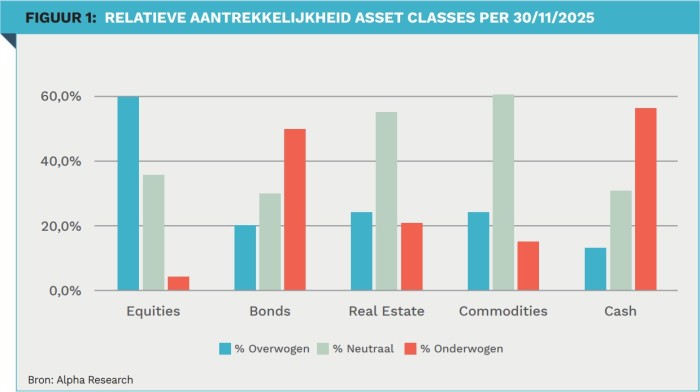
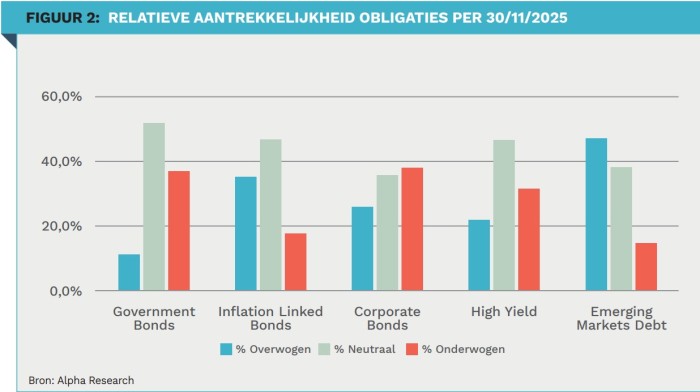
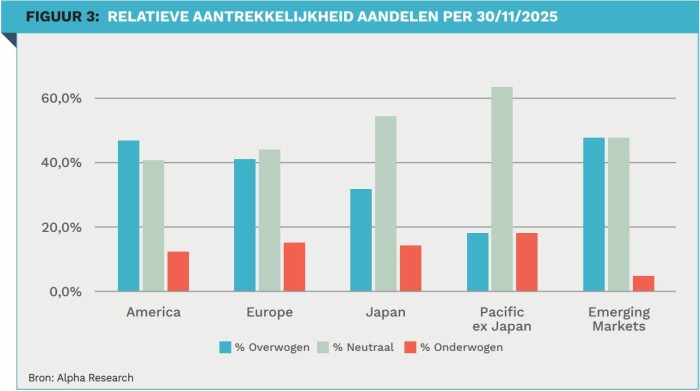
Where opinions differ more strongly is on investment strategy. Some experts remain positive about equities thanks to solid earnings growth and structural AI investments, while others are more cautious due to high valuations, especially in the US. However, there is agreement that emerging markets are attractively valued and offer valuable diversification. In the bond market, most experts again see room for stability, but only limited scope for further price gains. Private assets – especially private credit and real assets – are widely seen as structural building blocks in portfolios.
Opportunities lie in:
- AI and technology: structural demand for automation and productivity growth.
- Emerging markets: more attractively priced and benefiting from lower US interest rates.
- Sustainability: climate solutions, energy transition and green financing.
- Private debt and real assets: illiquid premiums, stability and protection against inflation.
Threats include:
- Geopolitical fragmentation and trade wars.
- Rising government debt and budget deficits.
- A possible correction in AI-related equities.
- Liquidity risks in the event of sudden market shocks.
On balance, a clear picture emerges: 2026 offers opportunities for investors who respond to technological innovation, sustainability and selective geographical diversification, but at the same time requires vigilance with regard to structural risks. The new return regime requires flexibility, discipline and long-term thinking in a world that is increasingly moving towards multipolarity.
Attachments
Share this post!
Related posts
-
 Read more about "Federated Hermes: Weekly Markets Wrap Up 22 October 2026"
Federated Hermes: Weekly Markets Wrap Up 22 October 2026
-
 Read more about "Federated Hermes: Weekly Markets Wrap Up 15 October 2026"
Federated Hermes: Weekly Markets Wrap Up 15 October 2026
-
 Read more about "Federated Hermes: Weekly Markets Wrap Up 8 October 2026"
Federated Hermes: Weekly Markets Wrap Up 8 October 2026
-
 Read more about "PIMCO: Growth holds, risks widen"
PIMCO: Growth holds, risks widen
-
 Read more about "Federated Hermes: Weekly Markets Wrap Up 1 October 2026"
Federated Hermes: Weekly Markets Wrap Up 1 October 2026
-
 Read more about "AllianzGI: Nieuw elan ondersteunt risicovolle beleggingen"
AllianzGI: Nieuw elan ondersteunt risicovolle beleggingen
-
 Read more about "Crédit Mutuel AM: Is September 2026 another difficult month for markets?"
Crédit Mutuel AM: Is September 2026 another difficult month for markets?
-
Read more about "Federated Hermes: Weekly Markets Wrap Up 3 September 2026"
Federated Hermes: Weekly Markets Wrap Up 3 September 2026
-
 Read more about "MFS: Vooruitzichten EMD zijn goed, ondanks lastig jaar"
MFS: Vooruitzichten EMD zijn goed, ondanks lastig jaar
-
 Read more about "Federated Hermes: Weekly markets wrap up 13 August 2026"
Federated Hermes: Weekly markets wrap up 13 August 2026