
PGIM: CLOs, an underrated asset class
PGIM: CLOs, an underrated asset class

This interview was originally written in Dutch. This is an English translation.
Collateralised loan obligations are back in the spotlight. Following the financial crisis, their robust structure has proven capable of offering investors stability and attractive returns, even in volatile markets. In this interview, we speak with Loren Sageser of PGIM about how these structured products work, why they are relatively attractive and what opportunities currently exist.
By Harry Geels
Could you briefly explain what CLOs are?
'CLOs, or Collateralised Loan Obligations, are securitised portfolios of broadly syndicated loans: loans to companies with a credit rating below investment grade. A typical CLO portfolio contains approximately 150 to 250 individual loans. The idea is that a manager, such as ourselves, actively manages the portfolio. CLOs are usually structured as closed-end funds with a reinvestment or active investment period of three to five years, followed by a multi-year repayment phase. For example, an asset manager may work with an investment bank such as Goldman Sachs or JP Morgan to raise capital from investors for the various CLO tranches: AAA, AA, A, BBB, BB and an equity tranche. Once this capital has been raised, it is used to purchase a portfolio of, for example, €400 million. The interest income from the loans is then distributed to investors on a quarterly basis, in order of seniority of the tranche.
There are three main reasons for adding AAA CLOs to a portfolio. Firstly, they offer a relatively attractive return. More specifically, CLOs deliver a higher yield than comparable corporate bonds. Secondly, they show a low correlation with traditional bond categories. The correlation with the Global Aggregate Bond Index has been only 0.26 since 2011, and the correlation with US government bonds is even slightly negative. The drawdown statistics are also favourable: during the COVID-19 crisis, CLOs fell by only around 5%, while other bond categories, including Global Treasuries, lost more than 20%.'
Are all CLOs the same in terms of structure?
'Most CLOs follow a traditional structure: an AAA tranche of around 60–65%, an AA tranche of around 12–13%, and the remaining tranches and equity make up the rest. Sometimes low-leverage CLOs are issued, with some junior tranches missing and a larger equity share. It is always important that the senior investor has sufficient protection before any losses occur, regardless of the total leverage. By ‘sufficient protection’, I mean that the senior tranche must have enough credit protection through subordination, overcollateralisation and excess spread. Total leverage in itself does not determine the risk, as long as the structure is robust. Ultimately, it is about how much loss is first absorbed by the mezzanine and equity tranches before investors in the most senior (AAA and AA) tranches are affected. If that buffer is large enough, the credit profile of the senior tranche remains strong, even in environments with higher leverage.'
Why do CLOs have multiple tranches with different ratings?
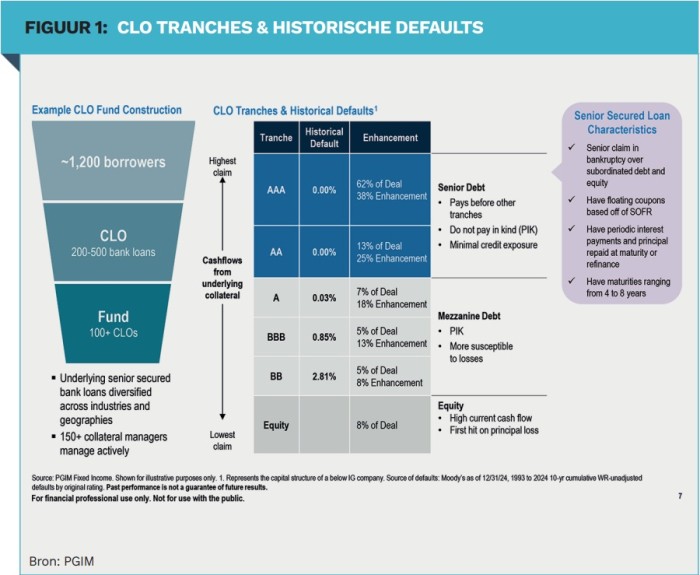
'The aim is to spread risk: to protect the senior loans while generating returns through the lower-rated tranches. AAA investors are at the top and run the least risk of loss. Any losses are first absorbed by lower tranches, such as BB or equity. In combination with a special purpose vehicle (SPV), this structure protects investors and ensures that they are not considered direct creditors of individual companies. As shown in Figure 1, the structure illustrates both the hierarchy (seniority) and the credit protection: higher tranches are protected by multiple subordinate tranches below them. For a €400 million portfolio, the AAA tranche typically represents around €240 million, or approximately 62% of the total. Losses first affect the lower tranches before the AAA investor suffers any loss. The historical default risk for AAA and AA tranches is negligible, and even for lower tranches the risk remains limited.'
What about the spreads?
'All CLOs have a floating rate, which means that the coupons consist of a base rate plus a spread. For AAA tranches, the spread is currently around 130 basis points above the base rate. As you move lower in the capital structure, the spreads increase: AA around 180 bps, A around 210 bps, and the equity tranche typically targets returns of just over 10% or even towards 15%. The yield-to-worst of a global AAA CLO portfolio is now around 5.6%, which is better than the 3.6% of the Global Aggregate benchmark and only 100 basis points below high yield, while the credit quality is much higher. It is striking that AAA-CLOs now offer higher yields than US government bonds, which no longer have a triple-A rating.'
CLOs had a bad reputation during the financial crisis. How have they changed since then?
'Before the Great Financial Crisis (GFC), structured products were often complex and poorly diversified, and were backed by subprime mortgages. CLOs, on the other hand, have maintained a consistent track record since the late 1990s. Their strengths are diversification, strict credit assessment and the so-called self-healing mechanism. This means that CLO portfolios are actively managed: maturing or underperforming loans can be replaced with new, higher-quality loans. This dynamic reinvestment process enables CLOs – unlike the static CDOs of the past – to recover after periods of stress. During the GFC, AAA and AA tranches remained loss-free, while only the lower tranches experienced significant market volatility.'
Can you tell us a little more about the self-healing mechanism?
'In addition to active management, CLOs have built-in protection mechanisms. If losses exceed certain thresholds, payments to equity investors are suspended and the interest received is used to repay senior tranches or reinvest in new loans. This deleverage-and-reinvest mechanism stabilises the structure, even in stress situations such as in March 2020 during the pandemic.'
Why do CLOs offer higher spreads than public corporate bonds?
'There are three main reasons for this. First, since the financial crisis, investors have remained cautious about structured products. Despite the strong track record of CLOs since the 1990s, a certain stigma remains. The perception-driven risk premium translates into higher spreads than the actual credit risk warrants.
Secondly, there is a structural market imbalance. The supply of high-quality investment-grade corporate bonds is smaller than the current high demand. In contrast, B and BB loans – the building blocks of CLOs – can be quickly and efficiently packaged into CLOs that meet the demand for high-quality debt instruments. This abundance allows for efficient diversification within CLOs, while the scarcity of alternatives keeps spreads high.
Thirdly, portfolio differentiation reduces idiosyncratic credit risk: the failure of a single loan has minimal impact on overall cash flows. Paradoxically, this built-in risk diversification leads to a relatively stable credit profile, but because it is more complex to model, investors demand a higher risk premium. That complexity premium is precisely what CLO investors are compensated for.'
What about liquidity and volatility?
'AAA and AA tranches generally exhibit stable prices and are considered safe havens within fixed income markets. They are well protected, typically held by long-term investors and traded less frequently. Lower tranches, such as BB, are more volatile and less liquid, as fewer investors are willing to trade them during periods of stress. An important difference from other structured products is that CLOs do not have margin calls, redemptions or forced liquidations. Managers do not have to sell when the market temporarily deteriorates. This dampens volatility and prevents chain reactions such as those seen during the financial crisis.'
Are CLOs mainly popular in the US?
'The largest part of the market is indeed in the US, with a size of approximately $1.4 trillion, while Europe is around €300 billion. Interest in European CLOs is growing, partly because the spreads there are currently more attractive. For investors, a global strategy with both US and European CLOs offers diversification and scope for opportunistic allocation.'
How important is the choice of manager?
'Crucial. Managers determine not only the selection and quality of the underlying loans, but also stability during periods of stress. A successful manager combines conservative management with sufficient returns, team continuity, experience and strict compliance with contractual tests. This influences both the performance and liquidity of the tranches.'
Are there any specific strategies that are currently preferred?
'Many investors are focusing on AAA tranches with high-quality managers and regional diversification. This limits risk while delivering additional returns compared to comparable investment grade corporate bonds. It is important to avoid excessive exposure to low-quality transactions and weaker portfolios. Careful, fundamental due diligence remains essential, especially in the current environment of tight spreads and yield chasing.'
How are current market conditions influencing strategy?
'With spreads at historically low levels, it is wise to remain conservative in senior AAA tranches. Managers assess the relative value between US and European CLOs, timing and risk/return considerations. The focus is on maintaining stability, liquidity and low volatility, while small, opportunistic shifts between regions can generate additional returns.'
Finally, what should investors remember about CLOs in their portfolios?
'CLOs combine diversification, robust risk management and attractive spreads. They are not a substitute for cash, but can serve as a core component of a well-diversified, high-quality portfolio. Historical data, self-healing mechanisms and careful selection of the manager make this asset class particularly resilient. In periods of tight spreads and uncertainty in the public markets, a senior AAA CLO offers an attractive combination of safety and return.'
|
SUMMARY CLOs contain approximately 150 to 250 individual corporate loans and typically have a similar structure with an AAA tranche of approximately 60–65%, an AA tranche of approximately 12–13%, and the remainder being lower quality tranches and equity. CLOs combine diversification, robust risk management and attractive spreads. The senior loans provide protection, while returns are generated through the lower-rated tranches. CLOs have a self-healing mechanism: expiring or underperforming loans can be replaced by new, higher-quality loans. Interest in European CLOs is growing, partly because spreads there are currently more attractive. |
|
Loren Sageser Loren Sageser is Principal and Portfolio Specialist at PGIM. He supports the Securitised Product platform and has over 25 years of experience in the industry. Before joining the firm in 2025, Sageser was Global Head of Securitised Product and Asset-Based Finance Product Strategy at Schroders Capital. Prior to that, he held senior positions at Nuveen and PIMCO. Sageser holds a BA and MA from Stanford University and an MBA from the UCLA Anderson School of Management. |
Attachments
Share this post!
Related posts
-
 Read more about "Valentijn van Nieuwenhuijzen: Is the bond market panicking, or are we?"
Valentijn van Nieuwenhuijzen: Is the bond market panicking, or are we?
-
 Read more about "Schroders: Waar gaat het mis met langlopende obligaties?"
Schroders: Waar gaat het mis met langlopende obligaties?
-
 Read more about "Aberdeen: Onvoorspelbare Fed zet obligatiebeleggers aan het werk"
Aberdeen: Onvoorspelbare Fed zet obligatiebeleggers aan het werk
-
 Read more about "Natixis IM: Obligatiemarkten nemen Washington niet op zijn woord"
Natixis IM: Obligatiemarkten nemen Washington niet op zijn woord
-
 Read more about "Allianz Trade: Verborgen AI-schuldenberg vergroot risico voor pensioengeld"
Allianz Trade: Verborgen AI-schuldenberg vergroot risico voor pensioengeld
-
 Read more about "RBC BlueBay AM: Obligatiemarkt capituleert, interessant koopmoment nabij"
RBC BlueBay AM: Obligatiemarkt capituleert, interessant koopmoment nabij
-
Read more about "Credit AM: Commentary subordinated debt"
Credit AM: Commentary subordinated debt
-
 Read more about "BlackRock: Japanse rentestijging vergroot druk op Amerikaanse staatsobligaties"
BlackRock: Japanse rentestijging vergroot druk op Amerikaanse staatsobligaties
-
Read more about "Columbia Threadneedle: Obligatiemarkt rekent op rentepauze Fed"
Columbia Threadneedle: Obligatiemarkt rekent op rentepauze Fed
-
 Read more about "MFS: Perfecte storm stuwt kapitaalmarktrentes omhoog"
MFS: Perfecte storm stuwt kapitaalmarktrentes omhoog