
Ko Colijn: Between European autonomy and dependence on the US
Ko Colijn: Between European autonomy and dependence on the US
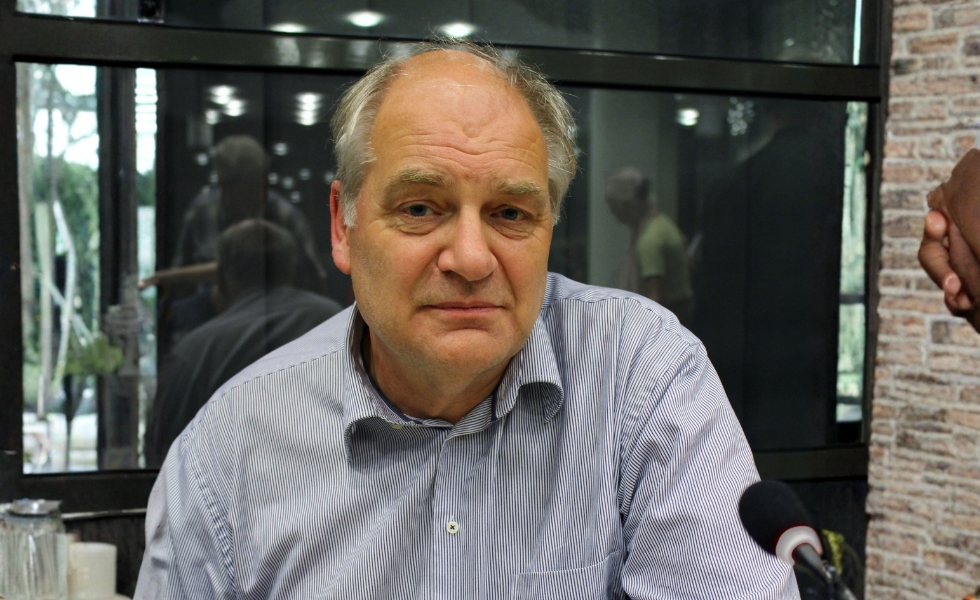
This interview was originally written in Dutch. This is an English translation.
Europe faces a crucial strategic choice: how can Europe guarantee its security without remaining completely dependent on Washington? Ko Colijn, researcher, journalist and professor, analyses the implications of recent NATO decisions, the challenges for the European defence industry, and the delicate balance between military preparedness, civil resilience and democratic legitimacy.
By Harry Geels
NATO recently adopted a proposal to reserve 5% of GDP for “security broadly defined”. In practice, this means an implicit spending commitment of approximately 3.5 to 5% of GDP per NATO member. How realistic is this and what are the risks for the Netherlands?
'The greatest danger of this policy lies in bureaucratic waste and inefficiency. Three issues immediately spring to mind. Firstly, the directive increases average price inflation in the military sector. Secondly, the persistent tendency of member states to award contracts nationally, known as 'orange” behaviour, leads to waste. Thirdly, the civilian spin-off from military technology has historically been overestimated. A structural allocation of 5% of GDP to security is therefore virtually impossible without sacrifices in other areas, such as education, healthcare or infrastructure. Without additional tax support, this will place a burden on future generations, through national debt or tax increases.'
Mark Rutte's recent manoeuvre – adding an extra 1.5% to the defence budget – was not taken seriously internationally.
'It was embarrassing and counterproductive. In the Oval Office, they laughed heartily about it. Worse still is the Dutch complacency: any doubts about the necessity of this extra budget are dismissed by virtually all political parties. NATO as a community of values is thus being sacrificed. Of course, an adequate deterrent to Putin is necessary and may cost money. But the way in which this is being done – putting national interests above efficiency, cherishing “national champions” – is outrageous. It will lead to a waste of resources and taxpayers' money. Back in the 1980s and 1990s, my colleague Paul Rusman and I investigated this waste, from State Secretary Jan van Houwelingen to the Cecchini Group and the bureaucratic painstaking work involved in large equipment projects. Decades later, hardly anything has changed for the better.'
There is a risk that national security will be used as an excuse to justify political and infrastructural projects that were already planned.
The American ambassador to NATO, Matthew Whitaker, warned in May that the extra defence spending should not become a grab bag. The “buy-in-your-own-country” behaviour of NATO member states cost taxpayers $64 billion in 2024 alone.
'The beauty of the +1.5% trick is that definitions are vague: infrastructure, secure computers, roads for tanks and lorries. Each country can interpret this creatively. For the Netherlands, this could mean almost £65 billion by 2035. Politicians can relabel existing expenditure as defence-related. Nevertheless, future cabinets face painful choices about spending cuts, increasing debt or raising taxes. European political creativity is illustrated by Italy, where a bridge to Sicily now partly falls under the heading of “security”. Bizarrely, in the Netherlands, even a revival of the Lely line, now playfully called the “Rutte line”, is acceptable as a “resilience project”.'
The European defence industry is often praised, but in reality it is fragmented and technologically lagging behind the US.
'There are fourteen large naval shipyards in Europe, where three would suffice. Concentration took place mainly commercially, not politically. Article 346 of the current EU Treaty protects nationalist reflexes: formally protectionist, but politically accepted. Initiatives such as a European Defence Commissioner or a European Defence Fund are insufficient to build a credible alternative. Member States too often choose national interests and European political will is too weak. Cooperation does exist, through Framework Nations, PESCO, the Nordic-5 and other constructions, but these are often regionally coloured, and semi-European superpowers continue to determine the initiative.'
Since Trump's presidency, Europe seems to have doubts about the American defence guarantee. Is strategic autonomy feasible?
'Rutte's complacency changes nothing: Article 5 obliges Member States to provide assistance, but this does not have to be military. The United States is likely to move more than half of its 120,000 European troops to the Pacific in the near future. The IISS calculated that if Europe replaces this on a one-to-one basis, it will cost a whopping $250 billion by 2035. Meanwhile, major European states are working on bilateral deals, such as France with Germany and the UK, with 500 nuclear weapons as a deterrent. Germany is combining NATO obligations with French cooperation and conventional long-range missiles. The Netherlands remains a spectator, while its dependence on the US is high. This is risky, because an American withdrawal would make smaller countries, such as the Netherlands, vulnerable.'
Work needs to be done on a European alternative. The Netherlands must not look away or gamble on an American president.
The debate on NATO expansion towards the east is polarised. Some see the possible expansion as the cause of Putin's aggression, others do not.
'Historian Mary Sarotte offers a masterful analysis. Until Trump's second term, NATO did everything it could to stay out of conflicts; after that, it took action, partly to temper Trump. The Baker-Gorbachev negotiations in 1990 were crucial: the commitment that NATO would not move 'one inch” eastward in exchange for German reunification. Former President George Bush Senior and the Republicans wanted to ignore that promise and expand NATO at all costs. Eastern and Central European countries then saw NATO as an indispensable safety net. And so one plus one became two: rapid expansions in 1999 and 2004 dramatically increased the distance between NATO and Russia. Sarotte concludes that a more cautious, diplomatic process could have prevented potential conflicts, but that opportunities were missed. Historical research teaches us lessons, but cannot solve the current crisis: now we must put out the fire.'
Security is not just about weapons; a resilient society is essential. But securitisation, labelling something as a security problem, can put democratic values under pressure.
'Rutte's 3.5–5% trick opens the door to chicanery, such as the aforementioned Italian Sicily bridge. The Ministry of Finance is currently identifying which existing projects could fall under this dubious heading. As mentioned, even the Lely line could be revived in this way. The risk is that national security will be used to justify political and infrastructural projects that were already planned, which would indeed put pressure on transparency and the rule of law.'
What will Europe look like in ten years' time and what role should the Netherlands play?
'Europe needs to buy time: a firm 10- to 15-year agreement with the US on the nuclear umbrella is essential. At the same time, work must be done on a European alternative. The Netherlands must not look away or gamble on an American president. Important treaties between the UK, France and Germany illustrate how European powers are pursuing autonomy. The Netherlands must join credible initiatives, such as Framework Nations and PESCO, NATO-supporting bilateral treaties between the UK, Germany and France, and actively participate in multilateral agreements. Only in this way can the country guarantee its security without remaining dependent on Washington.'
Do the drones in the airspace of NATO countries give a new dynamic to the threat of war?
'The buzzword of late is indeed drones. Since last summer, they have almost displaced individual wars from the front page and the screen. Sources that keep track of this have counted more than 40 drone incidents since the beginning of September. The war in (and against) Ukraine has accelerated the drone revolution, and it is fair to say that the war has now become “cross-border” in many respects.
Drones have also drastically changed the nature of warfare itself. In Ukraine, 50% of deaths are now caused by drones. A veritable race has developed between Ukrainian and Russian drone experts, and between detection, defence and attack technology, on land, at sea and in the air. It has also turned Ukraine into a testing ground, where NATO has almost become a requesting party. Many Western factories that initially provided military aid to Ukraine are now watching Ukrainian successes with interest, as they often shoot down two-thirds of Russian drones, while our expensive F-35s in Polish airspace only managed to shoot down 3 out of 20 Russian drones. Rutte and Schoof called this “skilful”.
Any country with its own drones has the ability to strike a larger country anywhere.
What began as a war in Ukraine is slowly growing into an increasingly broader NATO-Russia war. The perspective on the war is changing. Ukraine is teaching us that any country with its own drones has the ability to strike a larger country anywhere. Drones add a new dimension to warfare in two ways: they hybridise warfare, because “just below the pain threshold” of NATO Article 5, they cause widespread fear. This form of aggression is called hybrid warfare – disruption and sabotage – and is not actually covered by the old defence treaties. More specifically in relation to Ukraine, drones have also turned war experience into a revenue model. Even Trump seems willing to strike a deal with Ukraine on difficult weapons. Perhaps most importantly, the drone revolution is calling into question the 3.5-5% decisions on NATO budgets, because no one knows what warfare will look like in 10 to 15 years' time.'
The recent additional defence budget illustrates the complexity of defence spending.
'The Netherlands and Europe are at a crossroads. ‘Farewell point’ is not a good British English term, but it would be more appropriate. Europe is working on strategic autonomy through bilateral and multilateral agreements, PESCO and Framework Nations. NATO alliances remain crucial, but relying solely on American guarantees is too risky. The United Kingdom cannot stand by and watch; it must actively join in. At the same time, civil resilience and democratic legitimacy remain essential. Additional defence budgets must be spent carefully, waste must be prevented and choices must remain transparent. The next ten years will determine whether Europe can build a credible security alternative or remains dependent on Washington.'
|
Prof. dr. Ko Colijn Prof. Dr. Ko Colijn is a Senior Researcher at the Clingendael Institute and Professor of International Relations at Erasmus University. He obtained his PhD from Leiden University on Dutch arms export policy. Colijn publishes regularly on defence and terrorism, is often heard in the media in Belgium and the Netherlands, and was Director of the Clingendael Institute from 2011 to 2016. |

Attachments
Share this post!
Related posts
-
 Read more about "Columbia Threadneedle: Herstel olieaanvoer brengt dieselprijs niet omlaag"
Columbia Threadneedle: Herstel olieaanvoer brengt dieselprijs niet omlaag
-
 Read more about "BLI: Wereldeconomie houdt stand ondanks druk op energie- en rentemarkt"
BLI: Wereldeconomie houdt stand ondanks druk op energie- en rentemarkt
-
 Read more about "PIMCO: Little room for error in energy markets"
PIMCO: Little room for error in energy markets
-
 Read more about "DNB: Waarom laat de ECB de rente gelijk?"
DNB: Waarom laat de ECB de rente gelijk?
-
 Read more about "Flynth: Zonder koerswijziging stijgt voedselinflatie richting 10%"
Flynth: Zonder koerswijziging stijgt voedselinflatie richting 10%
-
Read more about "JSS: Geopolitiek en klimaatverandering kunnen landbouwprijzen opdrijven"
JSS: Geopolitiek en klimaatverandering kunnen landbouwprijzen opdrijven
-
 Read more about "J. Safra Sarasin: De metalen die de economische wereldorde veranderen"
J. Safra Sarasin: De metalen die de economische wereldorde veranderen
-
 Read more about "EDHEC: Can climate equity investors cope with oil price volatility?"
EDHEC: Can climate equity investors cope with oil price volatility?
-
 Read more about "DNB: De gevolgen van de stijgende olieprijs in perspectief"
DNB: De gevolgen van de stijgende olieprijs in perspectief
-
 Read more about "Schroders: Nieuwe energiecrisis versnelt wereldwijde energietransitie"
Schroders: Nieuwe energiecrisis versnelt wereldwijde energietransitie