
Harry Geels: What do SP and FVD have in common?
Harry Geels: What do SP and FVD have in common?

This column was originally written in Dutch. This is an English translation.
By Harry Geels
Votes on motions in the House of Representatives often reveal more about the political landscape than a hundred election manifestos. The recent vote on a motion that directly affects our country’s sovereignty was particularly interesting.
On 14 October, the House of Representatives voted on a motion tabled by SP MP Sarah Dobbe. The motion called on the government not to agree to restrictions on the veto rights of individual EU Member States. At first glance, this appears to be a rather technical European issue. The result was more interesting: FVD, PVV, the Markuszower Group, Mona Keijzer, SP, JA21, BBB, PvdD and SGP voted in favour; on the other hand, the VVD, D66, PRO, CDA, ChristenUnie, DENK, Volt and 50PLUS voted against the motion and thus, in this instance, did not rule out the possibility of restricting the right of veto.
Figure 1: Vote on the motion to reject the restriction of the right of veto
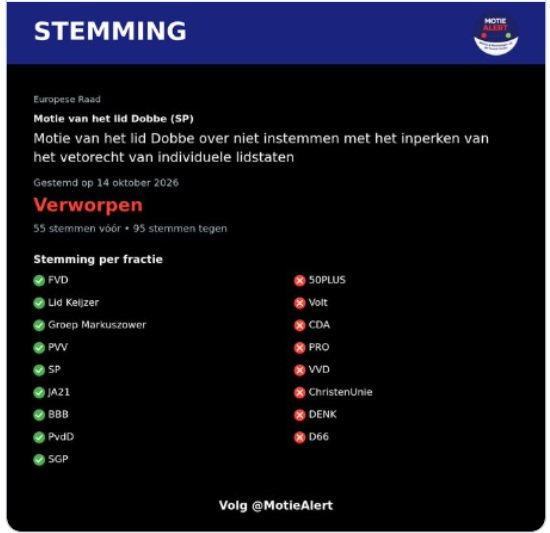
Anyone who views politics exclusively through the traditional left-right lens will find this a little surprising. Why are the SP, FVD, SGP and PVV on the same side? And why did the VVD, D66 and PRO agree with one another on this? To understand this, the political coordinate system I devised a few years ago is helpful. It does not consist of a single axis running from left to right, but of two dimensions that, historically, have often been used as a guide for classifying ideologies.
Political axis system with four quadrants
On the horizontal axis is the question of how much power we want to give the government. From collectivist and communist, with a major role for the state, to liberal, and further to the right, libertarian, with a smaller government and greater individual freedom. The vertical axis poses a different question: where should that political power actually lie? With the nation state, or increasingly with supranational institutions? That second axis therefore runs from national sovereignty (top) to supranationalism (bottom).
Figure 2: Four quadrants of political movements
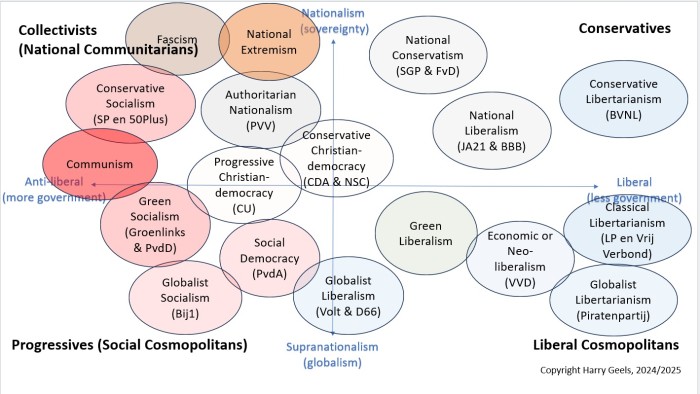
These two dimensions give rise to four political quadrants. In the top left are collectivist but nationally oriented political movements. In the top right are the conservative and national-liberal movements. In the bottom left are the progressive, socialist and cosmopolitan movements. In the bottom right are the liberal cosmopolitans.
The SP votes in the same way as the PVV, FVD and JA21
In my quadrant classification, it is not at all surprising that the SP and FVD voted the same way. They differ enormously on the desired size and role of government, but at the same time believe that political sovereignty should primarily lie with the nation state. It also becomes clearer why the VVD and D66 ended up on the same side in this vote. Their views on the role of government differ, but both accept a greater transfer of decision-making to the European level. As an aside, the SP has also always been a Eurosceptic party.
Of course, a single parliamentary vote does not, of course, prove a political model. It becomes more interesting when the same pattern emerges more frequently. This happened, for example, in December 2024 with the Eerdmans motion on retaining the right of veto. That motion explicitly stated that the right of veto is a crucial instrument for safeguarding the sovereignty and interests of individual Member States. Once again, parties such as the PVV, SP, BBB, FVD, SGP and JA21 stood united on one side, whilst the VVD, D66, CDA and Volt, amongst others, stood on the other. This is starting to become a pattern.
Sovereignty is just as fundamental a dividing line as government power
The contrast becomes even clearer when politicians speak not about a specific European measure, but directly about sovereignty. On the one hand, we find proposals to retain the national right of veto or even to reclaim national powers. On the other hand, we find proposals to abolish unanimity and to take European decisions by qualified majority. It always comes down to the same underlying question: who ultimately has the final say? In my view, that is one of the fundamental political questions of our time.
This shows that sovereignty, alongside the scope of government power, is a distinct political dividing line. What is remarkable is that two people can be in complete agreement that the government should carry out a particular task, yet fundamentally disagree on the question of which government should do so. The Hague, Brussels or, ultimately, even a more far-reaching form of supranational governance? That is why the one-dimensional left-right framework falls short. Anyone who merely asks whether someone is economically left-wing or right-wing misses an increasingly important dividing line in politics.
And then came 50PLUS
Nevertheless, the vote on the Dobbe motion also posed a problem for my coordinate system: 50PLUS. The party voted against the motion and should therefore, on this dimension, be placed relatively close to the supranational end of the spectrum. But try, if you will, to place 50PLUS convincingly in one of the four ideological quadrants. That proves difficult. This raises the question of whether the axis system falls short here, or whether we wrongly expect political parties to always represent a coherent political movement. After all, the axis system primarily classifies political movements, not political parties.
Liberalism, socialism, conservatism and nationalism are political philosophies with a more or less coherent view of humanity and society. Individual parties may deviate from these, for example because they operate hardly at all on the basis of such an overarching ideology, but primarily on the basis of specific interests. 50PLUS is a good example of this. The party emerged largely from the interests of a specific demographic group. Pensions, state pension (AOW), purchasing power, healthcare and the position of older people formed its raison d’être. These are legitimate political interests, but they do not automatically result in a coherent vision of state power and sovereignty.
The Party for the Animals presents another interesting borderline case. It began explicitly with animal welfare but, over the years, developed a much broader vision on the economy, climate, consumption and economic growth. An underlying social vision has certainly emerged there. However, its primary organising principle does not align with my two axes. This is even evident in its stance on the right of veto. In various votes on similar sovereignty issues, the PvdD did not always end up on the same side. Apparently, ecological or other substantive considerations can carry more weight than a fixed preference for national or supranational decision-making.
In conclusion
A political model should not attempt to pigeonhole every party at all costs. If a party does not fit neatly into a category, that may also say something about that party. For example, because a party scarcely represents an overarching ideology, such as 50PLUS, or because a different organising principle may carry greater weight and thus lead to varying voting behaviour, as with the PvdD.
It may also be the case that a political party or politician represents multiple political currents. Earlier, I described Trump’s ideology as a mixture of national extremism, conservative Christian democracy and authoritarian nationalism.
The vote on the European veto right illustrates at least one thing: anyone who categorises politics solely along left-right lines is attempting to reduce a reality comprising at least two dimensions to a single axis. No wonder, then, that political opponents sometimes turn out to be surprisingly close to one another.
This article contains the personal opinion of Harry Geels
Share this post!
Related posts
-
 Read more about "Federated Hermes: Weekly Markets Wrap-Up 29 October 2026"
Federated Hermes: Weekly Markets Wrap-Up 29 October 2026
-
 Read more about "Harry Geels: The remarkable support for the French protests"
Harry Geels: The remarkable support for the French protests
-
Read more about "Harry Geels: The ‘we’re doing so well’ fallacy"
Harry Geels: The ‘we’re doing so well’ fallacy
-
 Read more about "Carmignac: Extra begrotingsuitgaven VS lijken eraan te komen"
Carmignac: Extra begrotingsuitgaven VS lijken eraan te komen
-
 Read more about "DeVere Group: Bank tax raid would hit every borrower, saver and pension in UK"
DeVere Group: Bank tax raid would hit every borrower, saver and pension in UK
-
 Read more about "Han Dieperink: It won’t be long before we're all French"
Han Dieperink: It won’t be long before we're all French
-
 Read more about "Harry Geels: Tackling ageism with a negative income tax"
Harry Geels: Tackling ageism with a negative income tax
-
 Read more about "LFDE: Markten overschatten politieke risico’s en Frans besmettingsgevaar"
LFDE: Markten overschatten politieke risico’s en Frans besmettingsgevaar
-
 Read more about "MFS: Vervroegde verkiezingen van weinig invloed op Spaanse staatsobligaties"
MFS: Vervroegde verkiezingen van weinig invloed op Spaanse staatsobligaties
-
 Read more about "Schroders: Amerikaanse energietransitie groeit door ondanks weerstand overheid"
Schroders: Amerikaanse energietransitie groeit door ondanks weerstand overheid