
Harry Geels: The remarkable support for the French protests
Harry Geels: The remarkable support for the French protests

This column was originally written in Dutch. This is an English translation.
By Harry Geels
Who is actually protesting in France, why, and against what? The answer to these questions is far less clear-cut than some supporters of the protests would have us believe.
‘Let’s celebrate the fact that they’re taking to the streets.’ Under this unambiguous headline, an opinion piece by Noël van Veen, a campaigner at Oxfam Novib, recently appeared in *De Volkskrant* about the protests in France and elsewhere in Europe. According to him, resistance to the current state of the world is desperately needed and may even ‘cost a few windows’. That is quite a statement, for three reasons. Firstly, it is not yet entirely clear who is protesting; secondly, the crisis has various underlying causes; and thirdly, an employee of a partly publicly funded development organisation is very emphatically putting forward a political view of the protests.
But who is actually protesting?
If we are to believe the media, in France it is mainly ‘left-wing’ groups. But the reality is more complex. School pupils and students are protesting against the lack of prospects for the future and the poor quality of, and inequality in, education. Trade unions are opposing cuts and reforms. The ‘yellow vests’ are primarily protesting against higher (fuel) costs. In addition, there are pro-Palestinian demonstrators and anarchist and radical-left groups. And finally, there are rioters and looters. Anyone who speaks of ‘the’ French demonstrator is therefore quickly making an analytical error.
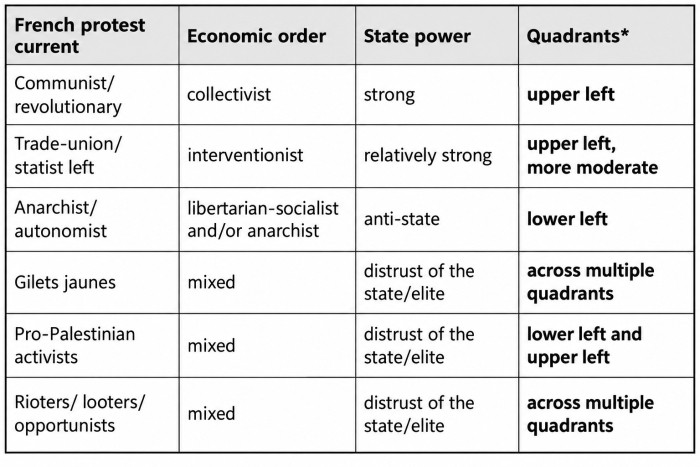
By the term ‘quadrants’, I am referring to my four-quadrant classification of political movements: Stop the left-right framework, part 2.
The big question is who Van Veen actually supports. After all, this is a hotchpotch of protest groups. He seems to support the first three groups in particular. He writes, after all, that the demonstrators are rightly angry because ‘politicians would rather cut back on social services than effectively tax the world’s wealthy, and because they are opening the door to data centres’. As an aside, I have argued many times that the left-right framework is inadequate. France is proof of this. People are not currently demonstrating for a single cause, but primarily against the existing order or the existing system.
The diagnosis appears to have already been made
Van Veen’s opinion piece reveals a clear political bias. He links young people’s anger primarily to three major themes: capitalism and inequality, the climate crisis, and what Oxfam Novib describes as Israel’s genocide against the Palestinians. These topics align remarkably well with Oxfam Novib’s existing campaigns. That is precisely the problem. A diverse protest movement thus risks being used not to investigate what is going on in society, but as confirmation of a political diagnosis that already existed before the protests began.
The three themes mentioned may well be relevant. But what about the loss of trust in the government and political institutions? Perhaps the debate centres not only on the scale of the French welfare state, but also on whether that welfare state can deliver on its promises. France now faces a budgetary problem that is becoming increasingly difficult to gloss over. Moreover, France operates within the eurozone, where very different economies share a single currency and a single monetary policy. Previously, a regularly depreciating French franc served as a safety valve to remain competitive. That is no longer possible.
At the same time, Europe must spend considerably more on defence. The IMF explicitly cites higher defence spending, an ageing population, and the digital and green transitions as structural pressures on French public finances. A bureaucratic government, a constraining euro and high defence spending present a far more complex political narrative than: inequality is high, so tax the rich; young people are concerned about the climate, so accelerate the transition; people are protesting, so celebrate that protest. Attributing France’s malaise primarily to inequality, the climate and Israel does absolutely no justice to the much broader set of issues.
‘Left’, ‘right’ or simply angry?
In France, we see a curious contradiction. According to parties on the conservative or liberal side, France is too socialist. According to progressive and centrist parties, it is too capitalist. One side protests because the government is doing too much; the other because it is doing too little. And, remarkably enough, they may ultimately end up on the same side. That does not mean their protest is meaningless. On the contrary. If the protest comes from different corners of society, that may in fact be a more powerful wake-up call than if everyone were demonstrating in support of the same agenda.
Oxfam Novib is, of course, fully entitled to take political stances. Climate change, poverty and development cooperation cannot be viewed in isolation from politics. However, an interesting question of where to draw the line arises when an organisation becomes increasingly involved in discussions about taxation, wealth distribution, climate policy and the Middle East, and one of its staff members openly applauds a European protest movement. Public funding does not oblige a civil society organisation to remain politically neutral, but it does legitimise the question of where development work and advocacy end and broader political action begins.
France as a model?
Meanwhile, the political deadlock in France is so severe that there is even talk of the sustainability of the Fifth Republic. Against this backdrop, the political unrest may also play further into the hands of Le Pen’s RN. But whether that is a solution to the problems is doubtful, because this party, just like the German AfD, encompasses various economic schools of thought. For instance, two economists within the RN, Saint-Étienne and Tanguy, are diametrically opposed on the pension debate, the role of the EU and the euro.
The French protests are not a harbinger of a left-wing revolution, but of something far greater: a society that no longer knows how to reconcile its conflicting desires within the same political and financial system. We should therefore not celebrate the French protests at all, but listen to them.
For ultimately, this is not just about France. The whole of Europe wants, all at once, to maintain a generous welfare state, become greener, finance an ageing population, substantially increase defence spending, and compete economically and technologically with the US and China. All of this must be paid for from the same economic base. In this sense, the streets of France hold up a mirror to Europe.
Politics is ultimately not about fulfilling wishes, but about making choices when not all wishes can be afforded at the same time. France currently seems barely capable of making those choices. Outside help (ECB, Troika?) appears to be necessary.
This article contains the personal opinion of Harry Geels
Share this post!
Related posts
-
 Read more about "Han Dieperink: It won’t be long before we're all French"
Han Dieperink: It won’t be long before we're all French
-
 Read more about "LFDE: Markten overschatten politieke risico’s en Frans besmettingsgevaar"
LFDE: Markten overschatten politieke risico’s en Frans besmettingsgevaar
-
 Read more about "DWS: ECB houdt rente ongewijzigd vanwege inflatie en Franse begroting"
DWS: ECB houdt rente ongewijzigd vanwege inflatie en Franse begroting
-
 Read more about "RBC BlueBay AM: Franse staatsobligaties ondanks politieke chaos interessant"
RBC BlueBay AM: Franse staatsobligaties ondanks politieke chaos interessant
-
 Read more about "Loomis Sayles: Frankrijk test het vangnet van de ECB"
Loomis Sayles: Frankrijk test het vangnet van de ECB
-
 Read more about "Harry Geels: The ‘we’re doing so well’ fallacy"
Harry Geels: The ‘we’re doing so well’ fallacy
-
 Read more about "Carmignac: Extra begrotingsuitgaven VS lijken eraan te komen"
Carmignac: Extra begrotingsuitgaven VS lijken eraan te komen
-
 Read more about "DeVere Group: Bank tax raid would hit every borrower, saver and pension in UK"
DeVere Group: Bank tax raid would hit every borrower, saver and pension in UK
-
 Read more about "Harry Geels: Tackling ageism with a negative income tax"
Harry Geels: Tackling ageism with a negative income tax
-
 Read more about "RBC BlueBay AM: Italië aantrekkelijker alternatief dan Frankrijk"
RBC BlueBay AM: Italië aantrekkelijker alternatief dan Frankrijk