Harry Geels: Higher interest rates are the new normal
Harry Geels: Higher interest rates are the new normal
This column was originally written in Dutch. This is an English translation.
By Harry Geels
After years of living in a world of free money, historically low interest rates appear to be a thing of the past. Many analysts see this as a threat to the financial markets. But higher interest rates can also be seen as a return to normality.
Since the credit crisis, we have been living through extraordinary financial times. Savings yielded nothing and bonds offered no return. Central banks kept interest rates low, bought up bonds on a massive scale and ensured that financial markets could always count on a lifeline when tensions flared. All of this came to be known as the ‘new normal’. But ‘this time is different’ are probably the most dangerous words an investor can hear. Consider, for example, how 10-year yields have risen recently.
Figure 1: 10-year yields over the past three decades
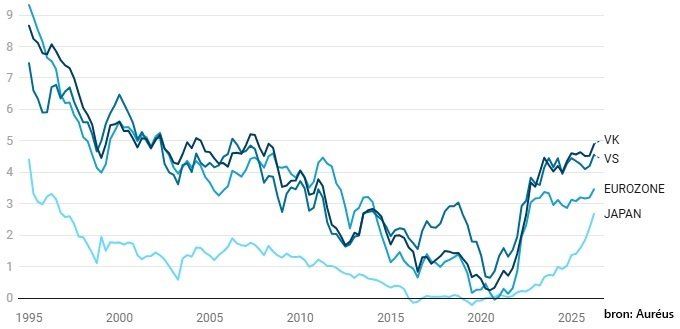
As an aside, in 2022 the eurozone saw nominal interest rates at almost zero, whilst inflation stood at well over 10 per cent. This meant that savers and bond investors lost more than 10 per cent of the real purchasing power of their assets. That period is now behind us. Interest rates have since risen sharply, which is often seen as a problem. However, higher interest rates can actually be a sign of a healthier economy and a healthier financial system. There are four positive developments behind the rising interest rates.
1) Economic growth
Following the 2008 credit crisis, the notion of stagnation became deeply ingrained in investors’ thinking. The developed world was thought to be sliding towards a Japanese-style scenario of low growth, low inflation and permanently low interest rates. Against that backdrop, zero interest rates perhaps made sense. The world now looks very different. Artificial intelligence, the energy transition, infrastructure investment, reindustrialisation, rearmament and extensive fiscal programmes are creating strong demand for capital. When demand for capital rises, its price ultimately rises too.
2) The return of real interest rates
For a long time, it seemed as though interest rates had all but disappeared. In reality, they were suppressed by a combination of low inflation, global savings surpluses and unprecedented monetary easing. That picture has changed. When the economy grows at a structurally higher rate and becomes more productive, a higher neutral interest rate is also to be expected. After all, money lent out today can be put to productive use elsewhere. The return on such lending is rising, which is precisely what a normal capital market should do.
3) The return of the term premium
After 2008, central banks purchased trillions in government bonds. This not only removed part of the risk from the system, but also part of the price attached to it. Investors were receiving hardly any return for tying up their money for the long term, even for bonds issued by high-risk countries and companies. In some cases, that return even turned negative. That situation is now reversing. A different monetary policy is being pursued and debt levels are rising. As a result, investors are rightly demanding compensation once again for inflation, policy and maturity risks.
4) ‘Lessons learnt’
For a long time, financial repression (an interest rate below the rate of inflation) seemed like a panacea. The aim was to keep the economy going by keeping interest rates low. The cost seemed limited. But in hindsight, that cost turned out to be higher than anticipated. Among others, the former Governor of the Bank of England, Mervyn King, has stated that the aggressive monetary and fiscal easing during the COVID-19 crisis – which saw major problems arise in supply chains – was a policy mistake: ‘too much money chasing too few goods’. We are still feeling the after-effects of this.
France versus the US
An interesting aspect of this discussion is the comparison between France and the US. Both countries have similar levels of budget and public debt (as a percentage of GDP). Nevertheless, Washington pays considerably more interest than Paris. The usual explanation is well known. The US economy is growing faster, has higher inflation expectations and, as a result, higher real interest rates. That is undoubtedly an important part of the story. But there is another factor at play.
US interest rates are determined within a single political union, with a single treasury and a single central bank. France is part of a monetary union in which the ECB is ultimately also responsible for the stability of the euro system. Since the euro crisis, investors have known that the ECB is prepared to go to great lengths to counter disruptive tensions in the bond markets. Mario Draghi’s famous words, ‘whatever it takes’, continue to influence the pricing of European government bonds.
As a result, French interest rates reflect not only an assessment of France itself, but also of how France is embedded within the eurozone – namely, that the ECB is likely to do everything in its power to keep France on board, if necessary by (once again) buying up bonds (under the TPI scheme). That is why US interest rates are likely to be closer to a ‘free market price’. In other words, US interest rates primarily tell a story about America, whilst French interest rates also tell a story about a flawed eurozone, where countries still diverge too much economically and fiscally.
In conclusion
Of course, central banks will intervene again in the event of another crisis. But such crisis policy is not the same as permanently suppressing the cost of borrowing. Central bankers, too, seem to be gaining a better understanding that artificially low interest rates entail significant social costs – at least, I hope so. That does not mean that interest rates can only go up from here. Business cycles, recessions and financial shocks – and interventions in response to them – will continue to exist.
It does mean, however, that we will probably have to bid farewell to the idea that zero interest rates are the natural state of an economy. Perhaps that world was, in fact, the exception. For the economy as a whole, it might well prove healthy for capital to have a price once again. The new ‘old normal’ could well be higher interest rates. Not because there is anything fundamentally wrong with the economy, but precisely because capital has been given a price again. And investors will have to get used to that once more.
This article contains the personal opinion of Harry Geels
Share this post!
Related posts
-
 Read more about "Nuveen: Bank of England kan Britse economie de nek omdraaien"
Nuveen: Bank of England kan Britse economie de nek omdraaien
-
 Read more about "Candriam: Bedrijfswinsten staan centraal"
Candriam: Bedrijfswinsten staan centraal
-
 Read more about "PIMCO: A recalibration, not a rate-hike cycle"
PIMCO: A recalibration, not a rate-hike cycle
-
 Read more about "PIMCO: Bank of England reaction"
PIMCO: Bank of England reaction
-
 Read more about "Han Dieperink: Interest rate hysteria"
Han Dieperink: Interest rate hysteria
-
 Read more about "AllianzGI: Oplopende Amerikaanse rente belangrijk onderwerp Jackson Hole"
AllianzGI: Oplopende Amerikaanse rente belangrijk onderwerp Jackson Hole
-
 Read more about "Payden & Rygel: Current US inflation pace to prompt immediate hikes"
Payden & Rygel: Current US inflation pace to prompt immediate hikes
-
 Read more about "AllianzGI: Bank of Japan houdt rente ongewijzigd"
AllianzGI: Bank of Japan houdt rente ongewijzigd
-
 Read more about "PIMCO: When monetary policy surprises stop translating"
PIMCO: When monetary policy surprises stop translating
-
 Read more about "RBC BlueBay AM: Obligatiemarkt prijst te veel renteverhogingen in"
RBC BlueBay AM: Obligatiemarkt prijst te veel renteverhogingen in