Harry Geels: The myth of Trump as a right-wing capitalist

This column was originally written in Dutch. This is an English translation.
By Harry Geels
Recent remarks by Trump (during his 4th of July speech) and Vance (in an interview with The Daily Wire) point more towards conservative-Christian, or even mercantilist, politics than towards liberal-capitalist views. Once again, it is clear that the traditional left-right framework is intellectually impoverished and unnecessarily polarising.
In his 4th of July speech, Trump did not speak of free markets, deregulation or free trade as the highest ideals, but of national greatness, American manufacturing, strong families and a government that actively contributes to those goals. His support for the so-called Trump Accounts, under which every American child born between 2025 and 2028 receives a starting capital of $1,000, fits into that same pattern. Together with his tariff policy, his preference for industrial policy and his aim to keep strategic sectors under American control, this points much more in the direction of economic nationalism.
This picture is further reinforced by Vice-President J.D. Vance, who is increasingly acting as the intellectual voice of Trumpism. In a recent interview with Michael Knowles of The Daily Wire, Vance stated that the Republican economic agenda is nowadays “much more Alexander Hamilton than it is Milton Friedman”. Hamilton championed protective tariffs, a national bank, and an active industrial policy—the very model to which Trump is returning. In doing so, he explicitly distances himself from the free-market tradition that for decades formed the economic backbone of the Republicans. According to Vance, the economy is not an end in itself, but a means of supporting human dignity, families, communities and a meaningful life.
It is noteworthy that Vance criticises not only free trade and globalisation, but also the meritocratic ideal so characteristic of classical liberalism. He argues that economic growth is of little value if it comes at the expense of family, community and social cohesion. In this respect, he is closer to conservative communitarianism and the Church’s social teaching than to the economic liberalism of Reagan, Thatcher, Friedman or Hayek. Anyone who still sees Trump and Vance as representatives of an unadulterated capitalist or libertarian right wing is, in fact, looking at a Republican Party that no longer exists.
Politics is no longer one dimensional
Trumpism is proof positive that the current political landscape is difficult to capture within a left-right framework. The political landscape is much better defined along two axes. The vertical axis runs from nationalism to globalism. At the top are the political movements that attach great importance to their own country and the cultural values upheld there. Globalists prefer to integrate into international structures. National borders are criticised because they exclude other people and hinder international cooperation deemed necessary.
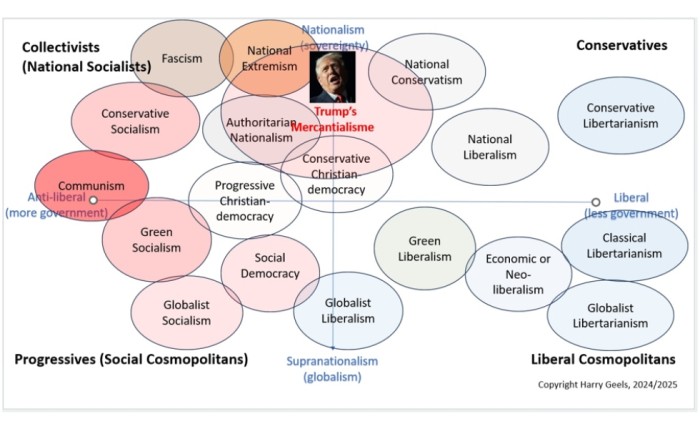
This creates four quadrants. In the bottom left, we find the progressive and socialist movements, which are both collectivist and internationally oriented. In the bottom right are the classical liberals, neoliberals and libertarians, who believe in open borders, free trade, globalisation and limited government. In the top right are the conservatives, who prioritise national identity, tradition and a sense of community, but without the strong state economic control found in socialist systems. In the top left are the collectivists, who combine a strong state with national interests and economic control.
It is striking that Trump hardly fits into the classical liberal camp. Free trade, globalisation, open markets and a hands-off government are not at the heart of his political project. His tariff policy, industrial policy, immigration restrictions, intervention in strategic sectors and his proposal for $1,000 in start-up capital for every child all point in a different direction. That does not mean that Trump is a socialist in the traditional sense of the word. It does, however, mean that the usual portrayal of Trump as an ultra-capitalist representative of the ‘right’ does not adequately describe reality.
Trumpism resembles, rather, a form of national-conservative mercantilism: a strong state, a strong nation, protection of domestic industry, support for families, and an economy which, according to Trump and Vance, must serve the national interest. In my framework, Trump therefore does not fall into the liberal-capitalist quadrant in the bottom right, but much higher up, in the area where conservatism, nationalism and economic intervention intersect.
In conclusion
Trump and Vance have recently distanced themselves clearly from the major ideological opposites of the twentieth century. In his 4th of July speech, Trump lashed out at communism and presented it as a threat to American freedom. At the same time, Vance is openly distancing himself from Milton Friedman and the economic liberalism that dominated Republican thinking for decades. In doing so, they reject both internationalist collectivism and globalist market liberalism.
An increasing number of political movements can no longer be categorised using the classic dichotomy between socialism/communism and liberalism/libertarianism. The real dividing line is increasingly drawn between nationalism and globalism, between community and the market, between economic intervention and economic laissez-faire.
Incidentally, all this is quite separate from my own political and economic assessment of Trump. The point of this column is not to defend his politics. I disagree with him on many issues. The aim here is to explain Trump’s place in the political landscape. Anyone who wants to understand today’s politics must finally bid farewell to the polarising left-right framework.