
Columbia Threadneedle: Smooth Wtp transition offers no guarantee for the future

This article was originally written in Dutch. This is an English translation.
The first major Wtp transition wave in early 2026 was remarkably calm on the interest rate markets. This is partly due to the pension reserves used to purchase additional LDI portfolios. However, pension funds transitioning in 2027 and 2028 still need to remain vigilant.
By Jan Willemsen, LDI Client Portfolio Manager, Columbia Threadneedle Investments
It could have been a storm. In the months leading up to 1 January 2026, analysts and implementers anticipated significant selling pressure at the long end of the curve, rising spreads and inevitable friction in implementation. After all, approximately 35% of Dutch pension assets were switching to the new Wtp framework at the same time. Yet the market remained remarkably calm. The swap curve held steady, volumes were absorbed by the market in an orderly manner, and the feared dislocations failed to materialise. This came as a relief and, for some, even proved that things were not as bad as feared. It also seemed to confirm that LDI repositioning can be manageable, provided it is carefully prepared.
This outcome is understandable. The transition had been announced well in advance. Implementers, funds and counterparties were able to pre-position themselves in good time. Increased coverage ratios in 2025 reduced the gap between existing hedging and target positions. And several funds began controlled reduction as early as November 2025, spreading the market pressure over several weeks.
Invisible dampers that helped in 2026
Additional dampers were at work beneath the surface. Several large Dutch pension funds have indicated that they will gradually adjust their life-cycle hedging, in close consultation with the pension administrator, so that there is no mismatch between the allocated and realised hedging return and they can therefore take longer to reduce their positions.
In addition, anticipation of insurance regulation in 2027 played a role. Changes in the yield curve and a lower balance sheet burden from long-term government bonds prompted European insurers to extend their duration. If insurers are net buyers at the long end, this helps to absorb pension fund reduction. In 2026, this cross-sector interaction probably already contributed to the calm, and insurers are expected to continue to counterbalance selling Dutch pension funds in the coming years.
The creation of new reserve portfolios was particularly helpful. These portfolios often carry interest rate risk and were filled with LDI-like building blocks. This created demand for swaps and long-term bonds, which partially offset the reduction in collective portfolios. Pension funds thus became their own counterparties to some extent. Under the old system, hedging was relatively homogeneous, but under the Wtp we see a range of choices. Some funds keep reserves interest-neutral in order to minimise fluctuations in allocations. Others opt for a short-duration profile, focused on cash flow matching. Still other funds fill the reserve with a long-duration character, with maturities of up to fifty years via swaps and long-term bonds.
Quantitative framework: from 45 to ~60 million DV01
It is tempting to extrapolate the calm of 2026 to later years. However, the starting conditions for 2027 are different. Firstly, the volumes are larger: the groups transitioning in 2027/2028 collectively represent more capital than the January 2026 group. Secondly, the dampening factors appear to be losing their impact. Funds that will transition later have already significantly increased their interest rate hedging in 2025/2026. This important dampening factor has therefore largely run its course.
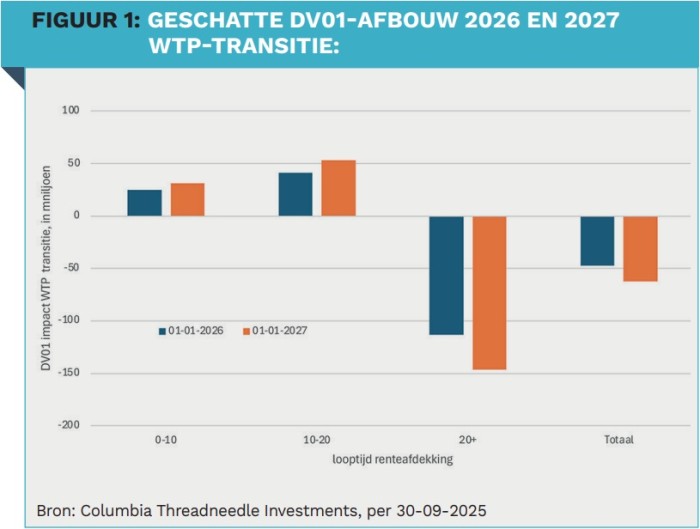
A practical way to indicate the order of magnitude is DV01. For the January 2026 group, we estimate a necessary reduction of around €45 million DV01, while for the January 2027 group, our estimate is closer to €60 million. These estimates are built up bottom-up from fund-specific transition plans (reference date Q3 2025) and are significantly lower than the market had anticipated a year earlier. This is an indication that early adjustments and reserves have already absorbed much of the impact.
However, the margins of uncertainty are large. The final DV01 flow depends on choices that are not always public: the hedge per age cohort, the use of surplus reserves such as direct increases, solidarity reserves, compensation deposits, and, above all, the investment mix within those reserves. In our base scenario, we assume that approximately half of the reserves will end up in duration-bearing assets. Variations on this can shift the aggregate DV01 by tens of millions, and the maturity distribution across the curve even more significantly.
Those who want to manage the coming wave will find generic assumptions of little use. A fund-specific lens is needed.
As mentioned, the estimates are based on the information available on the date of the analysis and the results will change due to market conditions, among other things. With a different coverage ratio, the risk estimates change significantly, so the estimates are surrounded by exceptionally wide margins of uncertainty.
LDI: from phase-out scenario to reinvention
When the first outlines of the Wtp became visible around 10 years ago, the prevailing expectation was that LDI strategies would structurally lose importance. A less guaranteed system, shorter obligations and more risk sharing would make the classic obligation-based thinking redundant. In hindsight, this reasoning appears to have been too simplistic. Absolute PV01 exposure is declining less than expected, and the Wtp has actually led to a broadening of LDI applications. The new system requires much more frequent recalculation of cash flows to be hedged: these are now recalibrated monthly on the basis of the total asset value. Moreover, whereas LDI was previously used mainly for static interest rate hedging, we are now seeing a range of new applications emerge. Reserve pots require their own LDI or CDI solutions.
Why 2027 and 2028 promise a different dynamic
Nevertheless, for the funds that will transition in 2027 or 2028, a generic “the market is calm, so we are too” conclusion is insufficient. Against the above background, there is a strong temptation to project the calm of 2026 onto 2027. But we see that some parameters have changed. Volumes are larger, natural buffers appear smaller, and policy diversity is greater. Above all, the market environment – and with it the coverage ratio – could tip at exactly the wrong moment. Generic assumptions are of little use to those who want to manage the coming wave. A fund-specific lens is needed: insight into the fund's own lifecycle architecture, into the sensitivity of the reduction of interest rate hedging for coverage ratio scenarios, into the chosen reserve strategy and into the practical feasibility of timing within the fund's own governance cycle. The calm transition of 2026 does offer comfort, but it is certainly no guarantee for the transitions still to come.
|
SUMMARY The first Wtp transition wave in early 2026 was surprisingly smooth on the interest rate markets. This calm can be explained by early preparation, higher coverage ratios and a phased reduction. Insurers and new reserve LDI portfolios acted as natural counterparties for the reduction of interest rate hedging. In 2027 and 2028, the pension sector will face larger volumes and fewer buffers to cushion the impact. There is considerable uncertainty due to fund-specific choices and market conditions. LDI remains crucial, but will have broader and more dynamic applications. The calm of 2026 offers no guarantee for subsequent transition waves. |
Read the original article in Financial Investigator magazine