Harry Geels: Germany strongly polarised over industrial crisis
Harry Geels: Germany strongly polarised over industrial crisis
This column was originally written in Dutch. This is an English translation.
By Harry Geels
It is becoming increasingly clear that German industry is undergoing an existential crisis. However, the German people are politically divided on how to resolve this crisis, as was evident from the recent elections in Baden-Württemberg.
Since 2019, 266,000 industrial jobs have been lost in Germany. According to an analysis by the Frankfurter Allgemeine, industry in particular is struggling with declining sales and falling exports. Despite major support programmes, the government is unable to alleviate the problems. Entrepreneurs cite rising labour costs and overregulation as the main obstacles to their competitiveness, while the current subsidies are seen primarily as “weiße Salbe”: cosmetic, not curative.
In addition to high labour costs, an inflexible labour market and overregulation, economists and other analysts cite other causes for the crisis in German industry. For example, after rapid industrialisation, China has started to compete directly with German industrial companies. Another problem is high energy costs. These are at least twice as high in Germany as in the US and three times as high as in China. Industry consumes a lot of energy, which makes German products expensive.
Figure 1
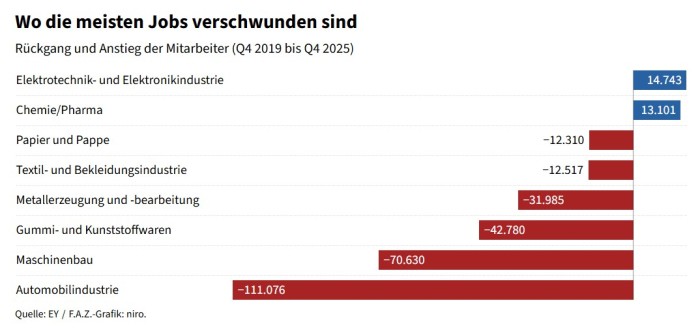
Source: Frankfurter Allgemeine
Polarised election results
Now that the crisis is becoming increasingly acute, the question is how to resolve it. In Germany, this has led to a striking political divide, as was evident in the recent elections in Baden-Württemberg, traditionally a real industrial state where Mercedes, Porsche, Bosch and SAP, among others, have their headquarters. The Greens – who are in favour of a government-led climate transition – remain the largest party, while the AfD – which is in favour of more market forces – more than doubled its share of the vote.
Figure 2
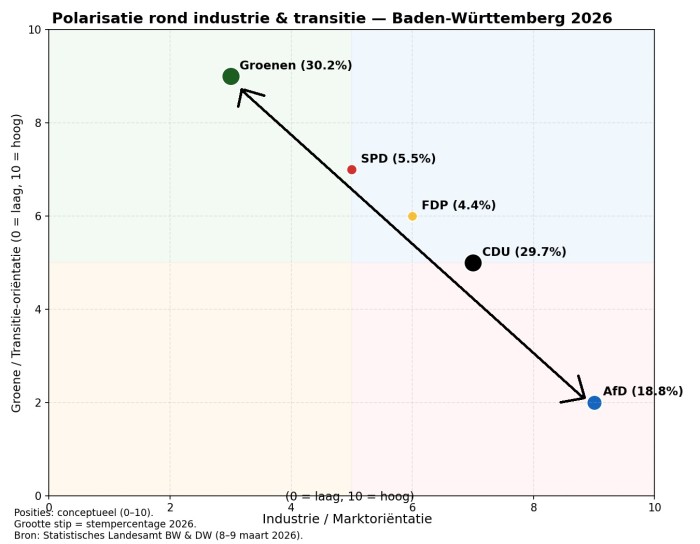
The AfD has mobilised the protest vote. In Mannheim and Pforzheim, both cities with industrial problems, the AfD achieved above-average scores. There are several reasons for the Greens' stable result. The party is particularly popular among students and civil servants. The relatively highly educated population of Baden-Württemberg sees the climate transition as the path to new growth. What helps the Greens in this federal state is that they have a pragmatic programme and leader here.
Germany's economic identity crisis
Underneath this electoral divide lies something deeper: a struggle for economic identity. While the Greens, led by the government, want to transform industry towards green growth, the AfD sees this same transition as a threat. According to them, industry needs more freedom, fewer rules and lower energy prices in order to compete again. The tension between the two visions is growing as economic reality hits harder than politics can absorb.
This contrast is reinforced by voters' differing interpretations of economic problems. For highly educated people in urban regions — Stuttgart, Tübingen, Freiburg — the industrial crisis is a sign that the country is innovating too slowly. For residents of industrial decline regions — Mannheim, Pforzheim — it is rather proof of misguided policy, excessive climate burdens and a state that interferes in matters it does not understand. The result: the same figures, completely different conclusions.
The missed opportunity: less micromanagement, more market forces
As far as I am concerned, the solution does not lie in simply mobilising protest votes, nor in even more subsidies, even more regulation or even more central coordination. These have not reversed the downward spiral so far and will not do so in the future. Industry would benefit most from a restoration of market incentives and less detailed regulation, so that companies can respond more quickly. And from genuine competition in the energy market, including scope for technology-neutral production.
Furthermore, lower labour and capital costs, so that Germany once again becomes attractive for investment, and policies that give investors confidence rather than uncertainty about ever-changing interventions. The remedy is therefore not more government, but a powerful market regulator that allows market dynamics to work and at the same time ensures that harmful practices are priced in. Entrepreneurship must once again become a virtue and offer a healthy balance between profit and risk.
This article contains the personal opinion of Harry Geels
Share this post!
Related posts
-
 Read more about "Schroders: Amerikaanse energietransitie groeit door ondanks weerstand overheid"
Schroders: Amerikaanse energietransitie groeit door ondanks weerstand overheid
-
 Read more about "Rick van der Ploeg: Climate transition still being undermined by misguided incentives"
Rick van der Ploeg: Climate transition still being undermined by misguided incentives
-
 Read more about "LFDE: AI en energie, een politiek vraagstuk"
LFDE: AI en energie, een politiek vraagstuk
-
 Read more about "DWS: AI geeft Duitse industrie glans"
DWS: AI geeft Duitse industrie glans
-
 Read more about "Han Dieperink: It won’t be long before we're all French"
Han Dieperink: It won’t be long before we're all French
-
 Read more about "Harry Geels: Tackling ageism with a negative income tax"
Harry Geels: Tackling ageism with a negative income tax
-
 Read more about "LFDE: Markten overschatten politieke risico’s en Frans besmettingsgevaar"
LFDE: Markten overschatten politieke risico’s en Frans besmettingsgevaar
-
 Read more about "MFS: Vervroegde verkiezingen van weinig invloed op Spaanse staatsobligaties"
MFS: Vervroegde verkiezingen van weinig invloed op Spaanse staatsobligaties
-
 Read more about "Harry Geels: Three hard-hitting final conclusions on the Box 3 debacle"
Harry Geels: Three hard-hitting final conclusions on the Box 3 debacle
-
 Read more about "Aberdeen: Reaction to the Brazilian elections"
Aberdeen: Reaction to the Brazilian elections