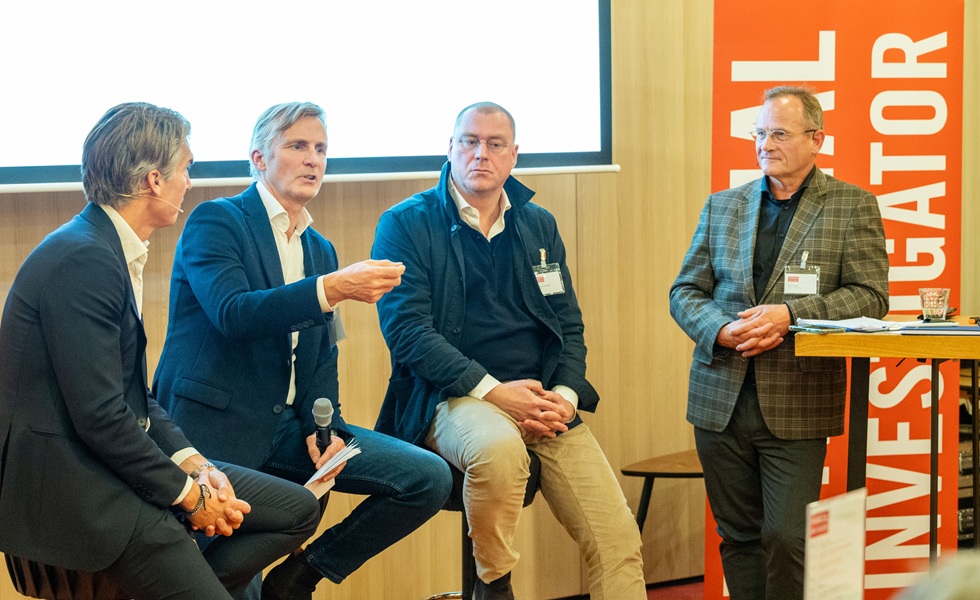
Panel discussion 'Blockchain & digital assets'
Panel discussion 'Blockchain & digital assets'
This report was originally written in Dutch. This is an English translation.
Is blockchain a brilliant solution to a problem that has not yet been identified, or are we missing out on a significant opportunity by not investing now in a technology that has the potential to generate exceptional returns? The panel discussion at the end of the Financial Investigator seminar on AI and blockchain was a fascinating conclusion to an afternoon full of insights into the disruptive technologies that investors need to form an opinion about.
By Esther Waal
|
CHAIR Pim Poppe, Lead Consultant, Probability & Partners PARTICIPANTS Valentijn van Nieuwenhuijzen, Senior Investment Advisor Jeroen Tielman, Head of Institutional Relations, Theta Blockchain Ventures Martijn van Veen, Managing Director & Partner, M11 Funds |
Two blockchain experts are participating in the discussion, but chair Pim Poppe surprisingly poses his first question to the outsider, Valentijn van Nieuwenhuijzen, who does not work in the blockchain sector. “Valentijn, from your investment perspective, what exactly do blockchain, crypto and digital assets entail?”
Van Nieuwenhuijzen is critical: 'Blockchain is a fascinating basic technology with a lot of potential, but the question is when this technology – this new digital infrastructure for recording financial and other transactions in a transparent and decentralised manner – will really come into its own. After all, it has been around for quite some time. We are familiar with blockchain from bitcoin and other cryptocurrencies, but what exactly crypto is remains somewhat unclear. Is it a digital pyramid scheme, or does the underlying technology have significant economic value?‘ Van Nieuwenhuijzen points to an area where he does see potential, namely the broader category of ’digital assets". ‘A cryptocurrency is not a claim on future cash flow. But tokenisation creates opportunities to establish a claim on underlying value or cash flows, both in infrastructure and in new business models. That is where I see the most interesting investment opportunities.’
With that comment on the table, Poppe turns to Jeroen M. Tielman, who informs investors about blockchain investments. ‘What efficiency benefits does blockchain technology generate?’
Tielman begins his explanation with a historical comparison: ‘In the mid-1990s, the wildest prediction was that one in six people would have a mobile phone – which was already considered a lot at the time. But step by step, broadband technology became suitable for more than just voice: first email via devices such as the BlackBerry, and eventually the breakthrough of the “handheld computer”, the iPhone in 2004. We are now at a similar point with blockchain. The technology is gaining more and more traction. Blockchain plays a role in the storage and transfer of value and eliminates the middleman. That storage and transfer of value accounts for about a third of the global economy. Given that the global economy is worth around £100 trillion, a third of that is enormous. Even if only 10% of that domain is affected by blockchain, the potential remains huge.
Blockchain as a toll road
Tielman then zooms in on an application where the impact is now tangible: the stablecoin. ‘Stablecoins are extremely efficient, especially for cross-border payments. It works the same way as when you deposit cash at a bank: you then see a digital claim on that money in your account. With stablecoins, this is done via dollars held by a trustee, which are exchanged for digital dollars. But look also at the tokenisation of securities, which Larry Fink of BlackRock believes is the next wave of innovation in blockchain. When you issue securities on the blockchain, they are settled within minutes. This allows you to trade globally 24/7. The global custody and settlement market represents 75 to 85 billion dollars per year. Blockchain has a lot of potential there. There are many more examples. Various blockchains issue tokens as proof of ownership. Compare it to toll roads: every time traffic passes over them, money comes in. In short, the inefficiencies in the current economy surrounding value transfer are precisely the area where blockchain applications have the greatest potential.
Crypto is ultimately just a high-risk asset. It has potential, certainly, but you have to treat it as high-risk.
More users, more value
“How can investors such as family offices achieve concrete returns with this?”, Poppe then wants to know. Tielman: “Compare it to 'early Facebook exposure”. The interesting thing about blockchain protocols is that they behave differently from traditional companies. These are initially financed with venture capital. Large investors often wait a while, because the early stage involves a lot of risk. With blockchain protocols, it works differently. There, the vast majority of the capital is raised at the beginning. The risk in that early phase is high – which is why you need to spread your investments widely – but the interesting thing is that once a blockchain protocol passes the tipping point, it no longer needs additional capital to continue growing. Then the rule is: the more users, the more activity, the more value is created in the protocol.'
Van Nieuwenhuijzen responds critically: ‘But why now? Hasn't blockchain been a kind of ingenious solution to a problem that has yet to be found for five to ten years? And how can I mitigate the risk that, just like in the early years of the railway revolution in America, I will invest in the railway that ultimately does not become the standard?’
‘By spreading it out broadly and over time,’ Tielman responds. ‘And it’s not as if there are no problems. There are many inefficiencies that we have simply become accustomed to. Blockchain technology can eliminate those inefficiencies.’
Digital assets as building blocks
Poppe shifts the focus to a related but more dynamic part of the blockchain universe: cryptocurrencies, Martijn van Veen's area of expertise. Poppe wants to know why a family office should build exposure in this area. Van Veen: 'I prefer not to call them ‘cryptocurrencies’, but rather digital assets. These are underlying assets in which you actually invest. They are in fact protocols – technology companies – on which applications are built, which in time can actually generate income.'
The inefficiencies in the current economy surrounding value transfer are precisely the area where blockchain applications have the greatest potential.
Van Veen has seen a significant increase in interest from asset managers, family offices and institutional parties. Whereas people were previously cautious, or labelled it speculative, we are now seeing broader, more professional interest. As far as Van Veen is concerned, this is logical. Based on research, he concludes that digital assets add value to a portfolio. You can look back at the performance of bitcoin and altcoins, smaller tokens.
If you add them in limited quantities to a traditional investment portfolio, such as a typical 60/40 allocation, you will see a significant improvement in annualised returns and the Sharpe ratio, all with a very limited increase in drawdowns. That is a clear argument for why adding them can be worthwhile."
Adoption benefits from regulation
Van Veen points to another development that should spark investor interest: the changing regulatory framework. ‘The US is clearly leading the way in this regard. We have recently seen stablecoins become legitimised: a regulatory framework has been created that will give this market a further boost. And steps towards legal clarity are also being taken with regard to altcoins. They will be seen as digital commodities. This opens the door for large institutional investors and pension funds to include the asset class. In our opinion, these developments will unlock a huge market and accelerate adoption."
Volatile market environment
Then there is the other side of the coin. ‘What are the biggest risks?’ asks Poppe. Van Veen points out that every investor must realise that this is an extremely volatile asset class. ‘You are at a very early stage in the process and tokens are often tradable very early on. But that also means that the token may be completely mispriced. You have to take into account that you are dealing with an extremely volatile market environment, partly because the market is not yet fully regulated.’
Poppe wants to know whether that risk is limited to a specific segment or whether it affects the entire sector. Van Veen: ‘You do indeed see spill-over effects, whether justified or not. But at the moment, there is a huge shift taking place within the market: more and more tokens are actually generating real-world revenue for token holders. This means that tokens – in analogy with traditional technology companies – can be valued on the basis of real cash flows. That changes the playing field and brings with it new risks.’ However, he is convinced that, as an institutional investor or family office, you can hardly afford not to embrace this asset class. But with one caveat: “If you do, do so to a limited extent and choose regulated parties with experienced professionals who know how to manage a fund and how to perform due diligence in this market. This will allow you to mitigate a significant portion of the risk.”
In our opinion, the creation of a regulatory framework will open up a huge market and accelerate the adoption of digital assets.
Tielman adds: 'The solution actually lies in diversification – both over time and across different positions – and in early allocation. In Europe, people are still somewhat hesitant. The longer Europe continues to hesitate, the greater the chance that this innovation will develop mainly outside Europe, leaving Europe behind.
Van Nieuwenhuijzen takes a different approach: 'The biggest risk, of course, is that it is a completely inflated bubble. The returns achieved in the past are nice, but the question must always be: what is the business case? What claim on future cash flows are you actually buying? For the majority of coins, that claim does not exist. Historically, crypto has certainly added diversification to portfolios, but it is not the safe haven that was once promised. In times of systemic stress or high inflation, crypto was not safe at all, and its correlation with the Nasdaq is positive and increasing. So it is simply a high-risk asset. It has potential, certainly, but you have to treat it as high-risk. And that means: allocate small amounts, be extremely disciplined, and only work with parties that can offer good liquidity and operate within a strong regulatory framework.
Van Veen agrees. 'Regulation and liquidity are essential. For us, it is quite unique that we can offer our product under an AIFM licence. And it is true that this asset class is highly volatile. Measuring cash flows can sometimes be difficult. You see this with gold, for example: it also has no cash flows, but is still considered an asset.'
Low capital, high potential
Tielman would like to add some nuance here. ‘You have to distinguish between non-revenue-generating assets, such as bitcoin and many other tokens, and revenue-generating assets, which is what we focus on entirely. We are interested in the new infrastructure, comparable to toll roads: every time traffic passes over it, revenue is generated. These types of protocols represent real property rights within new digital infrastructure. In the early stages, many projects will fail, perhaps 9 out of 10, or even more. But those that do break through will see a much stronger increase in value than traditional companies. So if you agree with the idea that blockchain could become a sector that affects perhaps a third of the economy, or even half of it, then this is an asset class where you can build exposure to something that has the potential to become huge with relatively little capital.
|
SUMMARY Tokenisation offers opportunities to record and trade proof of ownership without the intervention of an intermediary. The greatest opportunities lie in more efficient value transfer (stablecoins, settlement, tokenised securities). The early stages of blockchain protocols are the most important time to invest. With sufficient scale, the protocols can generate significant value without further additional financing. Digital assets can improve the traditional 60/40 investment portfolio, but they are highly volatile. Regulation and liquidity are crucial for institutional adoption. |
Read the original report in Financial Investigator magazine
Share this post!
Related posts
-
 Read more about "Nickel: Crypto ETFs are normalising digital assets as flows increase"
Nickel: Crypto ETFs are normalising digital assets as flows increase
-
 Read more about "Maven 11: Crypto, the most asymmetric opportunity in global finance"
Maven 11: Crypto, the most asymmetric opportunity in global finance
-
 Read more about "DNB: De digitale euro, een nieuwe stap in de evolutie van het geld"
DNB: De digitale euro, een nieuwe stap in de evolutie van het geld
-
 Read more about "Nickel: Crypto jobs are becoming more attractive for institutional investors"
Nickel: Crypto jobs are becoming more attractive for institutional investors
-
 Read more about "Nickel: Institutional investors are confident in crypto regulation"
Nickel: Institutional investors are confident in crypto regulation
-
 Read more about "Nickel: Crypto ETFs are turning up the pressure on regulators"
Nickel: Crypto ETFs are turning up the pressure on regulators
-
 Read more about "Bain & Company: Gebrek aan liquiditeit stuwt opmars stablecoins"
Bain & Company: Gebrek aan liquiditeit stuwt opmars stablecoins
-
Read more about "Nickel: Crypto IPOs affect institutional investors more than retail investors"
Nickel: Crypto IPOs affect institutional investors more than retail investors
-
Read more about "Nickel: Crypto on company balance sheets will continue to boom"
Nickel: Crypto on company balance sheets will continue to boom
-
Read more about "Nickel: Institutional investors back the long-term crypto outlook"
Nickel: Institutional investors back the long-term crypto outlook