
Evli: Solution needed for spread target under the Wtp
Evli: Solution needed for spread target under the Wtp

This article was originally written in Dutch. This is an English translation.
Many pension funds are looking for efficient matching solutions within the Wtp. Due to a structural spread requirement of approximately 35bps, building blocks are needed that offer a higher spread, low spread duration and limited tracking error.
By Jan Willem van Stuijvenberg, Investment Consultant and owner, Van Stuijvenberg Financial Services, and Marco Granskog, Director International Business Development, Evli Bank Plc
Most pension funds have opted for the solidarity premium scheme, whereby the matching portfolio and the return portfolio are invested collectively and the returns are allocated. In line with the lifecycle principle, exposure to both portfolios depends on age. Young people have a long horizon and a high risk tolerance, and therefore a relatively high exposure to the return portfolio. Older people have a shorter horizon, lower risk tolerance, and the emphasis is more on the matching portfolio.
Most pension funds use the so-called “theoretical variant” to allocate the return on the matching portfolio. This means that participants do not receive the actual matching return, but a theoretical return calculated on the basis of the cash flows to be hedged and DNB's RTS discount curve. Deviations between the actual and theoretical returns are settled with the return portfolio. Because young people are mainly exposed to the return portfolio and older people mainly to the matching portfolio, there is a risk of undesirable redistribution. To prevent this, funds try to structure the matching portfolio in such a way that the tracking error versus the theoretical return is low and the expected return is sufficient.
A matching portfolio consisting solely of cash and swaps has the lowest tracking error, but the return is insufficient. This is because the DNB RTS curve is based on Euribor swap rates, which include an interbank risk premium of approximately 15bps. Because pension funds do not receive this risk premium with only cash and swaps, this construction is not an option, despite the low tracking error. After all, the matching return will constantly be lower than the theoretical return, leading to a structural redistribution from young to old. Funds therefore have no choice but to use spread products.
Nordic credits are a sensible choice here, as this asset class offers a good balance between spread and spread duration.1 The spread provides the necessary extra return and the spread duration the unavoidable additional risk. Because many funds have long-term treasuries in their matching portfolios with a limited spread and high spread duration, it could be argued that these should be replaced by swaps and Nordic credits, which would increase the expected return on balance, while actually reducing the tracking error.
In many cases, however, the return requirement of 15bps is not sufficient, due to the way in which the theoretical matching return is usually calculated. This return consists of two components: the ‘return for the passage of time’ and the ‘return due to curve movements’. This is a common breakdown of the return on fixed income portfolios, which is now also applied to the cash flows to be hedged under the Wtp.
The “return for the passage of time” is nothing more than the return that would be achieved if only time passed and nothing else changed. In that case, the cash flows move one month closer and the curve shifts to the forward curve as it was already priced in at the beginning of the month. The return resulting from this is the “return for the passage of time”. When markets do not move and the forwards come out, this is the return that can be expected at the beginning of the month on the cash flows to be hedged.
Because markets move and forward rates do not always come to fruition, the final return is usually different, which is caused by the second component: “return due to curve changes”. This can be easily calculated by valuing the cash flows to be hedged against the actual curve at the end of the month and against the forward curve. The difference between the two gives the “return due to curve movements”. When this attribution is performed accurately, the total theoretical return is by definition equal to “return for the passage of time” + “return due to curve movements”.
Calculating both return components is more complex under the Wtp than under normal circumstances. This is because the DNB RTS curve must be used for the calculation. As this is not a market curve but a “regulatory curve”, it is not possible to directly derive a forward curve from it. The forward DNB RTS curve must therefore be calculated as follows: take the market curve at the beginning of the month, calculate the forward curve from it and use that forward market curve to calculate the forward DNB RTS curve. This seems very obvious when you read it like this, but it is something that is easily overlooked in practice.
Under the Wtp, it is customary to use 1/12th of the 1-year DNB RTS interest rate for the “return for the passage of time”. This proxy is practical, quick to calculate and has the advantage that each age group receives the same return in percentage terms for the passage of time. Intuitively, this seems like a useful, realistic approach, but unfortunately it has a bias. When the “return for the passage of time” is calculated in this way, the theoretical matching return is too high.
To demonstrate this, we modelled the current DNB RTS curve over a period from 2011 to the present. For each month in this period, we calculated the “return for the passage of time” and the “return due to curve movements”, applying two variants for the “return for the passage of time”: based on the 1-year DNB RTS interest rate and based on forwards. Figure 1 shows the monthly difference in theoretical return over this period. In the ‘proxy’ method, the 1-year DNB RTS was used for the ‘return for the passage of time’, while in the ‘forward’ method, the forward-based methodology explained above was applied.
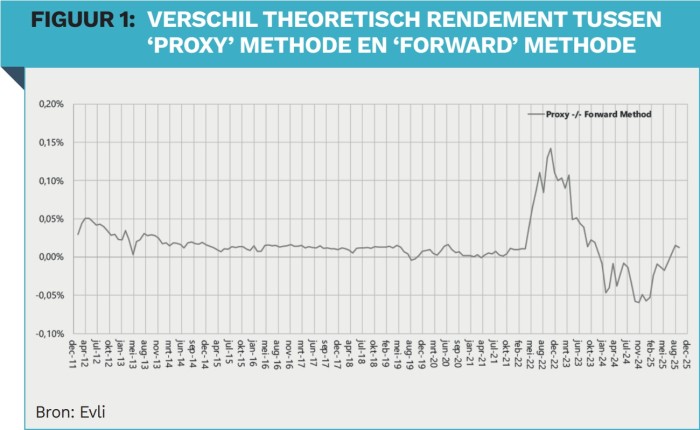
In virtually all months, the proxy method yields a higher theoretical return. The average difference is 20bps on an annual basis. This may seem insignificant, but together with the 15bps that must be earned on the spread as a result of the interbank risk premium, this now results in a total required spread of 35bps. This is 40% of the 90bps spread on regular investment grade credits, with a typical spread duration of 4.5. Because only part of the matching portfolio can be invested in spread products, regular IG credits will not be able to solve this 35bps problem.
Nordic credits are a better option, as they offer approximately 200bps spread at a lower spread duration of 2.5, which results in a lower tracking error contribution. In addition to Nordic credits, other spread products can also be used, such as ABS, mortgages and – to a limited extent – European high yield. Ideally, this will result in a matching portfolio with a neat expected outperformance at an acceptable tracking error, avoiding unnecessary redistribution between young and old.
1 Nordic credits as a smart matching building block under the Wtp, Financial Investigator 05-2025
|
SUMMARY A matching portfolio consisting solely of cash and swaps falls short by 15bps spread due to the interbank risk premium. Due to a bias in the standard calculation of the “return for the passage of time”, this shortfall can rise to 35bps. In many cases, the existing credits and mortgages will not add quite enough spread, and an allocation to Nordic Credits, ABS and a touch of HY can offer a solution. This can prevent undesirable structural redistribution, while in many cases even reducing the matching error. |
Attachments
Share this post!
Related posts
-
 Read more about "Anton Kramer: Explaining is not the same as assessing"
Anton Kramer: Explaining is not the same as assessing
-
 Read more about "PFZW: 5,7% rendement tweede kwartaal"
PFZW: 5,7% rendement tweede kwartaal
-
 Read more about "Mark van Schagen: In search of the right balance between efficiency and humanity"
Mark van Schagen: In search of the right balance between efficiency and humanity
-
 Read more about "Sweder van Wijnbergen: Pension funds' climate policy conflicts with the Tinbergen rule"
Sweder van Wijnbergen: Pension funds' climate policy conflicts with the Tinbergen rule
-
Read more about "Aon: Stijging dekkingsgraden pensioenfondsen houdt aan"
Aon: Stijging dekkingsgraden pensioenfondsen houdt aan
-
 Read more about "Dick Kamp & Raymond van Es: Applications of AI in the pension sector"
Dick Kamp & Raymond van Es: Applications of AI in the pension sector
-
 Read more about "Fidelity International: Nederlanders blijven vertrouwen houden in pensioenregelingen"
Fidelity International: Nederlanders blijven vertrouwen houden in pensioenregelingen
-
Read more about "Anton Kramer: Fund is benchmark"
Anton Kramer: Fund is benchmark
-
 Read more about "DNB: Een stevig fundament voor een bewegend pensioen"
DNB: Een stevig fundament voor een bewegend pensioen
-
 Read more about "Aon: Afwachtende houding werkgevers bij transitie naar nieuw personeel"
Aon: Afwachtende houding werkgevers bij transitie naar nieuw personeel