
Savills IM: Investors are returning to the shops
Savills IM: Investors are returning to the shops

European retail is back on investors’ radar. Tighter supply, stronger consumer spending and attractive yields are creating opportunities - in particular across retail parks, high streets and food retail.
By Ian Jones, Fund Director, Savills Investment Management
What is happening in the European retail sector?
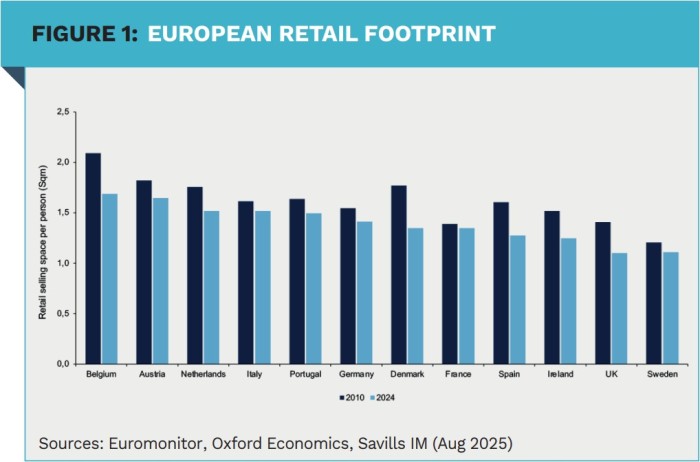
There are a number of factors at play, but in short, we see retail appearing on more and more investors’ shopping lists. The first point to make regarding retail’s resurgence is the changed European retail footprint (Figure 1). Over the past decade or so, the sector has been reorganised and now presents a tighter, more balanced market. Redundant space has been repurposed – many department stores and shopping centres have been reborn as mixed-use office and residential schemes for example – while new development has largely evaporated.
We also see improved tenant affordability. The past few years have seen a general resetting of rents throughout the European retail landscape. These corrected rents have improved tenant affordability and in turn now underpin a more sustainable leasing environment for the future.
And on the consumer side the economic outlook for spending also looks stronger across the continent. Oxford Economics forecasts European consumer spending to grow by 1.7% per year over the next five years, outpacing the 2000– 2024 average of 1.3%. Real wage growth should also continue to underpin demand and confidence, maintaining the sector’s momentum.
From a returns perspective, the numbers suggest that retail may be a bargain. According to the MSCI European Quarterly Index, retail delivered annual total returns just shy of those from the industrial and logistics sector in Q2 2025 and ahead of residential and offices. Retail parks in particular led the charge driven by strong income yields.
How easy is it for retailers to find quality space?
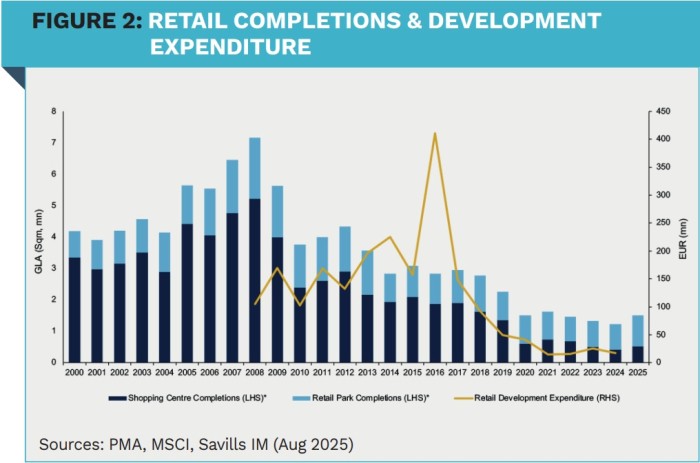
One way to look at this is around supply constraints. Take space under construction. New development activity in the retail space has been incredibly low since 2020 (Figure 2), and high construction and financing costs make a resurgence in new supply unlikely.
So, with a lack of new space, retailers are obliged to look at what is available now, and generally speaking, much of this needs adjustment to adequately serve the modern retailer and the modern consumer. We’re talking about warehouse space, click and collect functionality, energy efficiency to help with overheads, space fit for experience-based retailing, and even electric vehicle charging. These factors are putting pressure on retailers to find and secure the right space when its available.
Where do you see retail opportunities across Europe?
Obviously retail is heterogeneous and investors should take care to understand what opportunities are available across retail’s sub-sectors.
Retail Parks
We see more investors interested in retail park opportunities. Consumers continue to value the convenience of out-oftown shopping experiences, so retail park space can be a key element of an omni-channel strategy and click-andcollect services, while embracing mixed-use elements – for example cafes, gyms and hospitality spots – can increase dwell time and footfall at site. That said, when it comes to retail parks, investors must consider the leasing profile, anchor tenant tenacity, retail offer mix, catchment and competition.
High Street
The truly prime high street is perhaps a little shorter than it was five years ago. Retailers have been through a period of evaluating their space needs, and across Europe we typically see retailers having fewer stores in city centres or moving to high street areas with higher footfall. Now top European high streets are seeing increasing footfall figures and rental growth. Couple this with the limited space for new development in these areas and we see fundamentals supporting resilient income. That’s why many investors are now revisiting the high street. Following this period of change and value adjustment, yields in certain pockets of prime high streets are looking appealing.
Food Retail
For food retail, brick-andmortar space remains the clear number one sales channel. While online grocery sales are growing, retailer omni-channel strategies are still centred on physical stores.
Over the past decade or so the retail sector has been reorganised and now presents a tighter, more balanced market.
Demand for space in the sector is robust with construction costs high and planning law generally restrictive – in Germany, France and the Netherlands for example. The longer leases available in the sector are particularly attractive to long-term investors, with typically CPI-linked agreements augmenting income from high quality covenants.
What’s next for the brick & mortar and e-commerce dynamic?
Online shopping will continue to grow, but most of the retail spend still happens in-store. The takeup of online shopping also varies across Europe. The UK sees relatively high e-commerce sales as a proportion of all retail sales (roughly 27%) when compared to other European countries and the EU average (roughly 11%). European countries may move closer to the UK level over time, but physical retail has evolved to live alongside and complement online shopping.
As discussed, retailers across Europe have generally shrunk their footprint over the past 10 years as they have sought to optimise their store networks amid increasing e-commerce usage. But not only are many retailers now leaner, they are more sophisticated in how they use e-commerce and brickand-mortar together. Retailers are increasingly finding ways for the two channels to complement each other, rather than viewing e-commerce as a substitute to in-store.
What does ESG mean to the retail sector?
Retailers have seen their energy bills increase over the last few years and that has placed a real focus on a building’s energy efficiency and methods of reducing consumption. As is the general trend with ESG and real estate, it can often be a proxy for quality. A retail space that ‘does ESG well’ is likely to appeal to higher quality tenants and generate more stable income.
Aside from the obvious environmental considerations, social initiatives are intrinsically linked to retail real estate. Most sites employ locally and engage with the local community through events and giveback schemes. We see fantastic social initiatives taking place throughout our retail AuM with examples in Poland and the Netherlands.
And underpinning the ESG approach of retail real estate is the asset management strategy. High-quality retail assets do not stay high-quality unless there is an active asset management approach, and ESG is a core part of this.
|
SUMMARY The European retail sector has been transformed: less redundant space, minimal new development, and improved tenant affordability. Consumer spending is set to grow 1.7% annually, boosting retail momentum. Retail returns can rival industrial and outperform residential and offices. Supply constraints push retailers to secure adaptable, efficient spaces. Opportunities are seen in retail parks, prime high streets and food retail. Physical stores remain central despite e-commerce growth. ESG and active asset management are key value drivers. |
Attachments
Share this post!
Related posts
-
 Read more about "IVBN: Prinsjesdagpakket herstelt investeringsklimaat niet"
IVBN: Prinsjesdagpakket herstelt investeringsklimaat niet
-
 Read more about "Savills IM: European real estate debt finds its moment"
Savills IM: European real estate debt finds its moment
-
 Read more about "Schroders: Vastgoed steeds belangrijker voor 'AI-boom'"
Schroders: Vastgoed steeds belangrijker voor 'AI-boom'
-
 Read more about "Savills AM: European residential - looking beyond yields"
Savills AM: European residential - looking beyond yields
-
 Read more about "Drooms: Signs of recovery in the real estate transaction market"
Drooms: Signs of recovery in the real estate transaction market
-
 Read more about "Harry Geels: Many conventional wisdoms about housing do not always hold true"
Harry Geels: Many conventional wisdoms about housing do not always hold true
-
Read more about "Harry Geels: Conventional wisdoms about housing are outdated"
Harry Geels: Conventional wisdoms about housing are outdated
-
 Read more about "Harry Geels: Three advantages of owning your own home"
Harry Geels: Three advantages of owning your own home
-
 Read more about "DNB: Beter investeringsklimaat nodig voor private huurwoningen"
DNB: Beter investeringsklimaat nodig voor private huurwoningen
-
 Read more about "Achmea Real Estate koopt ruim 500 woningen namens PME Pensioenfonds"
Achmea Real Estate koopt ruim 500 woningen namens PME Pensioenfonds