Roundtable 'New Developments in ETFs'
Roundtable 'New Developments in ETFs'
This report was originally written in Dutch. This is an English translation.
In the United States, where the ETF instrument is highly accessible, there are significantly more private investors in ETFs than institutional investors, whereas in Europe the opposite is true. The EU can change this by reducing some of the friction and fragmentation in almost all areas of the ETF market.
By Hans Amesz
|
CHAIR: Philippe Roset, Independent Advisor
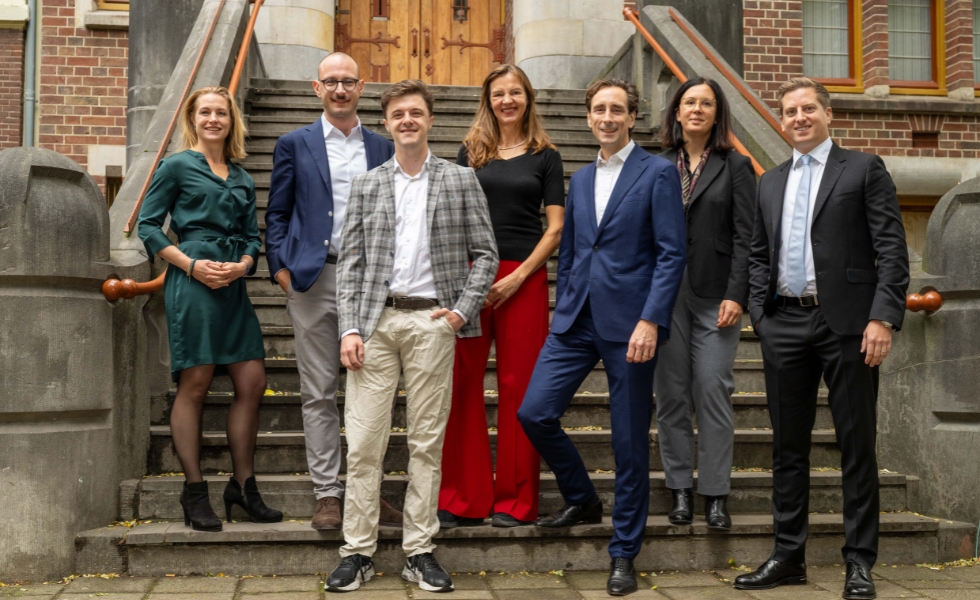
PARTICIPANTS: Effi Bialkowski, Van Lanschot Kempen Jolien Brouwer, Invesco Guido Hout, Index People Simon Hutcheson, Goldman Sachs Asset Management Sanela Kevric, Fidelity International Paul Linssen, InsingerGilissen Federico Sguazzini, JP Morgan Asset Management |
How does the European market differ from the American market?
Sanela Kevric: ‘In Europe, there are multiple markets, regulators and stock exchanges. In the United States, there is only one regulator and one stock exchange, which makes trading considerably easier. Regulation is also an important difference between the two markets. Demand for ETFs in the United States is so enormous because of the tax advantages associated with the ETF instrument.’
Jolien Brouwer: ‘In the United States, ETFs are not bound by UCITS rules. As a result, there is much more creativity in American ETFs. For example, there are long and short ETFs, or ETFs with a single share. It is a great market to get inspiration and see what works and what doesn't.’
Simon Hutcheson: ‘Thanks to a US ETF market rule introduced in 2019, traditional active managers can enter the ETF market in a much more streamlined way. Due to the favourable regulatory climate, the number of ETFs being launched in the United States is simply phenomenal.’
Effi Bialkowski: ‘There are many commission-free platforms in the US, which contributes to the fact that ETF investing by private individuals is much more widespread there than in Europe, where the development of commission-free platforms is still in its infancy.’
Guido Hout: ‘In the US, ESG policy is not being promoted under the current legislative agenda, but rather reversed. Investing in ESG ETFs is declining there, while in Europe there are two trends in the market: investors who demand a strict sustainability policy within ETFs and a group of investors who have invested in these stricter ESG ETFs but are now moving away from them because the tracking error relative to the benchmark is too large for them to accept.’
Why don't we see more managers using the dual share class model to issue both listed (ETF) and unlisted classes of the same fund? Isn't that the fastest route to market for newcomers?
Hutcheson: ‘It's either a question of how we can create more ETF share classes to enter the market with our existing successful investment fund strategies, or how we can convert investment funds into ETFs. At first glance, it seems like an absolute no-brainer, but behind the scenes there are three major challenges. One is taxation: Irish ETFs, for example, can have a significant tax advantage. Another problem is operational complexity. If you look at the differences between investment funds and ETFs in particular, ETFs are very efficient. From an operational point of view, it is quite a challenge to put them into the same investment instrument. Thirdly, there is the product strategy and how you think about positioning an ETF share class within an investment fund. If you have a successful track record in investment funds and you introduce an ETF share class, you generally want to do so at a lower price. In essence, you are then offering the same strategy at two potentially very different prices. The challenge is to ensure that you treat investors in the ETF share class and the investment fund fairly, so that the costs are borne equally by both investors.’
Due to the favourable regulatory environment, the number of ETFs launched in the United States is simply phenomenal.
The United States is often at the forefront of trends in ETFs. What are the most important points to look out for?
Federico Sguazzini: ‘The American and European ETF markets differ significantly in terms of size and acceptance, but Europe is catching up. The majority of the European market consists of equity ETFs, but as in the United States, we are seeing a strong rise in fixed-income ETFs, alongside performance-oriented products such as income-generating ETFs. Another important point we can learn from America is that there is a great need for education, so that clients can properly understand what an active ETF is and how they can use it within their portfolio.’
Hout: ‘There is a difference in voting behaviour between American and European fund providers. This is because European fund houses are more ESG-focused, as their client base demands it. When we select sustainable funds, for example, we look at the voting behaviour of American and European funds and see differences in the extent to which they implement their ESG policy through voting behaviour and engagement.’
Kevric: ‘In the US, they are already much further ahead in terms of the acceptance of ETFs. This is mainly because in the US you have to manage your own money when it comes to your pension. The ETF instrument is very accessible and democratic there.’
Hutcheson: ‘In general, there is less friction and fragmentation in almost every area of the market in the US. There are significantly more private investors in ETFs (60% to 70%) than institutional investors, whereas in Europe it is exactly the opposite. Europe can change this by reducing some of the friction and fragmentation.’
What is the advantage of an ETF structure for an active fund manager?
Kevric: ‘For us, it is generally easier and faster to launch an active ETF than a traditional fund. But in terms of the process, we use processes that are very similar to those of our traditional fund. That means it's all about our fundamental research. Incidentally, we do not engage in passive investing.’
We see the largest inflows and most success in research-enhanced index strategies that offer a lower tracking error compared to traditional indices.
Brouwer: ‘The ETF was launched primarily to democratise a certain type of investment for retail investors. The fact that we are now launching active ETFs once again democratises what was previously only available to institutional investors. A market is being offered that did not usually have access to fundamental research or quantitative approaches.’
Hutcheson: ‘The breadth of distribution opportunities for ETFs is interesting. And I think the simplicity, the ability to compare and contrast ETFs, both actively and with an index, is important for ETF investors. With an ETF, for example, you usually only have one price for the share class. You can have different types, but there is only one price for that share class.’
Bialkowski: ‘An ETF structure makes active management more accessible. We are currently investigating an active ETF proposition together with an international partner. It is an opportunity to share our experience in active fund management more widely.’
Sguazzini: ‘ETFs enable us to offer our clients a wider choice. In addition, ETFs provide access to parts of the market that are difficult to reach with traditional funds. We are an active asset manager, but the ETF structure opens up all kinds of new possibilities and can open many doors.’
Isn't the active ETF more of a marketing tool to sell less than optimal solutions to poorly informed investors in core categories?
Brouwer: ‘This is an amazingly well-formulated suggestive question that no one can possibly answer 'yes” to. The most important thing is that, as a fund issuer, you have to answer customer questions. So, what does the customer need? Which product offers a solution for that? Is it an actively managed fund or a passive approach? Or is it something for which you cannot provide a solution using a traditional benchmark? We distinguish four categories or situations in which an ETF must be active: the systematic beta plus, the structurally complex ETF, ETFs with an options overlay, and ETFs with a high conviction “alpha”.’
Hout: ‘From the answer to the previous question, I gather that ETFs open up a new market for providers of active funds, particularly the private market, including young people. In that respect, active ETFs also function as a marketing tool for a target group that often has limited investment knowledge. The question, however, is whether active funds are suitable for this group: the strategies can be complex and difficult to understand and offer no guarantee of better performance than passive investing. In many core categories, passive index funds are also available that are cheaper, with less dividend leakage and therefore higher returns for investors in the long term.’
Hutcheson: ‘It has become increasingly important to educate investors about the differences between active ETFs. Until now, we have mainly seen strategies with a lower tracking error, which fall between index funds and traditional investment funds. I think that will evolve towards strategies with more conviction. I would not be surprised if there were to be more focus on the way we provide information, for example about excess return targets, tracking error targets, and so on.’
How does the concentration of the portfolio compare to that of traditional ETFs?
Kevric: ‘Our active US Research Enhanced ETF, with a tracking error of 2%, contains 247 stocks compared to 500 in the S&P benchmark. If you then look at what we call our fundamental US large caps, you end up with 108 names, which is already quite concentrated compared to the original index. Traditional investment funds in the US portfolio contain between 50 and 100 shares.’
Brouwer: ‘How this compares depends on what you are trying to do. You also have more or less diversified products for very passive, thematic ETFs.’
Sguazzini: ‘The number of positions in the portfolio does not tell the whole story. We see the largest inflows and the most success in research-enhanced index strategies that offer a lower tracking error compared to traditional indices. When we look at fixed-income securities, the portfolio is often more concentrated than the index itself, but the opportunity area for an active manager is much broader. The US Aggregate Index represents only 48% of the total market, while an active manager can utilise the entire universe. We are introducing more and more active strategies with a higher tracking error and see this as an evolution of the market.’
Bialkowski: ‘You can avoid excessive exposure to specific risks through active management. That is an advantage over traditional ETFs.’
Hout: ‘We manage the concentration risk in our passive funds not by the concentration within the products we use, but by allocating in a different way. For example, in our standardised range of portfolios, we do not use an All Country World Index allocation, but a GDP allocation. This means that we have a higher allocation to European and Chinese equities than the ACWI index and relatively less to the United States.’
A market is being offered that did not usually have access to fundamental research or quantitative approaches.
Is the alpha of the active strategy at risk in the more transparent ETF structure?
Sguazzini: ‘That was the main question when we considered launching these strategies seven years ago. With regard to active ETFs, we have received positive feedback from our clients, namely that active ETFs should offer the same advantages that have made ETFs such a successful instrument. Every time we launch a new product, we look at three fundamental aspects: liquidity, transparency and capacity. The idea of publishing daily positions felt a little uncomfortable at first, but we believe that transparency is very important to our clients.’
Hutcheson: ‘Transparency is a valuable feature of both index and active ETFs, and it is positive that some progress is being made in this area. I think we will see more semi-transparent ETFs in Europe, because there is a lot of potential for them there.’
Brouwer: ‘The magic lies in how a portfolio is constructed, not just which stocks and which structure are chosen. I believe it all comes down to the question of why an ETF is active.’
Paul Linssen: ‘That's possible. An ETF structure is less attractive for less liquid assets. Daily transparency provides immediate insight into the positioning, even if that is not what you want. For example, when you, as an equity manager, are building up or reducing a less liquid position. If, as a result, the manager no longer includes more or fewer of these types of shares in the portfolio, this can have an impact on the alpha potential.’
What are the main advantages and disadvantages of using an active ETF compared to a traditional active investment fund, particularly for European investors?
Bialkowski: ‘The costs of an active ETF are generally lower than those of an active investment fund. But it is important to compare apples with apples. Many active ETFs focus on enhanced index strategies and are therefore not fully active. In that case, it makes sense that the costs are lower than for active funds. Transparency can also be an advantage, although this is not always important for retail investors. There are also disadvantages. For example, tax efficiency in Europe is more limited than in the US, and many active ETFs still have a limited track record.’
ETF investors can detect earlier whether there has been a shift in style relative to the chosen strategy.
Kevric: ‘A survey of our institutional and wholesale clients showed that 58% focus on costs, 27% buy for sustainability, and 23% for liquidity. So it’s a combination of factors, but ultimately costs and alpha generation are the most important.’
Brouwer: ‘With active ETFs, you have to be more careful than with traditional ETFs. You always have to check whether it fits into your portfolio. There are advantages: liquidity, cost transparency, but there are also disadvantages, namely that you have to pay close attention to whether the ETF is still doing what it should do within the defined framework, because you cannot assume that the active ETF, like a traditional passive ETF, will do what the benchmark does.’
Linssen: ‘I think that active ETFs will become the standard structure for most active funds, with exceptions for less liquid strategies, for example. In addition to advantages such as transparency and lower costs, the stock market listing also makes it easier to incorporate active strategies via digital platforms alongside the familiar passive ETFs.’
What else should investors know about active ETFs and why should they include them in their portfolios?
Kevric: ‘It is important to have a good structure for your ETF activities and to work with a large number of Authorised Participants, or APs. At the moment, there are many new players; everyone wants to offer active ETFs, but as I said, a good structure is crucial for this.’
Hutcheson: ‘The number of active ETFs being launched is very large. It's not just a matter of plug and play; you really need to understand the dynamics, the secondary markets and the infrastructure involved.’
Brouwer: ‘There are many different aspects of an active ETF that need to be managed. An investor with an active ETF in their portfolio should not think: okay, now I'm done. Keep an eye on the ETF, because there are many additional layers of checks and balances that need to be added.’
Bialkowski: ‘Even though the structure – such as an active ETF structure – is important, it remains essential that the investment strategy is appropriate. For example, an active ETF can fulfil a satellite function around a core of passive strategies. This creates more diversification in the portfolio. In addition, active ETFs can be used effectively for tactical adjustments to the portfolio.’
Linssen: ‘Investors will always need to have a good understanding of what they are investing in. This also applies to active ETFs. Ultimately, it is about understanding the underlying strategy and the exposure you gain from it. Whether this is achieved through a traditional fund or an ETF structure is of secondary importance.’
How important are ESG considerations in the development of active ETFs?
Kevric: ‘We systematically integrate sustainability considerations into everything we manage. So regardless of the type of ETF, we conduct exactly the same research as we do for any other financial instrument. It is simply part of the investment process in our company.’
Brouwer: ‘The reason we launched our first active ETF was to be able to include ESG in a portfolio that can at least replicate the MSCI World. It is important to us that we have products that meet ESG requirements.’
Bialkowski: ‘ESG plays an important role for us, including in the development of active ETFs. Even for clients who do not explicitly invest sustainably, we apply basic filters, such as excluding controversial weapons and tobacco. This ensures a minimum ESG standard on our platform.’
Sguazzini: ‘There are major differences between the US and Europe when it comes to sustainability. Within Europe, there are also different nuances: Scandinavian countries, for example, are ‘dark green’, while Southern European markets are slightly less advanced. Many clients have formulated a kind of basic standard for sustainability. There are different markets, but the ability to offer solutions that can be formulated and integrated, or that are already sustainable, is the path we have chosen.’
I think the active ETF is going to become the standard structure for most active funds.
Hutcheson: ‘For us, ESG considerations are fundamental. Some investors may want their investments to be aligned with certain climate goals. It is our responsibility to think carefully about this in terms of how we implement the portfolios.’
Given the increasing demand from investors for exposure to conventional weapons – especially in light of current geopolitical circumstances – ETF providers are considering adjustments to their SFDR Article 8 funds to allow for this exposure, while maintaining exclusions for controversial weapons and other sensitive sectors such as tobacco.
Bialkowski: ‘We are now seeing ESG funds also excluding conventional weapons, although that is not a requirement for us. It is important to us that funds do not have exposure to controversial weapons. Our regular clients are allowed to invest in conventional weapons and we are even seeing that they increasingly want insight into their exposure in that area. At the same time, we note that there are very few SFDR 8 funds that do invest in conventional weapons.’
Kevric: ‘Is there a threshold applied to conventional weapons?’
Bialkowski: ‘It is indeed important to have a clear definition of what is conventional or controversial.’
Hout: ‘The SFDR framework basically allows for the inclusion of weapons. In addition, the latest update states that defence companies can in certain cases be included as a sustainable form of investment from a social point of view. This means that fund providers must be able to adjust their sustainability policy if clients want to include defence companies in their portfolios. And, as with the more passive approach, many funds simply follow what the benchmark provider does. If there is sufficient interest in the market for the inclusion of certain types of conventional weapons, the benchmark can be adjusted.’
An active ETF can fulfil a satellite function around a core of passive strategies. This creates more diversification in the portfolio.
Sguazzini: ‘It is true that conventional weapons were not among the mandatory exclusions, but we are seeing a clear shift in client preferences with regard to this sector. Inflows and even product launches have been very strong since the beginning of the year. We remain in dialogue with clients to ensure that our exclusion frameworks are up to date and we monitor very carefully that controversial weapons are not included in our portfolio.’
What relevant trends can be expected in the coming year for investors using ETFs?
Hout: ‘Fund houses respond to investor preferences: when demand increases for less strictly screened investment products – for example, because investors do not want additional tracking error or exposure to defence companies – fund houses will respond to this. Perhaps a stricter ESG direction will be taken, in which case more sustainable products will come onto the market. It all depends on what investors want.’
Sguazzini: ‘We expect strong growth in active ETFs, especially in fixed income and income-focused products. More than half of the new fixed income ETFs are active, and the world's largest ETF is a derivatives income strategy. We expect these segments to grow significantly.’
Hutcheson: ‘There will be many new players entering the active ETF market, and we expect this to lead to considerable diversity of strategies within the active segment. This will not only involve active strategies with low tracking errors, which have been very successful so far. There will be active strategies with more conviction, which are likely to be semi-transparent. As ETFs perhaps become the instrument of choice, I think we will also see more diversity in the area of derivatives. In the past, the use of derivatives for investment purposes in ETFs may not have been so acceptable, but that now seems to be changing.’
Brouwer: ‘Now is a good time to invest in ETFs. This is evident from a few asset flows for the EMEA region. In September 2024, EMEA flows amounted to $147 billion, and at the beginning of October this year, that figure was $272 billion. Our focus is on active ETFs, mainly because they are new and still need a lot of education. Over the next twelve months, we will continue to focus primarily on core allocations of beta, commodities and the like. It is an exciting time to be in ETFs. A lot is going to happen.’
Investors are generally looking for the right balance between traditional funds and all the advantages of ETFs, and that is exactly what they will find in the high conviction segment.
Kevric: ‘If you look at cross-border assets, 38% of total assets are already in ETFs, which represents enormous growth compared to five years ago, when we were at 25%, which was already a lot. If you look specifically at the growth of active ETFs, you can speak of exponential growth compared to last year. We expect to see more demand in the high conviction segment. Investors are generally looking for the right balance between traditional funds and all the advantages of ETFs, and that is exactly what they will find in that domain.’
Bialkowski: ‘Thematic ETFs were already popular this year and this trend is sure to continue in the coming year. We are also getting more and more questions about crypto ETFs.’
Kevric: ‘There is a lot of demand for crypto. We have two separate companies: the American and the international. In the US, we were one of the first managers to launch a Bitcoin instrument. In just a few months, we raised a billion.’
Bialkowski: ‘Our regular customers cannot yet invest in crypto ETFs with us, but I can imagine that this will become possible in the future, at the request of customers. I am curious to see how investing in crypto ETFs will develop further at Dutch banks in the coming year. We will certainly discuss this again next year.’
|
SUMMARY Thanks to the favourable regulatory climate, a considerable number of ETFs are being launched in the US. The enormous demand for ETFs there is partly due to the tax advantages associated with this instrument. The American and European ETF markets still differ considerably in terms of size and acceptance, but Europe is catching up. The simplicity of ETFs and the ability to compare them, both actively and with an index, is important to investors. Many new players will enter the active ETF market, creating a considerable diversity of strategies. The trend towards thematic ETFs is expected to continue. |
|
Philippe Roset Philippe Roset is an expert in the field of ETFs. Since 2016, he has been responsible for SPDR ETFs' activities in Northern Europe. Prior to that, he worked for ETF Securities and iShares (BlackRock) in various positions, including in the areas of Capital Markets and Business Development. Roset started his career at the AFM and is a CFA Charterholder. He studied Law at Maastricht University. |

|
Effi Bialkowski Effi Bialkowski is an asset manager and investment fund specialist at Van Lanschot Kempen. She moved from Germany to the Netherlands at the age of 25 and started as a trainee at ABN AMRO. In 2000, she joined Staalbankiers as a private banker and later as an asset manager. Bialkowski has been working at Van Lanschot Kempen since the end of December 2016. |

|
Jolien Brouwer Jolien Brouwer is Sales Manager ETFs and Funds at Invesco and responsible for customer relations with banks, asset managers and financial advisers in the Benelux. She has over ten years of experience in the financial sector, including at VanEck. With her experience and enthusiasm, she makes investment solutions accessible to a wide audience. |

|
Guido Hout Guido Hout is an institutional asset manager at Index People Asset Management. In this role, he is responsible for optimising portfolios for both corporate and private clients. Hout graduated from Erasmus University Rotterdam with a degree in Finance & Investments and is currently a CFA candidate. |

|
Simon Hutcheson Simon Hutcheson joined Goldman Sachs Asset Management in 2024 as Head of International ETF Strategy & Development. Prior to that, he was Head of Product for SPDR ETF activities at State Street Investment Management for EMEA and APAC. He previously worked at Citi and Deutsche Bank. He graduated with a degree in Economics from the University of Southampton in 2006. He is also a CFA Charterholder. |

|
Sanela Kevric Sanela Kevric is Head of Sales Benelux at Fidelity International and Authorised Manager of FIL Luxembourg S.A. She joined Fidelity in November 2015. Prior to this, Kevric worked at Petercam Institutional Asset Management as Country Head Luxembourg and at Candriam/BIL as Portfolio Manager. Kevric holds two master's degrees in Business Administration and Finance and Accounting. |

|
Paul Linssen Paul Linssen is an experienced investment professional at InsingerGilissen (part of Quintet Group). As Head of Fund Selection at Quintet, he selects passive and active funds for the management and advisory portfolios, both for Insinger Gilissen and the other Quintet branches. He plays an important role in designing and implementing various propositions for the bank and provides support to private bankers and clients. |

|
Federico Sguazzini Federico Sguazzini is Executive Director and Strategist in the Product Strategy EMEA team at J.P. Morgan Asset Management, specialising in active ETFs and sustainable investing. He supports the strategic agenda with market analysis and shapes the global product platform. He joined J.P. Morgan in 2013 and has been a member of the Global Product Strategy and Development team since 2016. Sguazzini holds a Master's degree in Finance from Bocconi University. |

Attachments
Share this post!
Related posts
-
 Read more about "ETFGI: Global ETF assets reach record US$20.64 trillion"
ETFGI: Global ETF assets reach record US$20.64 trillion
-
Read more about "Nickel: Tokenized ETFs expected to drive mainstream market adoption"
Nickel: Tokenized ETFs expected to drive mainstream market adoption
-
Read more about "Vanguard: Ongekend sterke ETF instroom aan het begin van dit jaar"
Vanguard: Ongekend sterke ETF instroom aan het begin van dit jaar
-
Read more about "BlackRock: ETF-beleggers nemen risico, maar mijden opkomende markten"
BlackRock: ETF-beleggers nemen risico, maar mijden opkomende markten
-
 Read more about "Trend towards thematic ETFs continues (roundtable ‘New Developments in ETFs’ part 4)"
Trend towards thematic ETFs continues (roundtable ‘New Developments in ETFs’ part 4)
-
 Read more about "Advantages and disadvantages of active ETFs (roundtable ‘New Developments in ETFs’ part 3)"
Advantages and disadvantages of active ETFs (roundtable ‘New Developments in ETFs’ part 3)
-
 Read more about "The rise of active ETFs (roundtable ‘New Developments in ETFs’ part 2)"
The rise of active ETFs (roundtable ‘New Developments in ETFs’ part 2)
-
 Read more about "Invesco: Nieuwe AT1-ETF vermindert afhankelijkheid van de dollar"
Invesco: Nieuwe AT1-ETF vermindert afhankelijkheid van de dollar
-
 Read more about "US leads the way in ETF innovation (roundtable ‘New Developments in ETFs’ part 1)"
US leads the way in ETF innovation (roundtable ‘New Developments in ETFs’ part 1)
-
Read more about "Vanguard: Sterke ETF-stromen in december bekronen recordjaar"
Vanguard: Sterke ETF-stromen in december bekronen recordjaar