
M11 Funds: Making crypto accessible to traditional investors
This interview was originally written in Dutch. This is an English translation.
M11 Funds aims to bridge the gap between digital assets and the traditional investment world. The company makes crypto investable through fully AIFMD-regulated, liquid funds. Financial Investigator spoke with founder Martijn van Veen.
By Jolanda de Groot
Where does M11 Funds come from, and why did you consciously choose an AIFMD-regulated structure?
‘M11 Funds was established as a sister company to Maven 11, which has been active since 2015 and has since grown into a leading blockchain investor with a strong focus on seed and pre-seed investments in new blockchain start-ups. In this role, Maven 11 manages three closed-end venture funds.
M11 Funds was set up with the specific aim of offering liquid open-ended funds as an asset manager. Once tokens become tradable, a logical basis for liquidity is created, making the offering of liquid funds a natural next step.
My own background lies partly in portfolio management, but mainly in more than fifteen years of business development within the hedge fund sector. During that period, I worked closely with a wide range of investors, from high net worth individuals to large institutional allocators. I also worked extensively with European asset managers. From them, I learned that, in addition to a distinctive product and a solid operational structure, you must offer a regulated fund in order to be truly accessible.
A fund that is not AIFMD-compliant simply cannot be included in the discretionary mandate of many asset managers. Non-regulated funds are also often unable to be held within the usual custody infrastructure. With that reality in mind, we launched M11 Funds in 2021: a fully regulated, AIFMD-compliant structure for liquid crypto funds. We currently manage one fund, but in the first quarter of next year we will expand to three funds.’
What concrete bridge are you building between digital assets and traditional investors?
‘From the outset, our ambition was to make digital assets – or crypto, I use these terms interchangeably – truly investable for the traditional investment world. By offering this asset class within a regulated structure, we enable both private and institutional investors to access it in a trusted manner. When a private individual asks their asset manager to invest in one of our funds, they can do so because the fund complies with the required regulations. That same asset manager can also easily include the fund within their mandate. That is a bridge that unregulated managers simply cannot build.
We position ourselves between an emerging asset class, which is not yet formally recognised as a financial instrument in Europe, and the existing traditional investment sector. Bitcoin and Ethereum, for example, still do not fall under the classic definition of a financial instrument. In this area, we are currently seeing important steps being taken in the US. The so-called Clarity Act is about to be passed and creates a clear regulatory framework for digital assets, with altcoins also falling under formal regulation. This opens the door to broad institutional adoption. We expect this to lead to a large influx of capital, as many traditional investors are waiting for precisely this kind of legal clarity. Strikingly, there has been relatively little coverage of these developments in Europe and the media, even though I believe this is one of the most important milestones for the recognition of crypto as a mature asset class.’
Why do you now consider crypto to be a fully-fledged asset class?
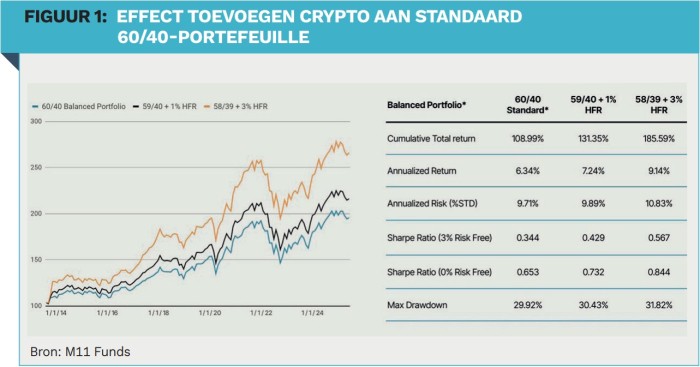
‘The reason is actually very factual. Various studies, including our own analyses, show that including Bitcoin, and even a limited allocation to altcoins, significantly improves the risk-return profile of a traditional portfolio. Not only do annualised returns and Sharpe ratios increase significantly, but drawdowns do not increase significantly either. From a portfolio theory perspective, this is a very powerful combination. We are also seeing these theoretical advantages being confirmed in practice. The first asset managers have already made an allocation through our fund, and in the coming months we expect a further inflow, mainly from traditionally oriented investors. There is a growing awareness that crypto is now a permanent asset class. We are seeing this trend not only in the Netherlands, but throughout Europe. Switzerland in particular is leading the way in this regard.’
From the outset, our ambition was to make digital assets truly investable for the traditional investment world.
What is the key reason to consider an allocation now?
‘The crypto market is still in the early stages of institutional adoption, but I believe we are on the cusp of a turning point. The aforementioned developments in the US, such as the Clarity Act and the previously adopted Genius Act for stablecoins, mark the emergence of a comprehensive regulatory framework. Once institutional investors in the US are able to embrace crypto in a permitted and regulated manner, the asset class is expected to enter a new phase of growth. It is likely that this effect will eventually also be felt in Europe and other regions. For investors who are looking ahead strategically, this is a logical moment to consider building up exposure before this influx takes place on a broad scale.’
What might a strategic allocation range look like for different types of investors?
‘In my view, the lack of a modest strategic allocation is a clear omission. It reminds me of earlier phases in which new asset classes, such as emerging markets or gold, initially met with resistance but ultimately proved to be essential building blocks within diversified portfolios. In terms of allocation ranges, we see that many asset managers start with 1% to 3% exposure, while family offices are often willing to allocate 3% to 5% or even slightly more, depending on risk appetite and investment horizon. With a relatively limited allocation, you can already benefit from the asymmetric return opportunities without the overall portfolio risk getting out of hand.’
Which risks are the most decisive and which mistakes do you see professional investors making most often?
‘I am pleased that more and more professional parties are taking crypto seriously. However, I do see one mistake recurring frequently: people usually start exclusively with Bitcoin, because it feels like the safe choice within a new asset class. That is understandable, but it may not be the place where the highest future returns can be achieved. It reminds me of investing in IBM or telecom companies during the internet boom: solid returns, but the real value creation was in the Amazons, Googles and Facebooks of the time. Today, the altcoin market offers a similar opportunity. There are now protocols and applications with an exceptionally attractive risk-return profile, which generate real income and whose value flows back to token holders. So, the essence is: diversification and thorough research. A well-constructed portfolio within crypto can have enormous potential, provided you look beyond the ‘big names’.’
|
SUMMARY A crypto fund that complies with the AIFMD regulatory framework is investable in a trusted and regulated manner for traditional asset managers. Research shows that crypto boosts returns and the Sharpe ratio without significant additional drawdown. The upcoming US Clarity Act could be a historic catalyst for global institutional inflows. The biggest beginner's mistake: buying only Bitcoin. A better approach is diversification, due diligence and selective altcoin exposure for optimal asymmetry. |