
Outlook 2026
Outlook 2026

This Outlook (except for the contribution of Luke Barrs) was originally written in Dutch. This is an English translation.
At the end of 2024, the experts we consulted at the time shared their expectations for 2025. They anticipated moderate growth for the global economy, a further decline in inflation, scope for interest rate cuts and a normalising investment climate. In addition, many of the experts expected stock markets to benefit from stable earnings growth, a slight decline in the dominance of the Magnificent Seven, and geopolitical factors – from trade tensions to elections – to continue to play an important role. It was also predicted that China would continue to struggle to maintain higher growth and that Europe would see only a limited recovery.
By Jolanda de Groot
Broadly speaking, these expectations for 2025 have been realised. Inflation continued to fall towards central bank targets, prompting both the Federal Reserve and the ECB to implement their first interest rate cuts. The global economy managed to achieve a soft landing: US growth remained positive but moderated, Europe showed signs of a cautious recovery and China stabilised, as predicted by various experts. Equity markets continued to rise, with the increase being more broadly based than in previous years, and bond markets benefited from the changing interest rate environment. At the same time, concerns about geopolitical tensions and fragmentation proved to be justified. Trade measures, election results and increasing rivalry between major powers regularly caused volatility.
This time, the various experts have focused their attention on the outlook for 2026. The central question is how the macroeconomic landscape will develop in a world that is still characterised by structural changes. Another important question is where the greatest opportunities for investors will lie in 2026 and what risks could influence market sentiment. Their answers together form the basis for the conclusion presented later in this Outlook for 2026.
|
Ralph Wessels Chief Investment Strategist, ABN AMRO
What is the economic outlook for 2026? ‘Investors have plenty of reasons to be optimistic about 2026. Equities remain attractive. At the same time, trends such as deglobalisation, high valuations and ever-increasing debt mountains pose risks. In a changing world, we expect the equity rally to continue in 2026. The main reason to remain positive on equities is that global economic growth will accelerate again. In addition, the fundamental picture remains positive, with double-digit earnings growth expected. Within equities, we prefer the US. Growth there is at a higher level and the region is more dominant in the field of AI. We see more and more investment opportunities emerging for “agentic AI”. In terms of equity sectors, we believe that the industrial sector will stand out due to investments in defence and infrastructure. We also remain enthusiastic about the financial services sector, which will benefit from economic recovery and a steeper yield curve. We are neutral on bonds with a neutral duration. We believe that the ECB has completed its cycle of interest rate cuts and that the Fed will lower its policy rate to 3% in 2026. At the same time, we see long-term interest rates in Europe and the US rising slightly. Within bonds, we still prefer high-quality bonds. Within that segment, we see more opportunities in covered bonds than in government bonds. We remain cautious on higher-yielding bonds because they are too expensive. Within this segment, we are neutral on EMD and negative on high yield. Finally, we are positive on gold, as central banks are structurally buying more gold and we expect the pound sterling to weaken further in 2026.’ |

|
Thomas van Galen Chief Strategist, Achmea Investment Management
Where are the biggest opportunities and threats for 2026? ‘The investment environment is currently defined by two harsh realities: inflation is structurally higher than in recent decades and geopolitical instability has returned as a permanent factor. This is not temporary noise, but the result of a world shifting towards a multipolar force field, in which economic blocs clash more often than they cooperate. In our Investment Outlook 2026, we show how five underlying transitions – geopolitical realignment, technological acceleration, demographic constraints, climate and energy transition, and high government debt – together form a new return regime that is putting pressure on the purchasing power of Dutch pension funds. The need to achieve real returns therefore remains as great as ever, even now that nominal interest rates are higher. This calls for a clear reorientation of portfolios. Whereas the trend in recent years has been mainly towards passive and liquid investments, we now see a greater role for real assets, alternative credit and active investing. These categories offer access to illiquid premiums, protection against inflation and more stability in a more volatile environment. Because equities are highly valued, we are first looking to broaden our range of alternative sources of return. Equities remain important for growth, but are no longer the only engine driving portfolios. Scenario thinking is key here: portfolios must be robust at the overall level under a variety of geopolitical, inflationary and growth path scenarios. We also see the new regime reflected in currencies. A deliberately weaker dollar under Trump and structural vulnerabilities in the eurozone make traditional currency anchors less reliable. That is why we believe that stores of value such as gold are worth considering again.’ |

|
Jacob Vijverberg Head of Asset Allocation / Portfolio Manager Global Diversified Income, Aegon Asset Management
What are the economic prospects for 2026? ‘Geopolitical tensions and the rise of artificial intelligence will continue to shape the economic climate in 2026. The United States' trade policy remains volatile; the Supreme Court may declare some tariffs invalid. So far, the negative impact of the trade war has been limited, but we expect it to increase somewhat in 2026. In the longer term, the loss of confidence, the need to become more independent from the US, and the further erosion of institutions, including the independence of the central bank, will have a greater negative impact. China is working to reduce dependencies, thereby strengthening its position in the trade war, while the US is maintaining its technological lead. Europe is lagging behind and needs time to become more independent in the areas of technology, energy and defence. Europe must tread carefully in the changing geopolitical landscape and invest heavily in defence and bringing back manufacturing. Major investments in data centres and energy infrastructure to support AI will stimulate growth, particularly in the US. In the longer term, AI can contribute significantly to innovation and productivity growth worldwide. In Germany, a fiscal stimulus package may provide slight support for growth, but challenges such as high energy costs and a lag in innovation remain. Overall, global growth will slow in 2026 as geopolitical uncertainties and trade barriers outweigh the stimulus provided by AI. The risk of a more significant slowdown or recession also remains.’ |

|
Han Dieperink CIO, Auréus
What are the economic prospects for 2026? ‘The year 2026 marks an acceleration in economic history. While artificial intelligence is revolutionising business models and promising unprecedented productivity gains, the global economy is still struggling with the aftermath of a decade of monetary experiments, trade tensions and geopolitical shifts. This is the era we live in: technological progress goes hand in hand with economic uncertainty, globalisation clashes with protectionism, and central banks balance between stimulus and stability. For investors, this new reality creates both challenges and opportunities. US equity markets are likely to reach new heights, driven by a handful of technology giants that account for three-quarters of all market returns. At the same time, interesting opportunities lie hidden in sectors that everyone has written off: from pharmaceuticals to basic materials. The dollar remains king against all expectations, the upward phase in gold is followed by the inevitable correction, and the November 2026 midterm elections are casting their shadow ahead. For the sensible investor, the solution lies in a disciplined “average in, average out” strategy. After all, it is impossible to time the peak of a bubble. This does not mean that you should abruptly dump all technology stocks, which would be throwing the baby out with the bathwater, but rather that you can gradually reallocate your portfolio to attractively valued segments outside the IT sector. This approach recognises both the potential of AI and the risks of overconcentration. By gradually taking profits on overvalued positions and reinvesting them in undervalued sectors, you can build a more balanced portfolio without running the risk of completely missing out on the final phase of the boom.’ |

|
Roelof Salomons Chief Investment Strategist, BlackRock Investment Institute
What are the economic prospects for 2026? ‘After years of adjusting to higher interest rates and geopolitical shifts, the global economy will be in a phase of moderate but resilient growth in 2026. Inflation will move towards target levels, although price pressure will remain due to shortages of energy, labour and raw materials. We are entering a new economic regime in which supply is more often the limiting factor. At the same time, growth dynamics are shifting structurally: technology, energy and policy together form the new framework. Artificial intelligence and automation are increasing productivity, but require adjustments in infrastructure and regulation. Central banks are cautiously normalising, but their policy space remains limited by high debt and persistent inflation risks. For investors, this means an environment in which long-term trends are more important than short-term cyclical fluctuations. We expect stable growth and falling inflation, with regional differences. The US remains robust thanks to lower interest rates and fiscal support, while Europe benefits from investments in defence, infrastructure and energy transition. Asia and emerging markets are gaining weight through regional production and technological integration. Equities remain attractive, especially in markets with strong earnings growth and solid balance sheets. Europe offers selective opportunities in financial institutions, industry and utilities. Bonds are regaining their role as stabilisers, with a preference for corporate bonds and shorter maturities. Private markets remain interesting through investments in energy security, digital infrastructure and industrial automation. Europe is at the heart of three structural trends – digitalisation, energy transition and security – which together form the basis for sustainable growth in the coming years.’ |

|
Daniel Morris Chief Market Strategist, BNP Paribas Asset Management
Where are the biggest opportunities and threats for 2026? ‘In 2026, flexibility and selectivity will be essential for investors as markets adjust to greater fragmentation of the global economy. Key themes for 2026 include the need for flexibility in fixed income strategies, given the challenges to economic growth and uncertain inflation expectations. We believe opportunities exist in defensive sectors, real estate and high yield investments, but a flexible approach is required. Fixed income markets are poised to benefit from continued central bank easing, with lower interest rates expected in both the US and Europe. With potential pressure on government bond yields due to fiscal concerns, particularly in leading economies, the overall environment remains favourable for credit markets, with their attractive yields and solid corporate fundamentals. Equity markets remain technology-driven, with US technology companies' earnings expected to grow robustly as artificial intelligence fuels capital expenditure and productivity gains. European equities offer compelling value, particularly as the region strives for greater strategic autonomy. Emerging markets, with their strong technology sectors, may benefit from lower US yields and a weaker dollar. Private assets, particularly alternative credit and real assets, continue to attract capital, supported by resilient fundamentals and favourable policy tailwinds, although selectivity and thorough credit analysis are becoming increasingly important. Sustainability remains a key focus. As regulatory frameworks evolve, European and Asian investors are leading the way in green bonds, decarbonisation and climate solutions. The transformative potential of AI remains, with robust fundamentals underpinning valuations and innovation creating new opportunities across various sectors.’ |

|
Jitzes Noorman Delegated CIO & Investment Strategist, Columbia Threadneedle Investments
Where are the biggest opportunities and threats for 2026? ‘First of all, alternative asset classes such as commodities and catastrophe bonds continue to score well in our Capital Market Assumptions (CMA) model this year. Commodities mainly because of their high expected returns, catastrophe bonds because of their combination of attractive returns and low risk. Furthermore, for both equities and high-yield bonds, the categories linked to emerging markets score better than those linked to developed markets in terms of risk-return ratio. This reflects, among other things, the strong performance of assets in developed markets in recent years, which has led to less attractive valuations and, looking ahead, slightly lower expected returns. The arguments in favour of the attractiveness of equities in emerging markets are the higher economic growth expectations and lower valuations. Another factor is that the correlation between equities in emerging markets and equities in developed markets is currently relatively low, which contributes to better portfolio diversification. Within fixed income spread products, we consider EMD LC to be the most attractive. The expected return is higher than for high yield bonds, while the assumed volatility is lower. There is no shortage of risks. These include ongoing geopolitical fragmentation, the unpredictability of Donald Trump's policies and a flaring trade war. Another concern is rising government debt, which, combined with higher interest rates in recent years, is putting pressure on the creditworthiness of governments such as the US and France. Finally, more and more investors are asking whether there is an “AI stock bubble”.’ |

|
Andy Langenkamp Senior Political Analyst, ECR Research
What are the economic prospects for 2026? ‘In 1986, Timbuk 3 scored a hit with The Future's So Bright I Gotta Wear Shades, in which optimism clashed with the threat of a nuclear apocalypse. That year, the S&P 500 posted a 19% gain. Forty years later, investors are once again in sunny spirits, with stock markets hovering around record levels. Once again, there is a threat in the air: not so much of nuclear war, but of new nuclear tests. The risk of this is becoming increasingly apparent. This fits in with the picture of gathering geopolitical clouds. The trend towards geo-economic fragmentation is strong. The politicisation of financial flows and trading systems will translate into less liquidity and higher credit risks and volatility. The key question becomes “how to operate in a fragmenting system with divergent rules, sanction regimes and data spheres?”. US-Chinese rivalry is the most decisive force. Technology, energy and raw material supplies, trade, financing and security are becoming more closely intertwined. Europe finds itself between two superpowers – and Russia – and, although it is not becoming a war economy, militarisation is playing a greater role. Defence budgets are rising sharply, while Germany, for example, is considering a return to conscription. Higher defence (and energy) spending, combined with overstretched AI valuations and sky-high government debt, pose an increasing risk, with a shift towards a world in which market volatility will be greater than in the decade following the euro crisis. Finally, a few events to keep an eye on: the simultaneous expiry of the truce in the US-China trade war and the US midterms in November. If the Democrats regain control of the House, Trump's policy space will be reduced. Furthermore, 2026 is an important election year in the emerging world. India, Mexico and Turkey will go to the polls against a backdrop of high debt, low(er) growth and growing inequality.’ |

|
Luke Barrs Chief Business and Client Officer for Fundamental Equity, Goldman Sachs Asset Management
What are the main opportunities and threats for 2026? ‘Looking ahead to 2026, we see several compelling opportunities and potential threats across global equity markets. In the US, the ‘Magnificent 7’ companies continue to demonstrate strong earnings. Beyond these tech giants, we see enterprise AI adoption accelerating across automation, customer engagement, and operational intelligence, creating opportunities including for integration platforms. Small-cap stocks in defense, technology, consumer sectors, and healthcare may offer growth potential, though higher volatility demands skilled active management. European markets show promise through increased capital spending driven by fiscal flexibility and reindustrialization, particularly in defense, energy, and financials. Japan benefits from moderating inflation, stable monetary policy, and potential fiscal support, with global megatrends in AI and semiconductors providing additional tailwinds. Emerging markets trade at approximately a 40% forward P/E discount to US equities, below long-term averages, suggesting this valuation gap may narrow given strong earnings profiles. However, several threats warrant attention. Performance among the ‘Magnificent 7’ is showing signs of greater dispersion rather than uniform strength, requiring careful monitoring of core business health as these companies aggressively invest in AI. Smallcap opportunities, while promising, carry higher volatility and liquidity risks that demand skilled active management to distinguish quality businesses from pockets of thematic exuberance. Additionally, for Japan, domestic politics and currency fluctuations will require close monitoring despite otherwise positive fundamentals.’ |

|
Sander van Ginkel Senior Investment Strategist, MN
What is the economic outlook for 2026? ‘It is uncertain whether the Supreme Court or a new Congress after the midterm elections will rein in Trump. We also expect a great deal of uncertainty and policy volatility in 2026. More important is how this short-term turmoil will affect the long term. To monitor this, we use a set of scenarios based more on megatrends. In these scenarios, we look at the major potential systemic changes over a 10-year horizon:
However, these scenarios are still too vague and are not our baseline expectation. In our baseline scenario, “Bend, don't break”, the global political, economic and financial order is under severe pressure, but survives by the skin of its teeth. Economic interests prevent further unravelling and mutual nuclear deterrence prevents a direct military clash between superpowers.’ |

|
Benoit Anne Senior Managing Director en Head of Market Insights Group, MFS Investment Management
What are the economic expectations for 2026? ‘The coming year will once again be characterised by a complex macroeconomic climate. Market volatility is likely to remain high due to ongoing geopolitical tensions, policy uncertainty, budget deficits and moderate growth. The US economy is proving resilient for the time being, although fiscal policy remains a significant source of risk. In Europe, the main question for investors in 2026 will be whether the high expectations for decent economic growth will actually be realised. Despite the mixed picture, the outlook for risk-bearing investments is predominantly positive. As long as there is no recession, equities worldwide will benefit from favourable market sentiment. However, prices in certain parts of the US stock market are currently very high. A broad geographical spread is therefore advisable. European and emerging markets offer interesting alternatives to the risks associated with holding US equities. Bonds are an effective means of limiting risk and diversifying portfolios. However, the return prospects for bonds are less favourable than two years ago. This is because interest rates are no longer as high and spreads are narrow compared to the past. As a result, there is little room left for either interest rates or risk premiums to fall. Finally, we believe that the dollar will remain sensitive to downward pressure in 2026, which could again benefit investment segments in emerging markets.’ |

|
Bob Homan Head ING Investment Office
What are the prospects for 2026? ‘The economic outlook for 2026 is not bad in itself. Global growth will remain reasonable, but we expect a lean year for investors. In Europe, we foresee a slight acceleration in economic growth compared to the current pace. This is mainly due to the introduction of additional fiscal stimulus measures. However, we believe that this stimulus will ultimately fall short of expectations. In the US, too, we expect the economy to pick up slightly towards the end of 2026. For China, we assume stable growth of around 4.5%. On balance, this results in a reasonable growth picture, in which corporate profits can increase. The consensus expectation for global equity earnings growth is 13%, but we consider this to be on the optimistic side. We are sticking to around 10%. On the interest rate front, we expect the Federal Reserve to cut interest rates further and the ECB to leave interest rates unchanged. Long-term interest rates may rise somewhat, mainly due to concerns about the sustainability of government debt. As a result, our yield expectations for bonds remain below the effective yield. Despite the tight spreads, we currently have a slight preference for corporate bonds. Our main concern with equities is valuations. These have already risen considerably and we see little upside potential. If earnings growth expectations are revised downwards, this could even lead to slightly lower valuations. In that scenario, the expected return on global equities would be limited to the dividend yield. Within equities, we currently prefer emerging markets and companies that are benefiting from structural growth in artificial intelligence.’ |

|
Richard Abma Chief Investment Officer, OHV Vermogensbeheer
Where are the biggest opportunities and threats for 2026? ‘As inflation fell in 2025, the European Central Bank was able to implement several interest rate cuts, but the aftershocks of years of tightening remain palpable. Short-term interest rates have fallen sharply, while long-term rates remain stubbornly high due to structural budget deficits, geopolitical uncertainty and the renewed focus on defence and energy transition. This tension is keeping capital market interest rates at a solid level and creating an attractive return climate for bond investors. Following the strong recovery of the bond markets in 2023, 2024 and 2025 – during which many investors were already able to benefit from higher coupons and price gains – the outlook remains favourable. The era of virtually interest-free markets is over. Those who actively respond to interest rate and credit differences now can also achieve stable returns in the coming years. The greatest opportunity lies in selectivity and active portfolio management. Differences between sectors, countries and maturities are increasing, making fundamental analysis decisive once again. Corporate bonds with solid balance sheets and limited maturities offer an attractive mix of return and stability, while medium-duration government bonds are adding value again. In addition, private debt continues to grow as a structural asset class. Companies remain dependent on non-bank financing, which means that well-structured SME loans with collateral or government guarantees continue to offer a risk premium of 1.5 to 2.5 percentage points above government bonds. The main threats are geopolitical fragmentation, rising government debt and liquidity risks in the event of sudden market shocks. In short, 2026 marks the consolidation of a new interest rate era: away from liquidity-driven returns, back to active management, credit insight and discipline.’ |

|
Robert Tipp Chief Investment Strategist, PGIM
Where are the biggest opportunities and threats for 2026? ‘In most developed markets, everything seems to point to a muddle-through scenario: low to moderate growth with inflation slightly above target, especially at the core level. This supports a potentially prolonged bull market in bonds driven mainly by income, rather than a short bull market fuelled by a rapid decline in yields. In the corporate bond market, spreads may narrow further, albeit to a limited extent. In addition, the yield curve is likely to steepen further, although long-term interest rates are now following short-term rates and appear to have clearly peaked in the US. This has positive implications for other Western markets, given the influence of the US market on correlations. In terms of technical factors, despite strong inflows into both equity and bond funds, money market funds remain surprisingly popular. In the third quarter, they swelled by nearly $300 billion. As a result, they not only reached an absolute record, but also historically high levels relative to GDP. All that money in money market funds represents a huge potential source of demand that could shift to equities and fixed income if the return on cash declines. In summary, the theme of “yield is destiny” is still driven by generous effective yields in the various markets. This theme could even gain momentum if a weakening US economy or a “Fed capture” scenario increases the downward pressure on interest rates.’ |

|
Peter van der Welle Multi-Asset Strategist, Robeco
Where are the greatest opportunities and threats for 2026? ‘According to our two outlooks for 2026, ‘The synchronised shift’ and ‘Holding the note’, the greatest opportunities lie in a rare but short-lived global economic upturn. This will be driven by easing trade tensions, a recovering manufacturing industry and the delayed effects of monetary easing. In the baseline scenario, the US economy grows by 2.1%, supported by AI-driven productivity gains and fiscal stimulus. The eurozone will benefit from fiscal expansion and the utilisation of savings surpluses, while China may experience a domestic recovery in the second half of 2026. For investors, this offers opportunities in stock markets outside the US, in emerging markets due to a weaker dollar, and in thematic investments in climate adaptation, clean energy and responsible use of AI. The green bond market also continues to develop. On the other hand, there are clear threats. The expected recovery will be short-lived, so flexibility remains crucial. In the bear scenario, there is a threat of a bursting AI bubble, rising unemployment and a mild recession in the US. Geopolitical uncertainties and policy dilemmas for central banks – balancing political pressure and a high-pressure economy – are increasing volatility. Meanwhile, climate-related physical risks are already having a measurable economic impact, stimulating the growth of transition-focused sustainable investment funds and financing through green bonds. Although sustainable investing currently faces challenges such as weak inflows, political polarisation and unclear regulations, the long-term trend towards sustainability remains intact. In 2026, tough choices and robust risk management will be necessary. In short: 2026 offers opportunities for those who respond to cyclical growth and sustainability themes, but requires vigilance in the face of temporary dynamics and structural risks.’ |

|
Joost van Leenders Senior Investment Strategist, Van Lanschot Kempen Investment Management
Where are the biggest opportunities and threats for 2026? ‘Looking ahead to 2026, we see two key uncertainties: the volatile trade war and the rapid advance of artificial intelligence. The trade war remains a game of escalating tensions and temporary détente, with no clear end in sight. For the US, we foresee a slight slowdown in growth and upward pressure on inflation, while other regions remain relatively unaffected. At the same time, the AI revolution in the US is offsetting much of this negative effect. Although the current dynamics are reminiscent of a euphoric bubble phase, we believe that structural demand is strong enough to support investment and further stimulate growth. In a resilient global economy, driven in Europe in 2026 mainly by gradually picking up consumption, we expect corporate profits to rise. This makes equities more attractive than bonds. US equities are pricey, but are benefiting from strong earnings momentum. Corporate bonds remain expensive due to low risk premiums. Within investment grade, we prefer the eurozone to the US. Here, we are counting on stable interest rates and a wait-and-see ECB. In the US, the Fed is likely to ease policy slightly, but we see upside potential for capital market interest rates due to sustained growth and high budget deficits. In short: opportunities lie mainly in equities, with a selective view on valuation and region. Threats come from geopolitical friction and possible corrections in AI-related segments.’ |

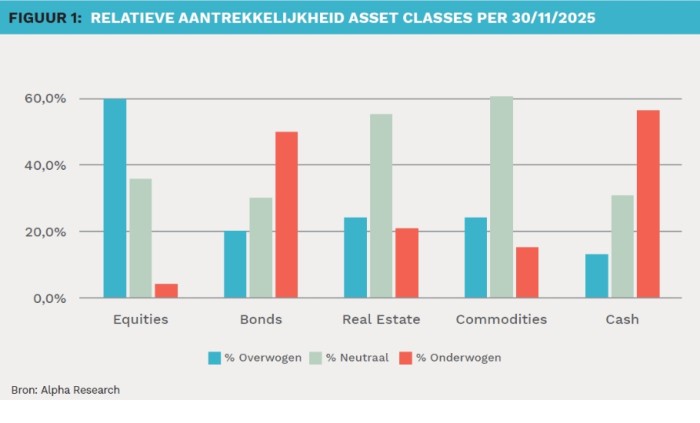
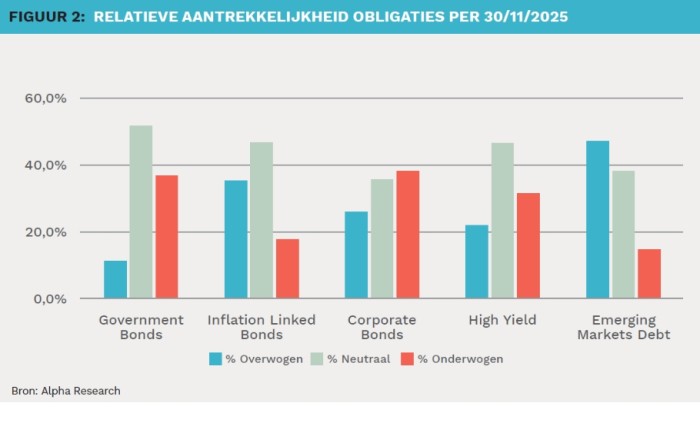
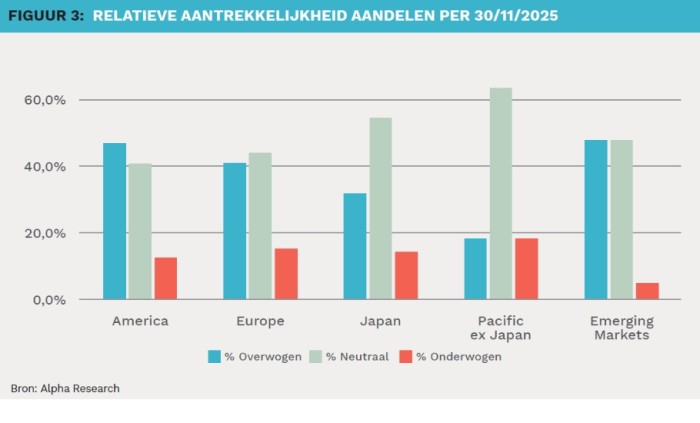
Conclusie
2026 tekent zich af als een complex en gelaagd jaar, waarin economische kansen en geopolitieke risico’s nauw met elkaar verweven zijn. Wat vooral opvalt in de Outlook-bijdragen, is dat beleggingsexperts het op een aantal kernpunten opvallend met elkaar eens zijn, terwijl hun accenten op andere gebieden juist uiteenlopen.
Over de structurele ontwikkelingen bestaat brede consensus: de wereld beweegt richting een gefragmenteerd geo-economisch systeem. De rivaliteit tussen de VS en China verdiept zich, handelsstromen en kapitaalmarkten worden sterker gepolitiseerd, en Europa zoekt zijn positie tussen deze machtsblokken, met hogere defensie-uitgaven en meer aandacht voor strategische autonomie. Deze trend wordt door vrijwel iedereen onderschreven, al is de mate van urgentie waar experts op wijzen verschillend.
Ook over de economische groei in 2026 zijn de meeste verwachtingen gematigd, al wordt benadrukt dat de economie veerkrachtig is. De Amerikaanse economie profiteert van AI-gedreven productiviteitswinsten en fiscale steun, al verschillen experts in hun inschatting hoe sterk dat effect werkelijk wordt. Europa groeit trager en ongelijker: sommige analisten zijn optimistisch over investeringen in defensie, energie en infrastructuur, terwijl anderen juist wijzen op structurele zwaktes, zoals hoge energiekosten. China laat een redelijk stabiel groeipad zien rond 4,5%.
Waar de visies sterker uiteenlopen, is bij de beleggingsstrategie. Een deel van de experts blijft positief over aandelen dankzij solide winstgroei en structurele AI-investeringen, anderen zijn voorzichtiger door de hoge waarderingen, vooral in de VS. Wel is men het erover eens dat opkomende markten aantrekkelijk gewaardeerd zijn en waardevolle diversificatie bieden. In de obligatiemarkt zien de meeste experts opnieuw ruimte voor stabiliteit, maar slechts beperkte ruimte voor verdere koerswinsten. Private assets – vooral private credit en real assets – worden breed gezien als structurele bouwstenen in portefeuilles.
Kansen liggen in:
- AI en technologie: structurele vraag naar automatisering en productiviteits- groei.
- Opkomende markten: aantrekkelijker geprijsd en profiterend van lagere Amerikaanse rentes.
- Duurzaamheid: klimaatoplossingen, energietransitie en groene financiering.
- Private debt en real assets: illiquide premies, stabiliteit en bescherming tegen inflatie.
Bedreigingen omvatten:
- Geopolitieke fragmentatie en handels-oorlogen.
- Oplopende staatsschulden en begrotingstekorten.
- Een mogelijke correctie in AI- gerelateerde aandelen.
- Liquiditeitsrisico’s bij plotselinge marktschokken.
Per saldo ontstaat een helder beeld: 2026 biedt kansen voor beleggers die inspelen op technologische innovatie, duurzaamheid en selectieve geografische spreiding, maar vraagt tegelijkertijd om alertheid op structurele risico’s. Het nieuwe rendementsregime vereist flexibiliteit, discipline en langetermijndenken in een wereld die steeds meer richting multipolariteit beweegt.
Attachments
Share this post!
Related posts
-
 Read more about "Schroders: Verstoring energievoorziening kan langer aanhouden dan aanvankelijk gedacht"
Schroders: Verstoring energievoorziening kan langer aanhouden dan aanvankelijk gedacht
-
 Read more about "BNP Paribas: Q1 Global Outlook"
BNP Paribas: Q1 Global Outlook
-
 Read more about "RBC BlueBay: Huidige marktdynamiek doet denken aan begin coronacrisis"
RBC BlueBay: Huidige marktdynamiek doet denken aan begin coronacrisis
-
 Read more about "Principal AM: Verbeterend sentiment ondersteunt de kracht van de markt"
Principal AM: Verbeterend sentiment ondersteunt de kracht van de markt
-
 Read more about "Payden & Rygel: Economics Forecast"
Payden & Rygel: Economics Forecast
-
 Read more about "Young Professionals: Soraya Grarji (AF Advisors)"
Young Professionals: Soraya Grarji (AF Advisors)
-
 Read more about "Payden & Rygel: Investment Grade Credit in 2026"
Payden & Rygel: Investment Grade Credit in 2026
-
Read more about "Carmignac: De prijs van veerkracht"
Carmignac: De prijs van veerkracht
-
 Read more about "Young Professionals: Herman Henken (Providence Capital)"
Young Professionals: Herman Henken (Providence Capital)
-
 Read more about "State Street: Groei ETF-markt stelt asset managers voor nieuwe uitdagingen"
State Street: Groei ETF-markt stelt asset managers voor nieuwe uitdagingen