Rens Borsje: Dedollarization!

This column was originally written in Dutch. This is an English translation.
By Rens Borsje, Senior Risk Consultant at Probability & Partners
The dominance of the dollar is under pressure due to shorter maturities, declining demand for Treasuries and (geo)political risks. What is yet to come? Or what is already happening?
In my opinion, the figures below illustrate perfectly what is going on. On the one hand, the maturity mix of US debt securities (US Treasuries) has shortened considerably in recent years. This shortening now results in a slightly lower interest rate (burden) on the national debt, but of course entails a huge refinancing risk.
Figure 1: Share of debt held by public by year of maturity
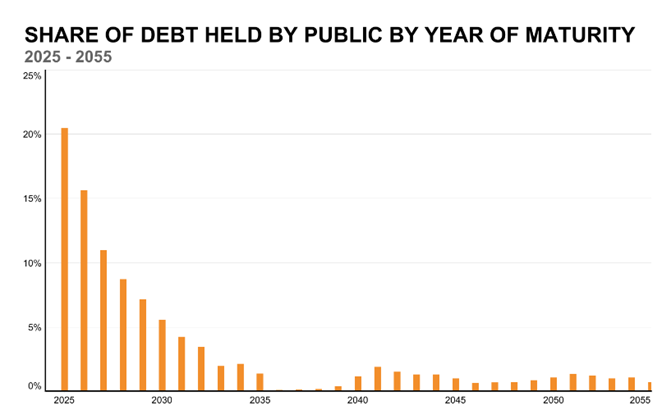
Source: Econofact.org
On the other hand, central banks are reducing their reserves in Treasuries:
Figure 2: Foreign central banks hold more gold than Treasuries
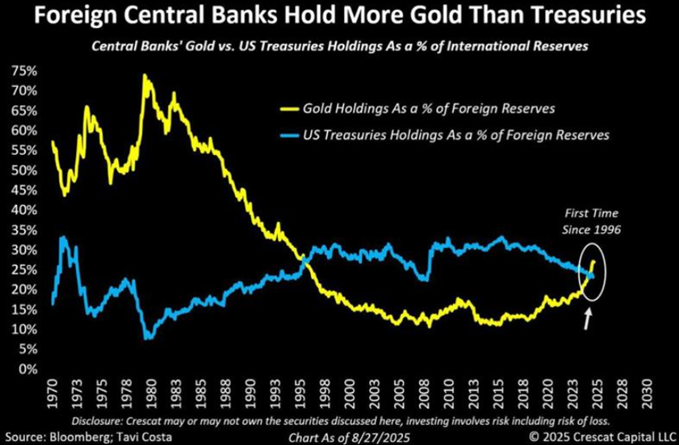
It is clear that Treasuries are no longer “the” safe haven and that gold, for example, is taking over this role.
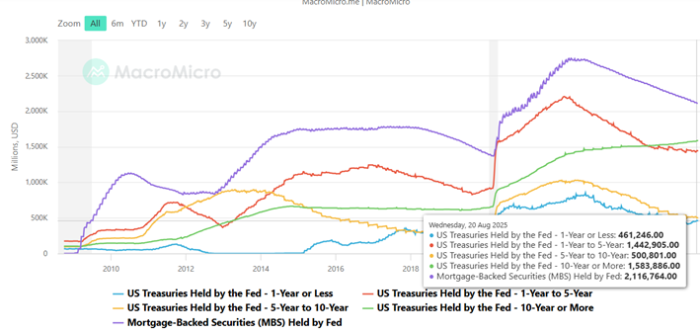
In addition, the Fed (like the ECB) is still phasing out quantitative easing. However, 10-year and longer-term Treasury holdings are growing. This amounts to pushing down the back end of the US yield curve (demand) in combination with less spending on the supply side.
Figure 3: US Treasuries held by the Fed
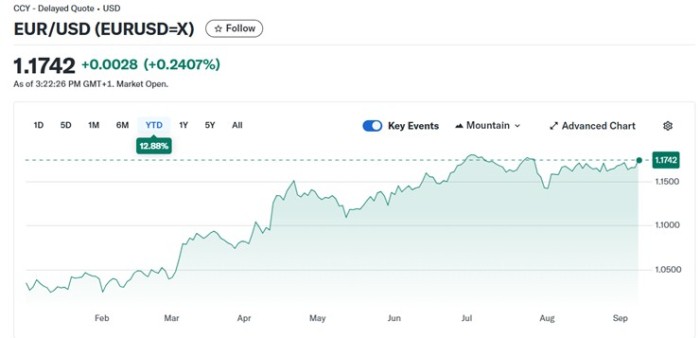
It is also increasingly becoming a topic of discussion for investors and asset managers: what to do with the US exposure of the portfolio. Driven by extra volatility in US assets and the added FX volatility of the USD or the costs of FX hedging, the allocated US weighting carries an increasingly greater risk. Logically, this higher risk results in a reduction of the position, assuming the risk appetite remains unchanged.
Figure 4: EUR/USD
Source: Yahoo finance
Macroeconomic instability
However, the financial markets still seem to be lagging behind what is actually happening. We are seeing one astonishing headline after another coming out of the US, while there is little actual response. After the initial commotion about the trade tariffs announced on Liberation Day and the relatively rapid recovery of the markets (except FX), I see increasing risk in the US:
- The US budget deficit is skyrocketing, while no serious steps are being taken to address this and it is receiving little attention.
- Since the start of Trump II, the US government has been continuously filling important positions with its “own” people, resulting in a loss of credibility. For example, the head of Statistics at the Department of Labour was recently replaced.
- Inflation expectations remain high in both the short and long term, despite the dip following the lack of effects and actual measures from Liberation Day. Food prices are skyrocketing and consumer confidence is plummeting.
- The latest macro figures from the US are not very encouraging, insofar as they are and will remain reliable.
- The pressure on Powell and the Fed to lower interest rates is only increasing in order to maintain the irresponsible spending pattern of the US government (for longer).
- Trump stands to gain from allowing the USD to weaken further in order to keep the national debt affordable and, in his view, increase the competitive advantage of the US.
- Even though the first version of the “Revenge Tax” in section 899 of the Big Beautiful Bill did not go ahead, I think it is unlikely that Trump will not try in some way to tax capital flows from the US in addition to goods flows. Either via individuals/companies or via direct interest payments on Treasuries.
- Due to the disappointing economy and/or increasing pressure from Washington, I expect there to be a greater chance of an interest rate cut in the US in the short term, with all the inflationary consequences that this entails.
The above summary is not a sustainable combination or a stable balance. Regardless of whether or not there is a master plan behind the actions of Trump and the Republican majority, Trump seems to radiate more of a “devil may care” mentality. The assumption that the current administration will continue to act rationally and that it will take responsibility for supervision and economically sound policy simply does not seem true to me, especially given the focus and actions of recent weeks.
The next crisis
As far as I am concerned, another crisis, starting in the US, is no longer an unlikely scenario, but one that is becoming increasingly probable. Inflation in the US can only rise. The dollar will soon no longer be the world's reserve currency and will continue to weaken, while the Treasury credit spread will skyrocket as demand for US debt securities declines. The Magnificent 7 will probably be the last to go under, given the declining level of market control due to the implementation of Project 2025 and their close ties to, and power within, the US administrative bodies.
Even if I turn it around and look at how the US could recover most quickly from the current situation, I see few positive paths to stabilisation. I would like to see a different, more competent government that is willing to actively tackle the national debt, market supervision, dollar weakness and inflation, no matter how painful that may be in the short term. Suppose the Democrats win the midterm elections and the US remains in deadlock for another two years before a new president can take office. In that case, I fear that the damage will already have been done and it will be too late to reverse everything.
Vance 1
Another scenario, of course, is that Vance takes over from Trump if his health fails him, or that another external player, driven by civil unrest, takes matters into their own hands. You cannot argue that this is an unlikely scenario, given all the (conspiracy) theories about Trump's health and the attack during the election campaign. This does not seem to me to be a better situation for the US. Vance appears to be an even stronger isolationist than Trump and even more intent on following the Project 2025 script.
Civil war
Another possible scenario is that populism will turn around and opponents of Trump/the current administration will unite and take power. Given Trump's recent deployment of the National Guard, the hardening of the debate between the two parties, and the building up and arming of ICE, I can hardly see this happening without bloodshed/civil war. This is obviously not a positive outcome.
Conclusion
Nobel Prize winner Paul Krugman actually sums this up best in his article, Why aren't markets freaking out:
'My read of economic and financial history is that market pricing almost never takes into account the possibility of huge, disruptive events, even when the strong possibility of such events should be obvious. The usual pattern, instead, is one of market complacency until the last possible moment. That is, markets act as if everything is normal until it's blindingly obvious that it isn't.'
My feeling is that a kind of game of chicken is playing out in the financial markets, where FOMO (fear of missing out) has taken over. Everyone wants to take advantage of the upside for as long as possible. After all, you can get out at any time and there is still plenty of time to do so. Missing out on returns because you got out too early is a mortal sin, especially if your competitor manages to pick up the slack. My main concern is whether Europe (and the rest of the world) will be able to detach itself from the US in time and unite, in order to limit the worst of the blow and not be dragged down with it.