
Russell Investments: A wider perspective on private markets

In which ways can investors future-proof their Real Assets investment portfolios?
‘The complexity of private markets has previously led some investors to steer away from the space. However, recent challenging economic conditions have further enhanced the role private market investments can play in portfolios. In order to future-proof portfolios, we believe investors should focus on the following key areas:
Diversification: More investors are now relying on private markets to help diversify their portfolios. This is due to a greater correlation between public debt and equities and growing awareness of the opportunity to diversify within the wealth of opportunities in private markets, from risk profile and strategy through to asset class.
Income preservation and predictable cashflows: More and more pension funds are considering private market investments for income. There is a range of approaches, from investing in long term predictable cashflows (for example: infrastructure) to private debt as an alternative to fixed income.
Responsible investing: Investors unaware of ESG and not integrating these factors into their investment processes may be exposing themselves to additional, unnecessary and possibly unrewarded risks. Through responsible ownership and the operation of Real Assets, particularly with real estate and infrastructure, investments can have a significant positive impact on the environment as well as returns.’
What is the role for sustainability and responsible investing in this?
‘Responsible investing is now globally recognised across both private and public markets, and the growth in the space seems set to continue. A recent survey by Bank of America showed 90% of millennials are ensuring their investments make a difference as their first investment criteria. Conversely, just under half of the baby boomers are prioritising their investments the same way, reinforcing the impression that demand for making a positive impact is increasing.
Furthermore, as government bodies around the world tighten regulations and guidance on responsible investing and sustainability, assets under management will likely continue to rise. Despite the challenges asset owners face when incorporating ESG factors into investment decisionmaking, the spotlight on responsible investing also presents an array of opportunities in the private sector.’
You argue for diversification. Is diversification also an option for smaller organisations?
‘Diversification is important regardless of the size of the investment portfolio. While size can influence implementation, a wide range of options exist to achieve requisite diversification needs. It is also important to diversify a private markets portfolio across other dimensions, including strategy, asset class, manager, vintage year, geography and sector.
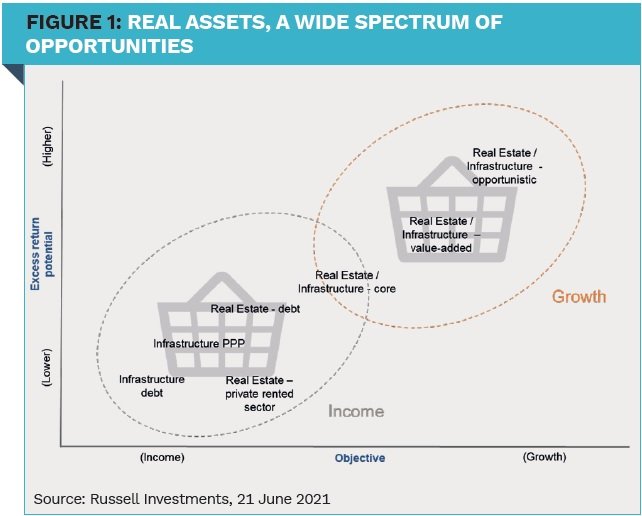
The ability to achieve exposure to a global opportunity set of sustainably focused investments can be challenging and is often restricted by internal skill sets. Obtaining private markets exposure through a multi-manager, multi-asset approach can provide investors with effective access as well as operational and reporting efficiencies, especially for small to mid-sized portfolios.’
What is the role of private markets in making Real Assets more sustainable?
‘There is a growing consensus around the importance of private investment to scale up sustainable development. Over the last couple of years, we have seen the private sector seize the opportunity to plug the gap for sustainable Real Assets. Examples include growth areas such as renewable infrastructure. While private markets offer compelling opportunities in terms of risk/return, they also enable strong influence over the stewardship of capital from a project standpoint. This makes private markets a robust channel for targeting and engaging in positive impact on environmental, social and governance causes.’
Which interesting trends do you see in impact investing in Real Assets?
‘Since 2015, we have witnessed climate change become one of the main sustainability issues being addressed through investment portfolios. Three themes we believe will make the biggest difference towards climate change mitigation include:
Energy revolution: Whilst renewable energy only accounts for 26% of the total generation today, the cost of solar energy and wind over the past ten+ years has gone down 89% and 70% respectively (Source: Global Trends in Renewable Energy Investment 2019, Frankfurt School, September 2019). The expectation is that renewable energy will make up 50-65% of power generation by 2050 (Source: Bloomberg New Energy Finance).
Incremental electrification: Efficiency comes not just from how energy is supplied, but also from how it is used. Various factors including 5G, energy efficiency, electrification of infrastructure and transport are expected to dramatically drive demand for electricity.
Decarbonisation of industry: The substitution of fuel sources is needed to support and manage sustainable growth as well as climate transition risk. Decarbonisation will require fundamentally different energy, by using alternative energy sources based on green electricity and green molecules, such as biofuels and hydrogen.’
Which challenges do you see on a global scale when it comes to becoming more sustainable in Real Assets?
‘One ongoing challenge is benchmarking. As with Real Assets, the opaque nature of the market and comparing these assets are common challenges. The investable universe is very large across Real Assets, increasing the challenge. However, we do see improvements being made through new standards including GRESB, which is a global ESG benchmark for Real Assets. For impact strategies, organisations such as GIIN help to provide investors with guidance on suitable impact metrics.
Another challenge the market faces is ‘greenwashing’. Managers with a lack of true commitment often market standard private market funds as ‘impact’. The demand for sustainable assets, especially those tied directly to UN Sustainable Development Goals (SDGs), is elevating prices within the market. It’s a reminder that, from a fiduciary standpoint, it is as important, or even more important, to fully assess the investment merits of these assets.
Finally, private markets already include an opaque and complex mix of strategies. The mix of strategies is only growing with the adoption of responsible investing and implementation of impact mandates. One by-product is an increase in new offerings. For less experienced investors, committing to ‘first-time’ managers, who often have limited contiguous track records as an operating team, can be daunting to underwrite.
The range of opportunities and risks highlight the importance of partnering with talented investment professionals. Those with access to elite operating partner networks and those who possess highly aligned professionals with the ability to source opportunities and appropriately identify an evolving set of risks. As the strategies broaden and mature across Real Assets, we believe incorporation of ESG into the cost of capital estimates and investment thesis will be crucial to both sustainable and responsible growth of Real Assets across the globe.’