
Invesco: Rethinking pension investment implementation under the Wtp
Invesco: Rethinking pension investment implementation under the Wtp

Under the Wtp, Dutch pension funds face the challenge of aligning investment implementation with each participant cohort’s intended risk profile and outcomes, while retaining collective investment and risk-sharing features.
By Georgina Taylor and Joanne Job
Under the Future Pensions Act (Wtp), the main challenge for Dutch pension funds is the shift from managing a collective portfolio to managing outcomes for different member cohorts. The funds will need to keep portfolio implementation aligned with each participant cohort’s intended risk profile and outcomes. That shift has implications for a fund’s investment processes, operating model, and participant communications.
Defining cohort outcomes and communicating with participants
Rather than looking only at the overall fund’s risk and return, pension schemes now need to understand how different age cohorts experience investment risk, growth, and retirement income over time. In practice, this means evolving from managing a single portfolio risk budget to managing risk across multiple participant profiles, each with different horizons, objectives, and retirement needs.
Participant communication is critical in this process. A pension fund’s investment approach must be explained in terms participants can understand. As pensions become more personalised, participants need clear explanations of portfolio exposures, how risks and returns are allocated, and how the investment approach supports their objectives.
Pursuing cohort outcomes collectively
The Wtp does not require funds to choose between cohort differentiation and collective investing. Under the solidarity contribution scheme, for example, assets remain collectively invested while financial results are allocated to age cohorts through predetermined rules.
The solidarity scheme retains important elements of risk pooling and stability, while allowing investment strategies to become more cohort-aware. The challenge is to deliver differentiated outcomes across cohorts without losing the scale, risk sharing, and efficient implementation that have traditionally underpinned the Dutch pension system.
Pension funds need to assess whether their collectively managed portfolios provide exposures consistent with each cohort’s intended risk-and-return profile. Schemes therefore need allocation rules, investment processes, and oversight that work together, rather than treating policy design and implementation as separate exercises.
Keeping exposures aligned with cohort targets
Defining an appropriate risk profile for each cohort is a starting point. From there, actual portfolio exposures need to remain consistent with each cohort’s intended risk profile as markets, participant capital, cashflows, and interest-rate conditions change. A portfolio can align with its target during initial implementation, yet drift from that goal before the next formal review.
As a result, schemes need to define what constitutes a material deviation, who is responsible for identifying it, and when action should be taken. Monitoring should look beyond aggregate performance to whether each cohort continues to receive the intended balance of growth, income, diversification, and liquidity. The objective for pension funds is to execute disciplined implementation adjustments when actual exposures materially depart from a cohort’s intended risk profile and outcomes.
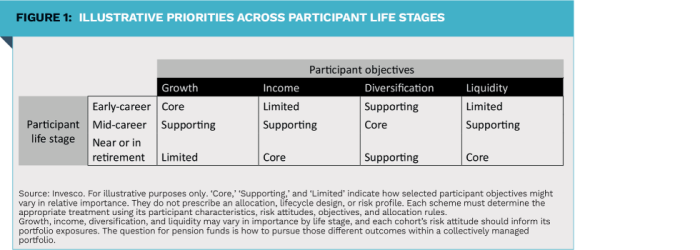
Maintaining alignment across multiple cohorts requires timely administrative and actuarial information, portfolio visibility, clear decision rights, and reporting. Together, those functions must quickly identify and address material differences between intended and actual exposures without creating disproportionate complexity. Ultimately, the key requirement is scalability. Pension funds may need to support more personalised outcomes without creating excessive operational complexity.
Considering private markets for different cohorts
Alongside portfolio implementation, pension funds are increasingly assessing new investment opportunities. Private assets are one area currently in focus. This asset class should be assessed based on its role in the overall portfolio and its alignment with the relevant cohort’s intended outcome. Depending on the strategy, private assets may offer potential return generation, income, diversification, or inflation-hedging capabilities. The suitability of private assets for each cohort depends on their investment horizon and the scheme’s broader liquidity needs.
Funds should weigh the potential benefits of private assets against risks such as valuation uncertainty and illiquidity. They therefore need visibility into cashflows, commit ments, and portfolio liquidity. The important consideration for schemes is whether the allocation can remain compatible with cohort objectives as participant needs and market conditions evolve.
Different private asset investment structures can have different implications for liquidity, access, valuation frequency and governance, and should therefore be considered alongside the underlying strategy. The investment structure is only one component. Liquidity management, valuation, governance, and transparency matter just as much.
Choosing partners that help connect implementation and outcomes
Dutch pension funds are not alone in their transition under the Wtp. The most valuable partners to Dutch pension funds will be those that can connect investment strategy with implementation and investment outcomes. Relevant partners may include pension administrators, fiduciary managers, asset managers, actuarial specialists, communication professionals, and technology providers.
Asset managers, for example, can help assess whether portfolio exposures and mandates remain consistent with cohort objectives. They can also explain the intended outcomes, risks, and roles of underlying investments in language pension funds can adapt for participants to help them feel confident in the outcomes schemes are delivering. Furthermore, managers with global defined-contribution experience can share lessons from other markets that Dutch pension funds may find applicable.
With their partners, schemes will need to enhance their portfolio implementation process to effectively serve the needs of their participant cohorts under the Wtp.
Clear communication can also help participants understand how the invest ment approach supports their pension outcomes.
|
SUMMARY Under the Wtp, Dutch pension funds need to ensure investment implementation remains aligned with each participant cohort’s intended risk profile and outcomes. Funds need timely information and clear decision rules to identify and address material differences between targeted and actual portfolio exposures. Effective investment implementation connects portfolio management, operational capabilities, participant communication, and external partners. |
Read the report in the digital magazine