
Erik Winands: Climate risk management in the banking sector, from insight to action
Erik Winands: Climate risk management in the banking sector, from insight to action

This article was originally written in Dutch. This is an English translation.
Record temperatures, forest fires and floods continue to illustrate the consequences of climate change in 2026. For banks, the key question is how they can translate their growing understanding of climate risks into responsible decisions.
By Marieke Bonekamp, Head of Climate Risk, Rabobank, Reintje Maasdam, Lead Climate & Environmental Risk Analytics, Rabobank, and Erik Winands, Professor by special appointment in Quantitative Risk Management, Universiteit van Amsterdam, and Head of Capital Adequacy and Scenario Analyses, Rabobank
From awareness to quantification
Climate change is having an increasingly direct impact on banks’ financial risks. That is why, in recent years, they have invested heavily in climate data and climate models, ranging from heatmaps and client scores to scenario analyses. This is not only to meet the growing expectations of regulators, but above all to gain a better understanding of their clients’ vulnerability and resilience. This is particularly relevant for Rabobank due to its close ties with the Food & Agri sector. For businesses in this sector, climate change is not a long-term issue, but has direct consequences for their revenues and competitive position.
Banks are mapping physical and transition risks in ever greater detail at client and portfolio level. Nevertheless, uncertainties remain due to the long time horizon and the unpredictable nature of climate change. Scenario analyses help to address this. They do not predict the future, but they do provide transparency regarding possible developments, vulnerabilities and the effects of measures.
Climate risk management, however, requires more than just analyses. Equally important is the development of knowledge and expertise throughout the organisation. Whereas climate change was previously mainly the domain of sustainability specialists, it is now part of the day-to-day practice of, for example, credit analysts, portfolio managers and directors.
From quantification to steering
Now that the basis for quantification is becoming increasingly robust, the focus is shifting towards using these insights in decision-making. This involves, for example, dialogue with clients, risk limits and portfolio-level objectives. After all, climate analyses only have real value when they lead to better choices. The challenge is that banks today must make decisions about risks that may not fully manifest themselves for years.
For example, physical climate risks are mapped by combining geolocation data with climate data. This provides both the bank and the customer with insight into exposure and potential measures. A dairy farm that relies on vulnerable water sources or a fruit grower in an area with an increasing risk of drought is not automatically assessed as being higher risk. However, it does provide a clearer picture of the measures and investments that may be needed to ensure these businesses remain future-proof in the longer term.
To make sound investment decisions of this kind, a reliable assessment of the effectiveness of these measures is required. Banks, businesses, insurers and public authorities must also work together on climate adaptation and its financing. By pooling knowledge and resources, the necessary investments can be implemented in a timely manner and on a broad scale.
Mapping physical climate risk: from location to financial impact
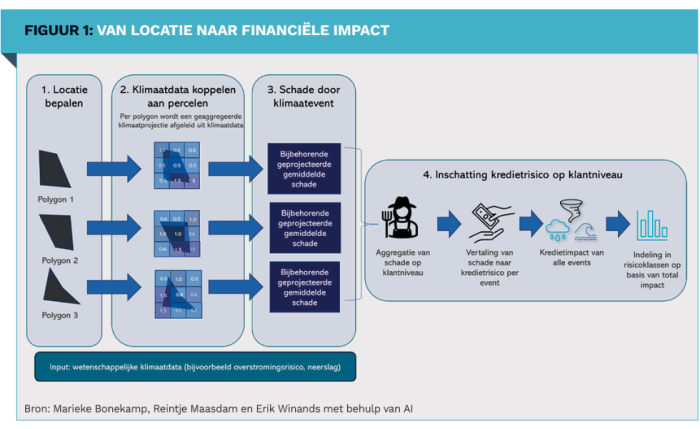
To determine the physical climate risk for a client, we follow four consecutive steps, as illustrated in Figure 1. Location is the decisive factor when it comes to physical risk. We therefore first map the client’s land parcels geographically. By establishing the exact location of each parcel, we can determine which climate risks it is exposed to.
Next, a climate impact analysis is carried out for each plot. In doing so, we use climate science datasets that provide insight into the intensity and frequency of various climate events, such as droughts, floods, wildfires and water scarcity. For the Netherlands, data from the National Information System for Water and Floods (LIWO) and the KNMI, amongst others, is used. The level of detail depends on the risk. For example, flood data is presented in 15-by-15-metre grids, whilst drought data is shown in 12-by-12-kilometre grids.
The challenge is that banks today have to make decisions about risks that may not fully materialise for years.
In the third step, the impact of these climate events on agricultural yields is determined for the agricultural sector. For each type of event, an expected yield reduction is calculated on the basis of scientific literature. These so-called damage functions are tailored to the specific sector and geographical location, ensuring that the calculations reflect the actual relationship between climate stress and agricultural productivity as accurately as possible.
Finally, the impact on yield is translated into credit risk. Sector-specific assumptions are used here, such as the price elasticity of demand and the fixed cost structure of farms. This outcome is ultimately translated into internal risk categories.
Managing under uncertainty
Climate risks currently receive less public attention than geopolitical developments, artificial intelligence and digital resilience. Yet they have not disappeared from the agenda. On the contrary, we see the consequences every day in discussions with clients who are facing increasingly extreme weather conditions. It is precisely in these issues that risk management, entrepreneurship and sustainability converge.
The foundations for analysing climate risks have been laid, and the findings are increasingly being incorporated into management decisions in a targeted manner. Climate risk management requires careful consideration, but complete certainty is an illusion. After all, anyone waiting for certainty when it comes to climate risk is, in all likelihood, waiting too long.
|
IN SHORT Climate data and climate models are becoming increasingly important. The focus is shifting from risk analysis to concrete management. Climate adaptation requires cooperation between banks, businesses, insurers and governments. Despite uncertainties and reduced public attention, climate risks remain urgent. |
Read the full report in the digital magazine