Cardano: Financial resilience in an uncertain world
Cardano: Financial resilience in an uncertain world
This interview was originally written in Dutch. This is an English translation.
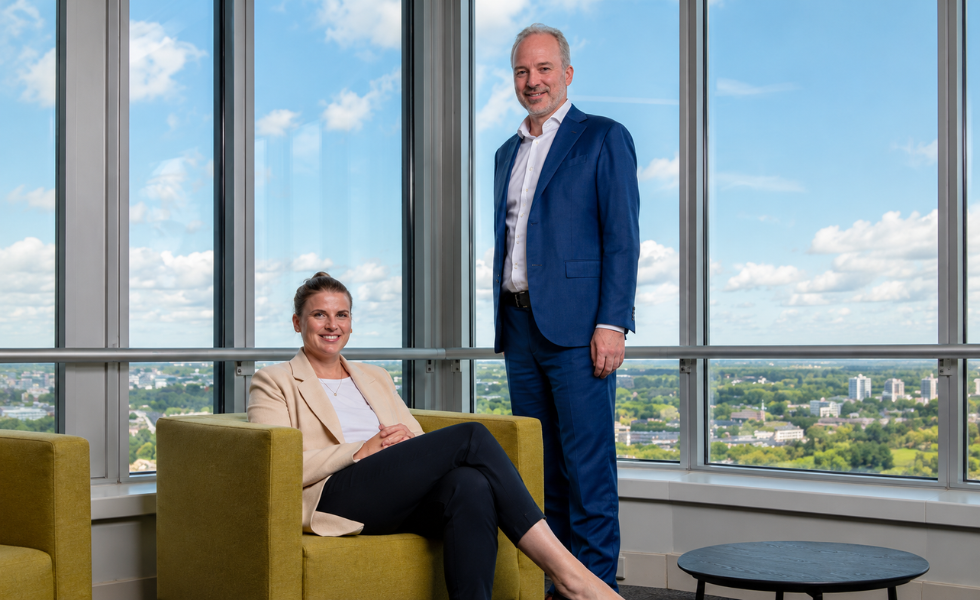
Jorg Sunderman and Noortje de Beijer-van der Vorst of Cardano see the institutional investment world changing rapidly. Their response: scenario planning, the ability to execute, and the conviction that resilience pays off.
By Michiel Pekelharing
What are the most significant developments in the world of institutional investment?
Jorg Sunderman: ‘There are three global trends that really stand out. The first is demographic change, combined with individualisation. From an investment perspective, this is a driving force behind, for example, policy, consumption and innovation. In an ageing country such as the Netherlands, issues such as healthcare are becoming increasingly prominent, whilst in a relatively young country such as India, issues such as youth unemployment are coming to the fore. Closer to home, demographic change is evident as the driving force behind the transition from a collective to a more individualised pension system. It will be interesting to see to what extent support for the system remains strong. As part of this demographic shift, we are now seeing, on the wealth management side, the transfer of wealth between generations, which is bringing about a change in financial services and investment preferences.
The second trend is climate change and the energy transition, which is closely linked to it. The need to move towards a more sustainable world, in which energy is also generated sustainably, is becoming increasingly clear. This offers investment opportunities for institutional investors, but also raises awareness of the risks that may materialise.
The third is AI and far-reaching automation. Technology companies are investing enormous sums in artificial intelligence, and that money must be recouped. This raises the question of who will reap the benefits. Bill Gates put it beautifully recently when he said that AI could become ‘the great equaliser’, making high-quality knowledge widely available at low cost all over the world. At the same time, there are concerns about employment and a shift in power from labour to capital. It is vital that we, as individuals, companies and governments, give this careful collective consideration, so that this shift takes place in an inclusive manner.’
The urgency often only really sinks in once the risks are upon us. What does that mean for the way in which pension funds and insurers need to look ahead?
Noortje de Beijer-van der Vorst: ‘In the absence of a crystal ball, we rely on the power of scenario planning. We define a limited number of extreme scenarios in which all major trends play a role. We then test these against a client’s policy. In the positive scenarios, you want to be able to capitalise on the opportunities and pass those benefits on to members or policyholders; in the negative scenarios, you want to be certain that you can weather them as well as possible. It is very important to really put yourself through those scenarios. Only then, as a board member, do you truly start to think about what you would do in practice.
Ten years ago, we developed the Cardano Pension Sim. This is a simulation tool that enables pension funds to monitor the effects of their investment policy across various economic scenarios. The tool has recently been updated to ensure it is fully compliant with the Wtp. Within it, board members can simulate an economic scenario from the perspective of three individual, fictional members and immediately see how purchasing power and other financial indicators are affected. This helps in two ways. Firstly, it allows you to assess in advance whether your policy is sufficiently resilient to all scenarios. Secondly, it helps you in a situation where a negative scenario materialises. If something like that actually happens, you will at least have experienced it before and know what you intended to do. Such a simulation quickly exposes vulnerabilities, and we see the lessons really being reflected in our clients’ policies.
You serve a wide range of institutional clients through a single central strategy. How do you ensure that this strategy remains relevant and focused for each client group?
De Beijer-van der Vorst: ‘From our central commercial organisation in Rotterdam, we serve pension funds, insurers, wealth managers, banks, family offices and not-for-profit foundations. We expressly do not offer the same solution to every target group. The common thread running through this broad client base is that they bear responsibility for the assets or pensions of others. Furthermore, the belief in scenario-based thinking and resilience is relevant across the board. We do not see ourselves as a fiduciary, but rather as a strategic investment partner and, above all, as a problem-solver. In certain areas, we possess a great deal of specialist knowledge and can add significant value. This may mean something different for each client, but we always approach it from the perspective of the in-depth expertise we have built up over the years. The core of our proposition is not breadth or standardisation, but better choices for our clients through strategic direction, scenarios and specialist execution.’
Sunderman: ‘Three themes recur across all client groups. The first is balance sheet risk management and, above all, the holistic thinking behind it. This revolves around the question of where a client wants to go and what risk-return profile goes with that. The second is sustainable investing. This is truly ingrained in our DNA, and we see clients increasingly setting their own priorities in this area. The third is private markets, where you can make an impact and offer client groups access to an asset class that provides significant added value in virtually any portfolio. That core principle keeps the strategy focused, whilst the implementation is often tailored to each client.
What does the name change from Mercer to Marsh People and Investments mean for Cardano?
Sunderman: ‘Cardano remains Cardano. Nothing has changed in substance, apart from the name change from Mercer to Marsh People and Investments with effect from 1 September 2026. Since the acquisition of Cardano in 2024, clients have already had access to a broader range of knowledge, expertise and solutions, and that will remain the case. Cardano and Marsh are, incidentally, entirely complementary. Marsh People and Investments operates from a consultancy perspective and is the world’s largest manager-selection firm, investing entirely through external managers. Cardano, on the other hand, is closely attuned to the financial markets and has direct sustainable investment strategies and its own trading desk. Together, we help asset owners in the best possible way to meet future obligations in an uncertain world. In doing so, we combine our expertise, data, scale and global reach with solutions in the areas of private markets, risk management, sustainable strategies, impact and more. The client groups accustomed to Cardano will continue to be served under the Cardano brand, and the same applies to the services that will now continue under Marsh’.
Could you give an example of how the combination of risk management, research and execution capability has led to a concrete result for a client?
De Beijer-van der Vorst: ‘A good example is a large pension fund that wanted to allocate a portion of its assets specifically to make an impact on themes closely aligned with its members’ interests. If you want to make an impact through investments, you soon find yourself in private markets. Categories such as private equity, private debt and property, in particular, involve very specific risks, where experience counts for a great deal. After all, once you’ve invested, you can’t simply pull out. Cardano brought its in-depth impact expertise to the table. What’s more, we have over 25 years’ experience in the Dutch pension market. So we knew exactly what a proposal to a pension fund board needed to include. However, we didn’t have a long-standing track record in every private market category. Marsh does, in the form of a global platform with a network of the best managers, access to scarce deals, extensive data and experience with primaries, secondaries and co-investments. You need both for this proposition. That way, you can construct a portfolio that makes perfect sense from the perspectives of both risk and return, as well as impact. We have already welcomed our first client for this.’
Sustainable investing and impact investing are increasingly coming under the microscope internationally. Does this make institutional clients more cautious in their choices?
Sunderman: ‘The public debate often centres on whether sustainability comes at the expense of returns. We believe that this dichotomy is too simplistic. In fact, there are investments where risk, return and impact go hand in hand very well. It is a long-term issue whose consequences we will increasingly see, and as far as we are concerned, this must be taken into account in an investment portfolio. Alongside an awareness of the risks, there are also investment opportunities.
Among the client groups that are genuinely engaged with this issue, we see that they have simply stuck to their strategy, regardless of market sentiment. Ultimately, I believe that is also their fiduciary duty. Surveys conducted by pension funds amongst their members consistently show that participants consider this an important issue. You do notice, however, that people are sometimes a little less explicit about it now. Depending on market sentiment, the topic is discussed to a greater or lesser extent. But the underlying trend continues. If there is an issue surrounding a company in the portfolio, we can always explain why it is or isn’t included. It is easy to exclude anything that is even slightly controversial. But anyone who wants to make an impact will have to drive change; simply excluding things won’t create a sustainable world. Our belief in driving the transition has therefore not changed. It’s the same as it was five or ten years ago. We do recognise that sustainability doesn’t develop in a vacuum, but we have always been consistent about it in our communications.’
What drives you personally to work towards people’s financial resilience, and how does that translate into your organisation’s current approach to risk management?
De Beijer-van der Vorst: ‘I’ve been working here for fifteen years now and have been part of much of this journey. After studying Biomedical Technology, I completed a Master’s in Econometrics. When I spoke to many companies after my studies, Cardano immediately stood out because of its philosophy and its mission to contribute to a better quality of life through financial services. This means that even in times of great uncertainty and turmoil in the financial markets, people can count on a secure income. At Cardano, my passion for solving complex technical problems and creating social impact come together. Fifteen years on, I still see that reflected in the people around me, only now with a much broader scope and a much wider range of activities.’
Sunderman: ‘My personal motivation has always been to leave the world a little better than I found it. That might sound a bit saccharine, but it’s a genuine driving force both in my career and in my private life. I originally chose to study Business Administration because I realised that, at the end of the day, the world revolves around money and interests. With Cardano, I’m now working to promote people’s financial resilience in a sustainable, liveable world. We call that resilience. The connection I feel with Cardano lies in its passion for sustainability and that financial resilience. This means we truly stand behind our clients and ensure they are successful and achieve their investment goals. If they are successful, so are we. But in my private life too, by actively volunteering at the Haaglanden Food Bank, I try to do my bit to contribute to the resilience of the city where I live.
|
Jorg Sunderman Jorg Sunderman has been CEO of Cardano Nederland since January 2025. Prior to that, he spent three years there as Head of Sustainable Asset Management and served as COO & Deputy CEO at Actiam (later acquired by Cardano). He began his career at Robeco, where he worked for almost 20 years, including as CFO/COO of Canara Robeco in India and as COO Asia Pacific in Hong Kong. Sunderman studied Business Administration at Erasmus University Rotterdam and is a board member of the Haaglanden Food Bank. |
|
Noortje de Beijer-van der Vorst Noortje de Beijer-van der Vorst has been Chief Commercial Officer (CCO) at Cardano Nederland since September 2023, where she is responsible for commercial strategy and client services. She has worked at Cardano since 2011, where she started in Risk Control & Operations and progressed to become Head of Client Servicing & Advice. She studied Biomedical Technology at Eindhoven University of Technology and Econometrics at Tilburg University. |