
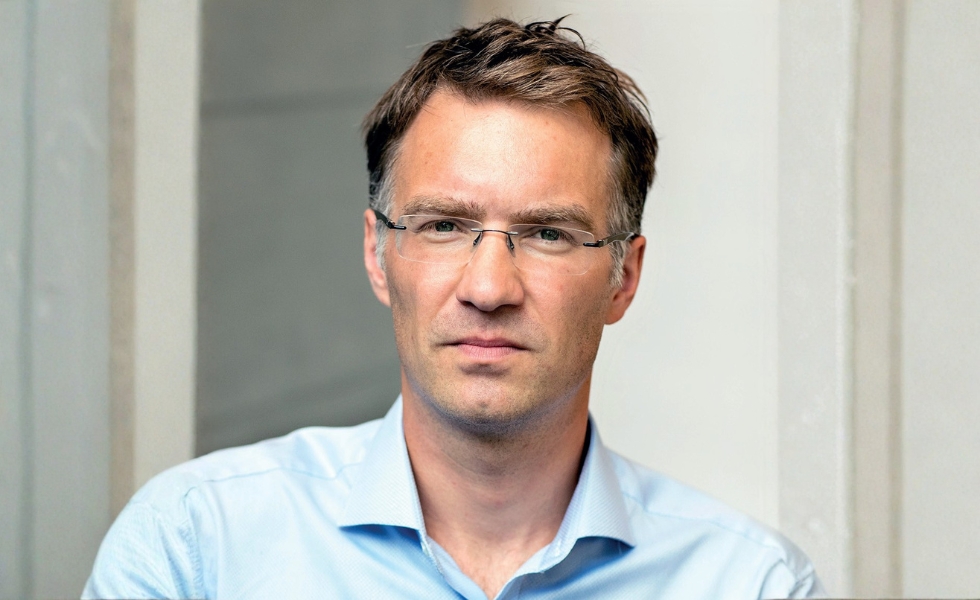
Joël van der Weele: People are by no means always interested in the truth
This article was originally written in Dutch. This is an English translation
Professor Joël van der Weele conducts research into how people deal with information, moral considerations and self-interest. According to him, rational decision-making can exacerbate polarisation. He also investigates how we can counteract ‘moral wiggle room’ – the leeway people allow themselves to justify morally dubious choices. Finally, he emphasises the importance of nuance and robust evidence in a field of behavioural economics that is still very much evolving.
By Harry Geels
It is often claimed that society is becoming increasingly polarised. Is that an accurate picture?
‘If we view polarisation as differences of opinion, I would say that this is nothing new. There are actually two types of polarisation: ideological and affective. The first refers to disagreement over political views, whilst the second concerns how we feel about people with different views. There is little evidence that ideological polarisation has increased in recent decades, not even in the US. Affective polarisation has, however, increased – in Europe, but particularly in the US. That is, of course, a problem, because it is harder to cooperate if we do not trust one another, and in some cases it can even lead to tensions or violence between people.
The role of social media in polarisation is not so easy to determine, as we often live in ‘bubbles’ even outside of social media. On the one hand, social media makes it easier for like-minded people to find and reinforce each other; on the other hand, it presents us with a more diverse range of opinions. Experiments in which people were, for example, unable to use certain social media platforms for a period of time show that the effects on political polarisation are relatively small. In contrast, the evidence for negative effects on young people’s mental health, for example, is much clearer. However, it is difficult to draw definitive conclusions because such research also requires the cooperation of the platforms.
Scientific studies show that people are unwilling to engage with certain information, or are even willing to pay to avoid receiving it.
There is, however, evidence that when people spend time with those who hold different political views, this can lead to greater mutual understanding.1 It is therefore important that we listen to those with differing views as much as possible, including in the academic world, unless, of course, they incite violence or spread hate speech. But people are often not inclined to do so. For example, I was surprised by the commotion that arose at my university when Jordan Peterson came to speak. He had to be provided with security, and I was unable to get to my office because of the protests. We must do everything we can to keep the dialogue going.’
Do ‘biases’ such as ‘willful ignorance’ or ‘selective perception’ also underlie polarisation? And do they have economic consequences as well?
‘Scientific studies show that people do not want to take in certain information, or are even willing to pay not to receive certain information. Israelis and Palestinians, for example, pay to avoid seeing the suffering of the other side.2 And some people who eat meat pay not to see information about meat production.3 In some parts of the US, it is even forbidden to film within the meat industry.
Such selective attention does indeed lead to polarisation. People are then quick to talk about ‘biases’, as if this behaviour stems from irrational considerations. However, it is often quite rational to avoid information or to seek it out selectively. For instance, life is a lot easier if you adapt your opinions to the group you are part of. A touch of overconfidence in your own opinion can also be quite useful if your aim is to persuade others. In short, people often do not think like scientists, but more like a press officer or a lawyer seeking to defend a particular position, and that can be quite useful in many circumstances.
People often don’t think like scientists, but more like a press officer or a lawyer seeking to defend a particular position.
Of course, there are also ‘biases’ that are less rational, such as ‘anchoring’, where your behaviour is unconsciously influenced by irrelevant figures. People also make many mistakes when dealing with probabilities, such as ‘baserate neglect’. However, we should generally be cautious about spectacular examples of cognitive failure. In social psychology, there has been a ‘replication crisis’, in which much research proved irreproducible. Behavioural science is a relatively young discipline, and there is pressure to make an impact, for example by identifying new ‘biases’.’
Could this also be a case of confusion over terminology? Discussions about inequality and taxation often become heated. To what extent do definitions and measurement methods play a role in this?
‘Some questions are inherently subjective, regardless of the definitions, particularly when it comes to questions about inequality and tax levels. The role of science is then to uncover the underlying facts, not to determine the final policy. However, even establishing the facts can be difficult in politically sensitive policy areas. Take the subject of inequality: there are well-known studies, such as those by Thomas Piketty, which point to ever-increasing inequality, particularly in the accumulation of wealth among, for example, the top 1 per cent or top 10 per cent of the population. Some recent studies, however, offer a more nuanced view. A heated debate is raging on this subject in leading economic journals, with both sides accusing each other of making ideological assumptions. Definitions also play a role here. My own research shows that the way in which you measure inequality – for example, using the Gini coefficient, or the share of income going to the richest 10 per cent – has a major influence on people’s political preferences. Politics and morality are therefore deeply ingrained in our description and analysis of the problem. It is difficult to eliminate that entirely, even for scientists. Fortunately, there are also topics where ideology plays a less significant role. In those cases, we quickly see that the findings of scientific research become more unambiguous.’
In your research, the concept of ‘moral wiggle room’ plays an important role. What exactly does that mean? And is there such a thing as a ‘moral licence’, for example when someone allows themselves to eat a burger and chips after exercising?
‘Let’s start with the moral licence, also known in technical terms as “moral licensing”. Experiments show that if people do something kind today, they are more likely to do something selfish tomorrow, because, after all, they did something good yesterday. In general, people often look for reasons why they should or shouldn’t carry out a particular moral action. In this context, ‘wiggle room’ – or, more commonly, ‘moral wiggle room’ – is an important concept. It refers to a situation where there are no clear moral standards and people look for excuses to be self-centred. Well-known examples include: ‘others do it too, so I’ll allow myself to do it as well’, or ‘I didn’t know that this behaviour would lead to negative consequences’. The greater the degree of freedom in the moral decision, the more wiggle room there is.
The effects of wiggle room have been clearly established by scientific research. For example, if a supermarket has two entrances and there is someone collecting donations at one of them, far more people are found to enter through the other door. They are effectively giving themselves an excuse not to have to think about that campaign. They also tend to turn a blind eye to the consequences of their behaviour. For example, they don’t want to know the conditions under which clothes are made in Bangladesh, where their meat comes from, or how rare metals for their mobile phones are mined in the Congo.’
So ‘wiggle room’ is harmful, both to the individual and to society as a whole. How do we solve this?
‘Market forces alone do not usually resolve this. It is difficult to give moral considerations a voice in competitive situations. This is because the market has an inherent, built-in wiggle room: if you don’t do it, someone else will. For instance, consumers fly off on holiday even if they are against environmental pollution, because others are doing it too, aren’t they? The logic of competition applies even more strongly to businesses. For example, companies want less regulation because otherwise they’ll lose out to competitors in other countries, even though they’re not, in principle, opposed to rules. Similarly, banks want the lowest possible capital buffer requirements, even if they know this could leave them in trouble during a crisis, so that they can compete more effectively.
The market has an inherent, built-in wiggle room: if you don’t do it, someone else will.
It is therefore difficult to behave ethically in a market, both for consumers and businesses. The government therefore has a regulatory role and cannot simply shift the responsibility for regulation onto consumers by means of a CO₂ label or a carbon footprint calculator. People understand this themselves and therefore vote in favour of regulation and even higher taxes, because they feel that they are unable to break free from this ‘wiggle room’ on their own.’
|
Joël van der Weele Joël van der Weele is Professor of Economic Psychology at the University of Amsterdam. He obtained his PhD from the European University Institute in Florence and has been working at the University of Amsterdam since 2013. His research examines the role of moral and political beliefs in economic decision-making, combining experiments and surveys with insights from game theory. |

1 https://drive.google.com/file/d/1pyny3fxtXd3JbJxA-WMARvOaSar4zi6N/view
2 https://conference.nber.org/conf_papers/f228731.pdf
3 https://pubsonline.informs.org/doi/10.1287/mnsc.2025.01176
Read the report in the digital edition of Financial Investigator magazine