
Revitalising European securitisation by re-esta blishing a strategic funding channel

European securitisation has long been recognised as a powerful financing tool capable of connecting long-term institutional capital with the needs of the real economy. Yet in the years following the Global Financial Crisis the market has operated well below its potential.
By The Duy Nguyen, Head of Secured Finance, BNP Paribas AM Alts
A combination of regulatory complexity, conservative capital requirements, and fragmented participation has constrained activity, particularly among insurers and other long-term investors. Recent policy initiatives suggest this dynamic may be evolving. European authorities have begun reassessing the role securitisation can play in supporting economic growth, strengthening bank balance sheets, and mobilising private capital for strategic priorities, including the green and digital transitions. Against this backdrop, proposed reforms to the EU securitisation framework aim to restore balance, improve proportionality, and unlock capacity across the financial system.
The role of securitisation in a capital-constrained environment
Securitisation enables banks to transfer risk and funding exposure from their balance sheets to capital market investors through the issuance of securities backed by pools of loans or receivables. When functio ning efficiently, this mecha nism supports credit origination, risk diversifi cation, and capital optimisa tion, and the benefits extend beyond the financial sector.
In Europe, however, securitisation activity has remained subdued compared with other jurisdictions. Despite strong asset performance and materially improved underwriting standards since the crisis, investor demand has been limited, especially from insurers. This has reduced the ability of banks to recycle capital and constrained financing capacity for households and businesses at a time when investment needs are rising.
Re-energising securitisation is therefore not solely a market objective. It is increasingly viewed as a structural component of Europe’s broader strategy to enhance capital markets efficiency and reduce reliance on bank-centric financing models.
Regulatory design and unintended consequences
The post-crisis regulatory framework was deliberately designed to prioritise simplicity, transparency and prudence. Initiatives such as the EU Securitisation Regulation and the intro duction of the Simple, Transparent and Standardised (STS) label aimed to restore investor confidence and differentiate higher-quality structures.
However, in practice, regulatory calibration has proven highly conservative for insurers, particularly under Solvency II. Capital charges applied to securi tised exposures have often been disproportionate to the actual risk profile of senior tranches, limiting the economic rationale for investment even in robust, well-structured transactions.
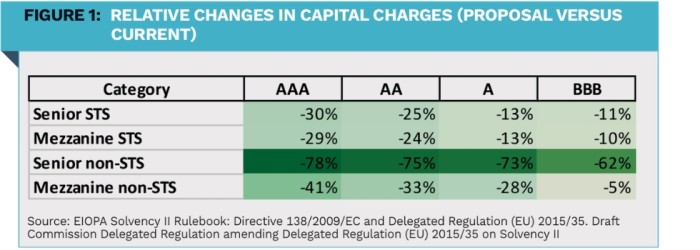
As a result, European insurers’ participation in securitisation markets has remained significantly below that of their inter national peers. This disconnect has constrained both investor diversification and the capacity of securitisation to fulfil its economic role.
Towards a more proportionate framework
Proposed reforms from the European Commission signal a meaningful shift in perspective. The objective is not deregu lation, but simpli fication and improved alignment, ensuring that capital require ments better reflect underlying risk characteristics while main taining strong safeguards. A key element of the reform agenda is the recalibration of capital charges for insurers, with greater consistency between the treatment of securitisation exposures under Solvency II and that applied to banks under the Capital Requirements Regulation. Particular attention is being given to senior tranches and non-STS transactions where historical performance, structural protections, and transparency standards warrant differentiated treatment.
If implemented effectively, these changes could materially improve the relative attractiveness of securitised assets for long term investors, without compromising financial stability or investor protection.
Expanding the institutional investment opportunity set
For insurers and other institutional investors, a more proportionate regula tory environment could significantly broaden the investable universe. Securitisation offers access to diversified pools of underlying assets – ranging from consumer and SME loans to residential mortgages – combined with predictable cashflows and a clearly defined risk hierarchy.
Senior tranches, in particular, typically benefit from substantial credit enhance ment, priority of payment and conservative structural features. These characte ristics can align well with long-dated liabilities and capital preservation objectives, while offering incremental yield relative to similarly rated public credit.
Greater participation by long-term investors would also enhance market depth and resilience, reinforcing securitisation’s role as a durable funding mechanism rather than a cyclical or opportunistic one.
Supporting real- economy financing and policy objectives
Beyond portfolio conside rations, revitali sing securi tisation can support broader economic objectives. By enabling banks to optimise capital usage, securitisation can facilitate increased lending capacity across consumer, corporate and real estate segments. This is particularly relevant in the context of Europe’s invest ment needs related to climate transition, infra structure development and digitalisation.
Over time, securitisation structures may also evolve to further integrate sustain ability considerations, supported by improved data availability and reporting standards. As such, the asset class has the potential to play a complementary role in financing environ mentally and socially aligned outcomes.
Discipline remains essential
While the direction of reform is construc tive, prudent implementation remains essential. Investor confidence depends on transparency, consistent application of rules and robust risk governance. For institu tional investors, thorough due diligence, structural analysis and ongoing monitoring will continue to be critical components of any securitisation allocation.
A successful revival of European securiti sation will therefore depend not only on regulatory change, but on sustained market discipline and alignment across stakeholders.
A re-emerging strategic pillar
European securitisation is approaching an inflection point. With regulatory reform underway and policy momentum building, the asset class has the potential to re-establish itself as a strategic pillar of Europe’s capital markets architecture.
For long-term investors, this evolution may offer access to a broader set of well structured opportunities, supporting portfolio diversification while contributing to the efficient financing of the real economy. The reform has reached the final stage of the EU legislative process (Parliament, Council, Commission), with completion expected in the second half of 2026*. If adopted, the new frame work is expected to enter into force on 30 January 2027 and as this nears completion, securiti sation deserves renewed attention within institutional asset allocation frameworks.
|
SUMMARY European securitisation has remained constrained by complex regulation and high capital charges, limiting insurer participation. Reform proposals aim to simplify the framework and improve capital treatment, particularly under Solvency II. Aligning insurer and bank capital rules could unlock significant institutional demand. Lower capital charges would enhance return on capital and broaden the investable universe. Revitalised securitisation can support bank lending and real-economy financing. Strong risk discipline and transparency remain essential to ensure sustainable market growth. |
* Source: European Parliament Press Release 5 May 2026: Securitisation: maintaining transparency and investor protection, reducing costs | News | European Parliament
Read the article in the digital magazine