
Diana Choyleva: Oil is the weapon for US to attack China
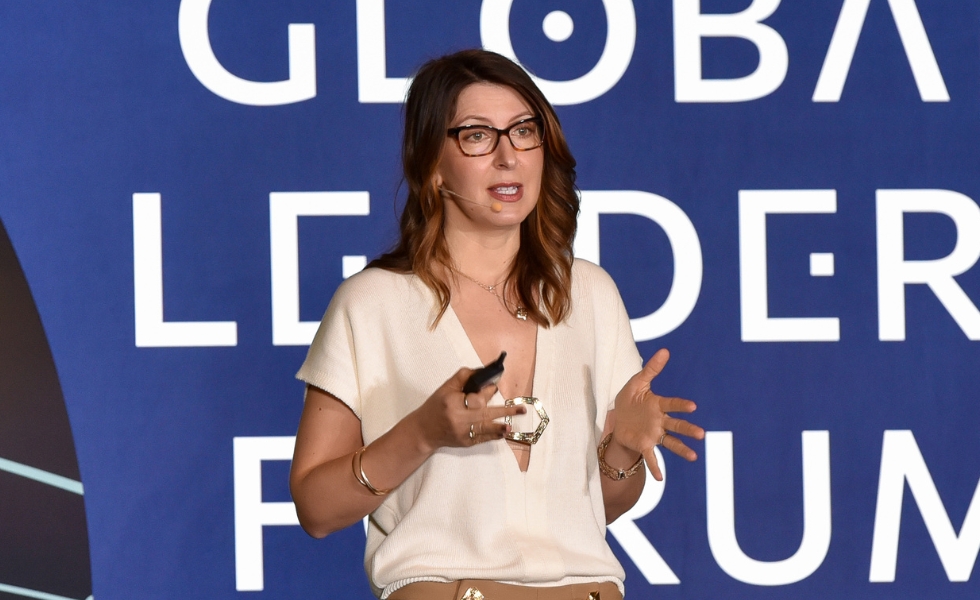
When economist Diana Choyleva heard the news of the regime change in Venezuela on January 6th, her reaction was immediate. Iran, she told colleagues and clients, would be next. It was not a guess. It was the latest in a sequence of calls she has been making – correctly – for the better part of three decades.
Door Joost van Mierlo
Choyleva is founder and Chief Economist of Enodo Economics, a London-based macroeconomic and geopolitical forecasting firm she established in 2016. Her analytical focus is not China in isolation, but rather how China is reshaping the global macro and geopolitical environment, and what that means for investors who may never own a single Chinese asset. ‘The pushback I constantly get from asset managers is: we are not investing in China, so we don’t need to understand it,’ she says. ‘That is precisely the misunderstanding. China affects everything else. Understanding its political, geopolitical, strategic, economic and technological dynamics, and how they interact with the rest of the world, is not optional for serious investors.’
Enodo applies what Choyleva describes as a dual prism: understanding simultaneously how Chinese policymakers see the world and how Western investors systematically misread those signals. ‘The gap between those two perspectives is where the most significant market risks live.’ That interdisciplinary approach underpins an advisory practice spanning institutional investors, business leaders and policymakers across multiple administrations and governments. To sharpen the geopolitical analysis, Enodo convenes the Consilium, whose members include former US Treasury Secretary Janet Yellen, former Bank of England Governor Sir Mervyn King, former head of MI6 Sir Alex Younger, former UK Chief of Defence General Sir Nick Carter, and investor Jonathan Ruffer, among others.
Choyleva’s track record offers good reason to pay attention. In 2006 she co-authored ‘The Bill from the China Shop’, identifying the build-up of US household debt – financed by Chinese savings surpluses – that would trigger the 2008 crisis. She coined ‘the great decoupling’ to describe the bifurcation of the world into two competing spheres well before it became consensus, predicted the US-China trade confrontation from 2018 onwards, and warned investors about semiconductor supply chain vulnerability years before the CHIPS Act. Her record has misses too: she argued in 2016 that the eurozone faced a structural breaking point. It did not, and she acknowledges it. In 2021 she flagged a Taiwan confrontation as likely within four years. The firm’s dedicated conflict-probability forecasting service has since revised that assessment downward, driven by the overhaul of the People’s Liberation Army she describes in this interview. The call was early, the analysis remains live.
Understanding China’s political, geopolitical, strategic, economic and technological dynamics is not optional for serious investors.
Over the past five years, her research has turned to how China is building its own financial sphere of influence, culminating in two major reports: ‘China’s Quest for Financial Self- Reliance’ and ‘Petrodollar to Digital Yuan’, which argue that global financial bifurcation is the most widely misread macro risk in institutional portfolios today.
How would you describe the relationship between the US and China at the moment?
‘We are in the middle of a great power competition that is not going away anytime soon. To understand the Chinese, you have to appreciate that they start from a premise of exceptionalism. They ruled the world and were the largest economy for many millennia. Then came what they call their century of humiliation. In their view, that was a historical aberration. Now is the time to return to their rightful place.
China wants to engage with the world entirely on its own terms, which is, of course, exactly what the US under Trump also has in mind. Both cannot happen simultaneously, so something will have to give. But it is important to understand that we are currently in a relatively stable phase. Both sides are dealing with domestic political imperatives that make a direct clash unattractive right now. Trump is visiting China in mid- May, and Xi will make a return visit in the autumn. Both sides have reasons to want a detente, even a superficial one, for now.’
What are the domestic issues you are referring to in China?
‘There has been a complete transformation of the Chinese army over the past few years. In 2021, I predicted that a confrontation over Taiwan was likely to happen over the next few years. It has not happened, and the principal reason – the one that has driven us to lower our probability forecast for conflict – is the anti-corruption campaign that Xi has been running inside the People’s Liberation Army.
To understand Xi’s power, you must understand that he holds three key roles. He is president of the country. He is general secretary of the party. But his third role – as chairman of the Central Military Commission (CMC) – is the most powerful of the three, and the one most often overlooked in Western analysis. I would not be surprised if Xi were to pass the presidency to someone else in his fourth term, but he will keep the CMC chairmanship and the party leadership. The presidency is the most visible role to the outside world, but it is also the least important to him.
We are currently in a relatively stable phase. Both sides have reasons to want a detente, even a superficial one, for now
The CMC used to have nine members. There are now effectively two, one of whom is Xi himself. Several military commands are currently without a permanent commander. The army is being rebuilt from the inside, and that process is not yet complete. That is also one of the reasons, I believe, that the US chose this moment to act on Iran. The window in which China could meaningfully respond militarily was assessed as limited.’
What about the conflict in the Middle East?
‘When I heard the news about Venezuela on the 6th of January, my immediate thought was: Iran is next. I discussed it within our team, and we decided to convene the Consilium specifically on the topic of Iran, setting the meeting for 4 March, which, as it happened, fell just a couple of days after the war broke out. The timing was coincidental. The analysis was not. There is a whole chain of events that feeds into what has happened, beginning with the Hamas attack on Israel. The Middle East has its own logic and its own internal dynamics. But if you step back and look at it through the lens of US-China competition, a clear strategic rationale emerges. When Trump launched his tariff war, China reacted very differently from its response in his first term. They pushed back hard and played the critical minerals card. America was forced into a tactical retreat. They had been playing the technology card for years, but China had largely managed to work around it. The critical minerals threat was of a different order. It would have disrupted American military production within a month. The US needed a new card to play. That card was oil.
The US needed a new card to play. That card was oil.
If the US and its allies succeed in disrupting China’s influence over Iran and Venezuela, they would control roughly 60% of global oil flows and 70% of global reserves. I want to be precise: I am not saying the US went to war with Iran solely for this reason. But many people are asking whether this is a blow to the petrodollar system. In my view the argument is backwards. What the US has done is mount a strategic defence of the petrodollar infrastructure, attacking the alternative system that China has been quietly building with Gulf state partners.’
Has this damaged China?
‘China is in a very difficult position. It cannot afford to alienate Riyadh in order to support Tehran. That tension creates a real constraint. Oil also matters because it underpins the role of the dollar as the world’s reserve currency, and here we come to China’s long-term plan to undermine that role. One fifth of all global trade conducted in dollars is oil trade. And when you narrow the decision tree down to this question, you end up with one person: Mohammed bin Salman. If he were to decide, for whatever reason, to accept payment for oil in any currency, the entire architecture begins to shift very quickly. The position of Saudi Arabia – relying on China economically and on the US for security – is the central tension the world is now watching.’
You call this China’s long-term plan. Do you think they will be able to achieve it?
‘China has been building its own sphere of influence within which everything operates on its own terms, including the ambition to buy whatever it needs using its own currency and its own financial infrastructure. This effort began with the Snowden revelations, which made clear that the Americans were using SWIFT as an intelligence tool. China built its own global payments system – CIPS, the Cross-Border Interbank Payment System. The network effects of SWIFT are powerful and CIPS has struggled to overcome them, but the infrastructure now exists.
More broadly, the global financial system is on the cusp of a massive transformation, driven by technology, by the US-China competition, and by populist political movements. These forces are converging in ways that will fundamentally change how payments and capital markets operate over the next five years. Most conventional asset allocation frameworks are simply not built to handle it. Most investors are still asking questions of the past, about tariffs and supply chains. Those questions matter. But the more consequential story, the one that will define the next decade, is the financialisation of China’s economy. Policymakers and investors who are fighting the last war will be poorly positioned for what is coming.’
|
Diana Choyleva Diana Choyleva is founder and Chief Economist of Enodo Economics, an independent macroeconomic and geopolitical forecasting firm, and a Senior Fellow at the Asia Society Policy Institute’s Center for China Analysis. A global macro economist by training, she has focused on how China is reshaping the world economy and geopolitical order for over 25 years and is a sought-after keynote speaker at forums including the World Economic Forum and the Milken Institute Global Conference. Her most recent work, Petrodollar to Digital Yuan (2025), examines the transformation of the global monetary order. |
Read the full article in Financial Investigator magazine