Harry Geels: Four monetary mechanisms that exacerbate inequality

This column was originally written in Dutch. This is an English translation.
By Harry Geels
In our society, there are various structures that perpetuate inequality. The monetary system is one of them. It favours the ‘haves’ over the ‘have-nots’ through inflationary policies, support for financial markets, and financial repression. Monetary policy also supports banks, including through monetary bailouts.
Capitalism is often at the centre of the debate on inequality. However, there are three underlying structures in our society that contribute far more to inequality, namely the market power of large corporations, monetary policy, and banking policy. Government policy also influences inequality through taxes and subsidies, although its net effect is more difficult to determine. Monetary policy increases inequality in various ways, often not immediately apparent.
Quantitative easing
As previously argued, (monetary) policy is never neutral. There are always people who suffer as a result and people who benefit from it. Quantitative easing (QE) – the printing of money by central banks to buy up investments – is a clear example of a technique with profound political consequences. It demonstrably leads to rising prices, because an additional buyer enters the market without regard for the underlying ‘fundamentals’ of the assets being purchased.
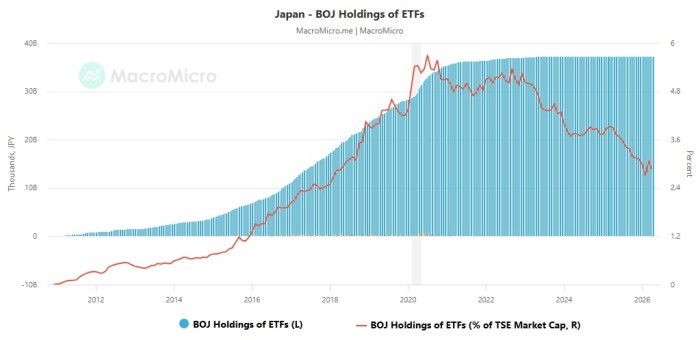
QE thus favours the holders of investments. They can then use stock market gains to spend. QE used to mainly involve government bonds, but since the credit crisis it has taken on all sorts of forms. In the US, the Fed bought up toxic property investments from banks. The ECB began purchasing corporate bonds from large companies, and the Swiss and Japanese central banks (SNB and BoJ) have even bought up shares (and ETFs) on a large scale.
The SNB now has more than $200 billion in US equities on its balance sheet. At one point, the BoJ held almost 7% of the Japanese equity market (see chart below). Apart from the fact that such a buying policy supports investment prices, it also distorts the principle of the free market. QE should therefore not really be used by central banks. Certainly not on a structural basis. At most, temporarily during a severe crisis.
Monetary (and fiscal) bailouts
During the credit crisis, various banks were rescued by governments. Some received state aid, others were taken over. These are outright ‘wealth transfers’ from taxpayers to bankers. But monetary bailouts are more subtle. For instance, in their supervisory role, central banks effectively allow banking oligopolies to exist in most countries, which cost consumers money (for example, through excessively low interest rates) to the benefit of bankers.
Other examples of monetary bailouts include the aforementioned purchase of toxic property investments and the emergency instrument LTRO (Long-Term Refinancing Operations), which the ECB deployed at the height of the euro crisis, particularly in December 2011 and February 2012, when banks no longer dared to lend to one another and several eurozone countries were at risk of losing access to the capital market. In two rounds, the ECB then provided over €1 trillion in multi-year loans to European banks at extremely low interest rates.
Officially, these were ‘liquidity measures’, but in reality the LTRO functioned as a monetary bailout. Although banks did not receive a capital injection, they did receive unlimited and cheap money from the central banks. That money was then largely used to buy government bonds from vulnerable countries, thereby indirectly rescuing governments as well. The LTRO thus prevented bankruptcies and interest rate shocks, but did so by shifting risks onto the central bank’s balance sheet.
Financial repression
A third monetary mechanism operates via the interest rate channel. Central banks, notably the BoJ and the SNB, have attempted to keep interest rates low almost everywhere in the world, albeit for different reasons (the BoJ to stimulate growth and inflation, the SNB to depress the exchange rate of the Swiss franc). The ECB has even set interest rates below zero for a long time. This has structurally disadvantaged savers: their wealth does not keep pace with inflation and loses value in real terms.
It is precisely lower and middle-income groups that hold a relatively large proportion of their wealth in savings and deposits, whilst wealthier households have access to credit and invest in property and financial assets. Low interest rates drive up asset prices whilst simultaneously reducing the debt burden for those able to borrow. In this way, interest rate policy acts as a silent redistribution from savers and wage earners to debtors and asset holders, an implicit tax on prudence and a subsidy on wealth and leverage.
Inflation policy
Finally, inflation policy also exacerbates inequality, as it primarily erodes the purchasing power of people who must spend the bulk of their income directly on housing and living costs. For them, inflation acts as a silent tax. Wealthier households consume relatively less and invest a larger proportion of their income. It is precisely these financial and real assets that often benefit from loose monetary policy through lower interest rates and higher prices, enabling the wealthy to more than offset price inflation with capital gains, even if the price index for luxury goods has risen more than the ‘standard’ price index.
In conclusion
What these monetary mechanisms have in common is that they conceal political choices behind technical jargon. Quantitative easing shifts wealth to asset holders, bailouts protect financial structures from market discipline, and inflation and interest rate policies primarily erode purchasing power and savings. Together, they form a system in which risks are hedged at the top and borne at the bottom. Inequality is not an explicit policy objective, but it is a structural consequence.
This article contains a personal opinion by Harry Geels