Harry Geels: The 10 ‘major’ perceived risks for 2026
Harry Geels: The 10 ‘major’ perceived risks for 2026

By Harry Geels
Every year, lists are published again with the biggest risks for the upcoming investment year. This is a pointless activity for three reasons.
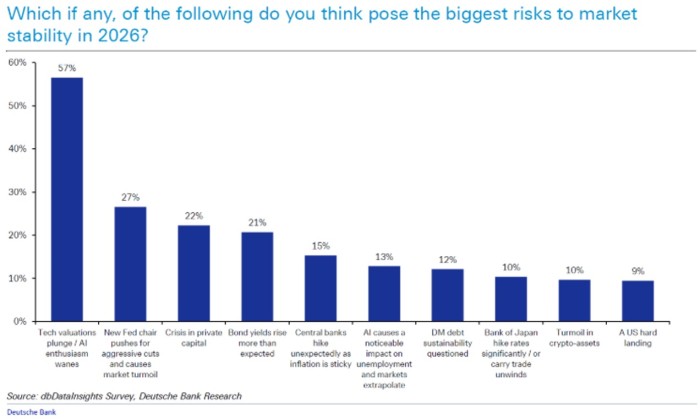
They are appearing again on many investment blogs: the biggest investment risks for the coming year. For example, a poll by Deutsche Bank Research identified ten of them. The largest perceived risk at the moment is that AI turns out to be a bubble that could burst next year. Monetary policy is also almost always mentioned. This time as well: it could prove to be far too loose, or unexpectedly become tightening after all, because inflation remains stubbornly high.
1. The listed risks don’t really matter
There are at least three caveats to such lists. First, these lists don’t really matter in the long term. There are always worries and risks. That is simply part of investing, and it’s also what we are rewarded for. Markets always climb a wall of worry. Lists may be useful as thought exercises, but they are rarely good timing tools. At most, they can serve to highlight certain points in diversification.
2. Markets are mostly affected by unknown risks
The formerly influential American politician and military figure Donald Rumsfeld once distinguished between four types of risks: Known knowns (things we know that we know), Known unknowns (things we know we don’t know, for example election outcomes or the timing of a recession), Unknown unknowns (things we don’t know that we don’t know), and Unknown knowns (things we actually do know but ignore or suppress, for example due to behavioral biases or politics).
Market prices mostly reflect the known knowns and partly the known unknowns. The unknown unknowns, also called “black swans,” cause the biggest problems in the stock market. And even if some investors were well able to identify unknown risks, a market crisis often unfolds differently than expected, and the impact is slightly different than predicted, because complex chain reactions frequently occur.
3. Lists often make us too defensive (and that costs returns)
Third, such (annual) lists feed our tendency to take less risk than necessary, which leads to insufficient long-term returns. The most well-known bias here is myopic loss aversion: we look at short-term losses too often and too narrowly, and as a result we systematically underinvest in risk-bearing assets. Ambiguity aversion reinforces this: when probabilities are unclear, we prefer the safe option, diversify too much, or hedge risks too often.
What to do?
The advice is not to ignore risks, but to be aware of what these lists mean and how they influence us. If there are many (major) risks, it could also mean that prices are depressed—i.e., that perceived risks may actually be an opportunity to invest. A well-known quote says: “The biggest risk in investing is not investing.” At the same time, a portfolio should be able to meet its known obligations as well as possible across different scenarios.
The investment process takes priority over precise return and risk forecasts. Use the Rumsfeld framework: monitor known knowns and check their pricing, mitigate known unknowns proactively with hedges, diversification, or contractual clauses, and for unknown unknowns accept residual risk and build antifragility, for example with alternative investments, less embedded leverage, and liquidity pockets to buy during downturns.
Conclusion
Every year we list the “biggest risks.” That’s fine as a mental exercise—or, more cynically, as stock market folklore to be enjoyed with caution. Risks existed in the past market year as well, summarized briefly as “Trump’s unpredictability.” The fuss over import tariffs, for example, caused a sudden 20% drop in March, yet the year still ended with a substantial gain. The art is not in predicting all risks, but in embracing the unknown.
This article contains a personal opinion from Harry Geels