
Aegon AM: Maintaining purchasing power: desirable and possible?
Aegon AM: Maintaining purchasing power: desirable and possible?

This article was originally written in Dutch. This is an English translation.
Recently, there has been a renewed focus on maintaining purchasing power under the new pension system. But is maintaining purchasing power even possible? And do participants actually want this?
By Gosse Alserda, Senior Investment Strategist, Aegon Asset Management
The objective of a pension scheme is to provide participants with a pension income that maintains their purchasing power. It is important to distinguish between long-term purchasing power maintenance and short-term purchasing power management.
Long-term purchasing power retention
Over the long term, we see that inflation averages around 2% per year. This means that pension benefits must increase by at least 2% per year in order to maintain the same purchasing power in the long term. An expected increase in pension benefits can be structured in various ways.
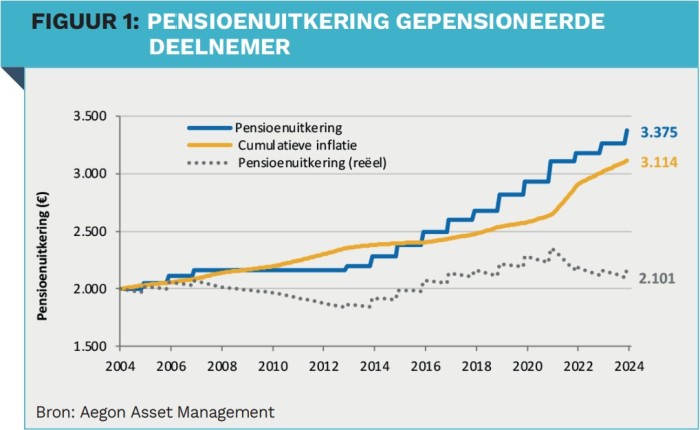
Most pension funds choose to give pensioners exposure to excess returns. The associated risk premiums ensure that the benefit increases on average, although there are of course also scenarios in which they have a negative impact. A backtest over the period 2000-2024 – as shown in Figure 1 – shows that long-term purchasing power maintenance is possible. Looking to the future, it also seems possible to offer sufficient exposure to excess returns to compensate for inflation.
Purchasing power management is not free. Inflation-linked investments often have a lower expected return due to the absence of an inflation risk premium.
An alternative approach could be to start with a lower benefit and then increase it over time. Technically, this means taking a discount on the projected return. In general, this option is not preferred by participants, who would rather have a higher benefit when they first retire.
It is also questionable whether maintaining purchasing power is necessary in the long term. Recent research by Netspar1 shows that, on average, expenditure decreases as pensioners get older. Fitness declines in later life and, as a result, so does spending. A certain degree of loss of purchasing power in the longer term therefore seems to be in line with the spending patterns of the average participant, although this does not necessarily apply to individual participants.
Short-term purchasing power control
Although long-term purchasing power retention seems possible, short-term purchasing power control is a greater challenge under the new pension schemes. Although the lag in indexation was one of the reasons for the pension transition, the new pension schemes are still primarily nominal in nature. In particular, the solidarity-based contribution scheme with a theoretical protection return – which most pension funds opt for – offers little opportunity to provide pensioners with short-term inflation protection. The protection return is always based on the nominal interest rate, which means that inflation protection must come from the excess return. However, the excess return mainly goes to young people and only to a limited extent to older people, while it is precisely older people who may need purchasing power management.
Pension funds that consider purchasing power management important can opt for the actual protection return. When investing in inflation-linked bonds or inflation swaps, the inflation protection ends up with older people. In addition to the fact that this inflation protection is not perfect (because it is based on European inflation rather than Dutch inflation, among other things), it also exposes older people to other risks. This creates a greater mismatch for older people and, in addition, we see that in the case of the actual protection return, the portfolio is often somewhat less efficient, partly due to the division of the portfolio into different pots. As a result, more risk must be taken for the same expected return. Although the inflation risk decreases, other risks arise, which means that the total risk does not necessarily decrease.
Another option is purchasing power control via the solidarity reserve. However, this can only be used for unexpected inflation (i.e. shocks relative to expected inflation). In order to provide adequate protection, the solidarity reserve must be of sufficient size, i.e. the reserve must be larger when used for purchasing power control than when it is not used for that purpose. A larger reserve simply means a lower (initial) benefit, which again raises the question of whether this is in line with the preferences of participants.
Expenditure generally decreases as pensioners get older, so a decline in purchasing power does not necessarily have to be a bad thing.
With regard to purchasing power control, we can also ask ourselves to what extent this is necessary for the average participant. For most participants, their total pension income consists of both the state pension (AOW) and the supplementary pension. For the average participant, the state pension accounts for approximately 40% of their total income. The AOW is normally increased annually in line with inflation and therefore offers purchasing power control in pension income. This is particularly relevant for lower incomes, for whom the AOW accounts for a larger proportion of their pension. According to Nibud, it is precisely this group that is sensitive to inflation risks. For participants with higher incomes, the inflation protection provided by the AOW is relatively smaller, but this group is less sensitive to inflation risks. They can more easily adjust their consumption patterns or use their savings to compensate for the decline in purchasing power. Moreover, purchasing power control is not free. Inflation-linked investments often have a lower expected return due to the absence of an inflation risk premium. Moreover, assets used for this purpose cannot be used, for example, to spread returns more effectively.
Conclusion
In the long term, the new pension schemes are expected to offer a pension with purchasing power. A backtest shows that this could have been the case over the past 25 years, and sufficient exposure to excess returns also seems possible in the future to compensate for the expected inflation. In the short term, however, purchasing power management is a lot more complicated. There are options for introducing some degree of control, but this often involves greater exposure to other risks. As a result, in many cases the overall risk does not decrease, whereas it should be the overall risk that is the focus. It is also questionable to what extent purchasing power protection is necessary in the short and long term. Expenditure generally decreases as pensioners get older, so a decline in purchasing power does not necessarily have to be a bad thing. In the short term, the state pension already offers direct purchasing power control for many participants. This is particularly the case for participants with lower incomes, who are most sensitive to inflation risks.
|
IN SHORT The new pension system can offer long-term purchasing power protection through exposure to excess returns, although this is not necessary for all participants because expenditure decreases with age. Short-term purchasing power control is difficult: the nominal protection return offers little direct inflation protection for older people. Alternatives to purchasing power control, for example via the actual protection return or the solidarity reserve, entail additional risks or lower benefits. The question is whether purchasing power control is necessary. The AOW already offers partial protection against inflation for lower incomes. |
1. Recently presented research by Jim Been, Eduard Sauri-Andru and Marike Knoef on “Households” spending over the life-cycle'.