From 'less bad' to measurable impact (Roundtable 'Biodiversity' – part 2)
From 'less bad' to measurable impact (Roundtable 'Biodiversity' – part 2)
This text was originally written in Dutch. This is an English translation.
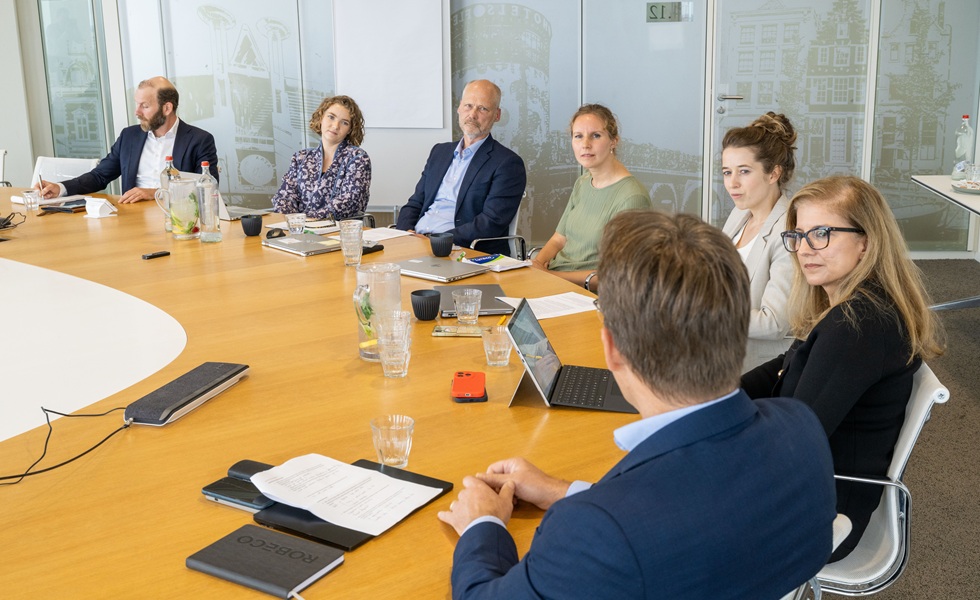
In part 2 of our round table report, the experts discuss how asset managers integrate “less bad” versus “more good” into investment decisions, which data and guidelines help in this regard, and how engagement and innovative strategies ensure both a measurable impact on nature and financial returns.
By Hans Amesz
This is part 2 of the report. You can read part 1 here and part 3 here.
|
MODERATOR Don Gerritsen, Deloitte
PARTICIPANTS Jolien de Jongh, Achmea Real Estate Sophie Kamphuis, MN Sasha Miller, Nuveen Lucian Peppelenbos, Robeco Robert- Alexandre Poujade, BNP Paribas Asset Management Gerard Roelofs, Impact Orange Partners Nikki Trip, AF Advisors |
How does nature/biodiversity fit into your investment approach? Doing less “bad” or doing “more good”? Is it purely about impact allocation or does it generate regular investment returns?
Miller: 'The answer is: both. Integration and engagement play a key role in the investment process. On the impact side, and with regard to concerns about greenwashing, we have clear internal impact definitions and follow the Operating Principles for Impact Management – we are one of the founders and continue to focus as a company on setting industry standards. Every investment has a theory of change and measurable outcomes. We have the entire impact process verified externally. In fixed income, we focus on direct and measurable results through impact bonds. All our impact products in all asset classes are focused on both financial returns and impact results.'
De Jongh: 'In the Netherlands, we only have direct real estate. Since January, we have been working with a number of other asset managers. We took a map of the Netherlands and looked at all the municipalities where we are present. Based on that, we selected two locations where we want to improve the entire area in collaboration with an ecologist and the municipality. This includes greening, but also solutions for water and heat, for example. You can achieve more in a larger area than if each party only looks at its own building or street. To be honest, measuring this is still complicated. We want a considerable degree of detail that offers immediate prospects for improvement. That is why we are testing a number of methods, such as calculating how much CO2 the greenery captures.'
How do you embed this strategically? How do you integrate biodiversity, with less of the bad and more of the good?
Peppelenbos: 'When it comes to nature, we often use 'less bad versus more good”, but we do that less when it comes to climate. Are electric vehicles and wind turbines “good” or “less bad”? Let's follow the mitigation hierarchy: avoid, reduce, restore, system change. All of this is “doing good”: it contributes to global policy agreements to halt nature loss in the long term. This must be measurable in order to be credible. So yes, we need investments in nature itself, such as agriculture and forest land, but also in companies that measurably and credibly reduce their negative impact and contribute to halting and reversing nature loss.'
Roelofs: 'The CSRD, the Corporate Sustainability Reporting Directive, says little about what we should do about nature loss, let alone how we should measure it. If we had a parallel approach throughout the chain, as we do with climate, we would also know who is contributing negatively or positively. But we are not there yet. The sense of urgency to define, measure and take action is still too limited. Even when it comes to innovative forms of financing to halt biodiversity loss, for example through blended finance, where the state can play a clear role, that urgency is hardly present.'
Peppelenbos: 'I disagree with regard to definitions and measurements. A tremendous amount of work has been done: TNFD identifies where dependencies and impact are high for each sector, with corresponding core metrics. The data for this is far from complete, but good enough to provide guidance. We can accurately determine which companies are performing well, reasonably or poorly in terms of nature transition in material sectors such as materials, energy and real estate.'
Kamphuis: 'For your liquid portfolios, there are plenty of opportunities to 'do less badly” based on data. You can identify which companies have a greater or lesser impact on various drivers of biodiversity loss and steer accordingly. To achieve a positive impact, we have investigated propositions for a direct and indirect (or systemic) impact on biodiversity. We see many opportunities in sustainable forestry, regenerative agriculture and technological solutions within private equity.'
Miller: 'There is still work to be done on data. We don't have everything we need at the moment, and that is what the transition and much of the involvement is currently focused on. It is a work in progress. In the area of natural capital, we conduct TNFD assessments, use IBAT to assess biodiversity risks, utilise tools such as biodiversity indices in collaboration with ETH Zurich, and measure and value, where possible, the ecosystem services that provide natural capital at our sites. By monitoring the availability and value of ecosystem services over time, changes in risks to nature and biodiversity can be identified, as well as opportunities for improvement.'
Roelofs: 'We have researched (bio)data suppliers and methodology providers. The correlation in results between these providers was extremely low. We already knew this was the case for climate, but now we are seeing it for biodiversity too. That is shocking.'
Trip: 'I think we know enough to identify sectors and companies that cause a lot of damage. Waiting for perfect data is an excuse we cannot use to do nothing now.'
Peppelenbos: 'Indeed. Follow the TNFD definitions: these determine the priority sectors and the core topics for each sector. We have enough (proxy) data to make the analysis. Take mining, for example, a sector with an enormous impact. We can measure water, waste, emissions, recycling, assets in vulnerable areas and risks associated with tailings dams. That doesn't cover everything, but it's enough to differentiate between companies and build portfolios. Nature is complex, but let's not make it unnecessarily complicated.'
Kamphuis: 'You can use reporting, policy and performance to steer various biodiversity-related themes, such as water or deforestation. The Financial Biodiversity Foundation provides helpful guidelines for setting portfolio targets. Because biodiversity touches on many different themes, it is important to prioritise these themes in the portfolio, also with a view to maintaining the desired risk-return profile.'
Trip: 'In public markets, it is mainly about ‘less harm’, although there are positive exceptions. Just be honest that you can claim limited direct positive impact there, otherwise the concept of impact becomes diluted. In private markets, there is a much greater chance of actually “doing good”. But then you come to the question: is it just about financial return, or a broader understanding of value? Perhaps there are investments that are less financially profitable but yield a lot socially. Do we do that as the financial sector, or does the government do it? Or do we do it together, with a “shadow price/return” alongside financial return?'
Poujade: 'At the company level, we can already measure idiosyncratic risk reasonably well; there is even convergence between some data providers. Difficult topics – such as chemicals, plastics and oceans – still require a lot of qualitative analysis. There are data gaps. And systemic risks (tipping points) are difficult to translate into company valuations. For example, what is the impact of the savannisation of the Amazon zone on hydro, real estate, agriculture, and so on? We lack macro scenarios for this.'
Peppelenbos: 'People are working on short-term scenarios for physical nature and climate risks within the investment horizon. Some also model tipping points. We are still in the early stages with these “new generation” scenarios, but we are getting there.'
Roelofs: 'A Dutch professor recently published a paper on incorporating nature events into valuations, discount rates, cash flows and so on. It's interesting to see how that can be built in.'
Miller: 'We are doing something similar in the area of climate change and nature loss. We see it as a megatrend to be included in asset allocation, alongside other important structural trends such as the ageing population.'
Roelofs: 'There is a paradox. On the one hand, as investors, we believe that the greatest impact can be achieved primarily in the private markets. In terms of biodiversity, I think that is broadly the case, for reasons of additionality, measurability, materiality, and so on. But in the long term, the greatest leverage may lie with large listed companies: their potential to do something about the destruction of nature is phenomenal. I would like the CSRD to be clearer about this.'
Trip: 'There is enormous potential there, but influencing them is difficult. In public markets, you have exclusion and engagement. The problem is that we are often not numerous enough to really change decision-making. There is a lack of majority, and also a lack of legislation. In this area, we need to change the large multinationals.'
It's all about credibility. Lean on best practices and standards and build the most credible product for the asset class in question.
Kamphuis: 'The TNFD nature transition plans provide useful guidelines for assessing concrete steps taken by issuers in implementing their biodiversity strategy. It is then important to take a critical look at the financial details of the transition plans, as with climate, such as Capex, Opex and R&D budget. This helps to distinguish between frontrunners and laggards in the portfolio.'
Trip: 'But then enough shareholders have to vote in favour. The risks must be clear and financially attractive. The science is already there, so what is stopping shareholders?'
Miller: 'I agree that engagement is often the biggest lever for many portfolios. Things are also happening in the area of regulation, for example in the United Kingdom, where a consultation is underway on transition plans in the areas of both nature and climate. And fixed income markets are underestimated as a way to scale up the direct and measurable impact in public markets. There are huge opportunities there alongside private assets.'
Poujade: 'With regard to capital expenditure, it would be very useful to have more information in order to be able to distinguish between companies. Sometimes companies do not seem very proactive in reducing their biodiversity impact. That is to say, they take few active steps to limit the negative impact of their supply chain. But if you look at their capital expenditure and investments, the reality may be different. To succeed in their transition, companies must look for the potential business case. For a fast food restaurant, for example, this means finding out whether customers will accept shorter chips than usual, or using potato varieties that require fewer fungicides. Win-win situations exist, but how many are there?'
Many biodiversity hotspots are located in emerging markets. We are seeing more interest from pension funds in investigating these markets for their impact potential.
|
Don Gerritsen Don Gerritsen is Director and EMEA Sustainable Investment Leader at Deloitte. Prior to this, he held various management positions at PRI, the UN and KPMG in the US, the UK, Kenya and the Netherlands. He is the author of Guidance to Inspirational Leadership and founder of the pro bono mentoring initiative Pay It Forward. Gerritsen holds an Executive MBA in Strategy and a Master's degree in Public Administration. |

|
Jolien de Jongh Jolien de Jongh has been working at Achmea Real Estate since 2019, and since 1 April 2023 as ESG Manager Real Estate and Manager Investment Solutions. In this role, she is responsible for policy, new initiatives and reporting in the field of ESG. Embodied carbon and biodiversity are among her priorities. |

|
Sophie Kamphuis Sophie Kamphuis is Senior Responsible Investment Advisor at MN, where she advises clients on strategy development and active shareholding in the field of biodiversity. Previously, she worked at impact investor Triple Jump on impact funds in the field of renewable energy and SME financing. Before that, she worked as a strategy consultant for local banks in Asia and Africa on themes such as inclusive financing, digitisation and sustainable agriculture. |

|
Sasha Miller Sasha Miller is Managing Director and Head of Responsible Investing Strategy at Nuveen, responsible for the RI platform, international activities and innovation to deepen client relationships. She chairs the RI SteerCo and oversees the Impact platform. Prior to this, she held senior positions at Schroders, most recently as Head of Client Propositions and Strategy. Miller holds an MBA from Oxford and a BA in International Relations from Johns Hopkins. |

|
Lucian Peppelenbos Lucian Peppelenbos is Head of Sustainable Investment Thought Leadership at Robeco. He oversees the frameworks for integrating sustainability into the investment process. This includes SDGs, social themes, climate change and biodiversity. Before joining Robeco, he worked at APG Asset Management. Peppelenbos began his career in 1999 and holds a PhD in Social Sciences from Wageningen University. |

|
Robert- Alexandre Poujade Robert-Alexandre Poujade joined BNP Paribas Asset Management's ESG research team in 2015 and leads thinking on biodiversity. He has collaborated with Capitals Coalition, UNEP-WCMC and Global Canopy, among others, and represents BNP Paribas in forums such as TNFD and PBAF. He obtained a Master's degree in Management, specialising in Finance, from ESCP Europe Business School in Paris in 2010. |

|
Gerard Roelofs Gerard Roelofs is an impact investor and co-founder of Impact Orange Partners. With over 30 years of experience in asset and fiduciary management, he has held board positions at Kempen and NN Investment Partners and was a partner at WTW. Previously, he held positions at Deutsche Asset Management, ABN AMRO and UBS. He is also active as a supervisor. |

|
Nikki Trip Nikki Trip is a Consultant and Sustainability Specialist at AF Advisors. She mainly advises pension funds and asset managers on sustainable investing. She is also chair of JIIP (Young People in Institutional Pensions), a speaker and an aspiring pension fund director. She is also active in the media as co-host of BNR Duurzaam and commentator on pension issues. |

Attachments
Share this post!
Related posts
-
 Read more about "PRI: Ruim 800 beleggers zetten stappen richting biodiversiteitsdoelen"
PRI: Ruim 800 beleggers zetten stappen richting biodiversiteitsdoelen
-
 Read more about "Biodiversity as both a risk and an investment opportunity (’Beyond Net Zero’ round table – part 1)"
Biodiversity as both a risk and an investment opportunity (’Beyond Net Zero’ round table – part 1)
-
 Read more about "Roundtable 'Beyond Net Zero'"
Roundtable 'Beyond Net Zero'
-
 Read more about "Triodos IM: Beleggers moeten land- en bosbouw juist niet mijden"
Triodos IM: Beleggers moeten land- en bosbouw juist niet mijden
-
 Read more about "BlackRock en Natural History Museum in Londen kondigen samenwerking aan om biodiversiteitsverlies aan te pakken"
BlackRock en Natural History Museum in Londen kondigen samenwerking aan om biodiversiteitsverlies aan te pakken
-
 Read more about "a.s.r.: Meetmethode voor plasticimpact in beleggingen"
a.s.r.: Meetmethode voor plasticimpact in beleggingen
-
 Read more about "DGBC: Natuur Portfolio Index moet biodiversiteit in vastgoed meetbaar maken"
DGBC: Natuur Portfolio Index moet biodiversiteit in vastgoed meetbaar maken
-
 Read more about "Triodos IM: Verlies van biodiversiteit is systeemrisico voor beleggers"
Triodos IM: Verlies van biodiversiteit is systeemrisico voor beleggers
-
Read more about "Schroders: Ontbossingsbelofte onder de loep van een belegger"
Schroders: Ontbossingsbelofte onder de loep van een belegger
-
 Read more about "KPMG: Bedrijven benutten beschikbare biodiversiteitsdata te weinig"
KPMG: Bedrijven benutten beschikbare biodiversiteitsdata te weinig