
Harry Geels: The end of banking (as we know it)
Harry Geels: The end of banking (as we know it)

This column was originally written in Dutch. This is an English translation.
By Harry Geels
Professor Campbell Harvey recently announced the end of the bank as a business model, citing four key developments. It is an interesting view, but things are unlikely to happen that quickly. Regulatory inertia and political interests will keep banks afloat for a long time to come.
According to Professor Campbell Harvey of Duke University, traditional banking is under pressure from four mutually reinforcing forces: fintech, private credit, stablecoins and AI. Each of these developments is sufficient in itself to change the playing field, but together they pose a structural challenge to banks’ business models. What was once a firmly established combination of savings, payments and lending is being broken down into separate components by new, more efficient players.
In a recent post, Harvey describes these four developments. He begins with an obvious source of frustration: the far too low interest rates on savings. Most banks do not even pay out half the money market rate. This is no coincidence, but a consequence of market power. Large banks can afford to pay barely anything on deposits, precisely because switching banks involves friction and alternatives are not equally accessible to everyone. It is therefore high time for more competition.
Fintech
The first development Harvey mentions is fintech, which, incidentally, is far from a homogeneous sector, but rather a collection of specialised sub-segments, each ‘attacking’ a part of the banking sector. In payments, players such as Adyen and Mollie have captured the user interface and margins; in lending, crowdfunding and private credit platforms compete with banks by allocating capital more directly and structuring it more quickly.
When it comes to wealth management, robo-advisors and investment apps are putting pressure on banks, whilst in infrastructure (BaaS, APIs, KYC/AML tools), new players are actually taking over the back-end of banks. On top of that come stablecoins and embedded finance, which completely decouple banking functions from the bank itself and integrate them into other ecosystems (platforms, e-commerce). The common thread: fintech reduces friction, increases transparency and breaks the banking model down into separate, competing building blocks.
However, Harvey fails to mention that banks are also arming themselves against fintech, and are doing so along three lines. Firstly, by repositioning themselves as platforms and infrastructure (open banking, APIs, Banking-as-a-Service). Secondly, by investing heavily in technology (and AI) themselves to improve customer interaction. Thirdly, they are leveraging their regulatory (systemic) position to maintain trust, scale and credit creation. Banks are seeking to move from being all-in-one providers to becoming a hub within a broader financial ecosystem.
Private credit
Private credit is probably the most direct challenge to the traditional banking model, as it takes over precisely what historically made banks unique: lending. Non-bank credit funds provide loans directly to businesses, without the balance sheet and liquidity constraints of banks, and with greater flexibility in terms of maturities, covenants and structure. This is particularly popular in the mid-market and leveraged finance segments.
The rise has been spectacular: the global private credit market has grown to around $1.7–2 trillion and has increased fivefold since 2009. In specific niches, the shift is already well advanced: in leveraged buyouts, private debt financed around 77% of deals in 2024 (compared with just 23% for banks). At the same time, in Europe, the situation remains relatively limited at the macro level: banks still hold around 76% of the lending market share, although this is some 10 percentage points lower than before the financial crisis.
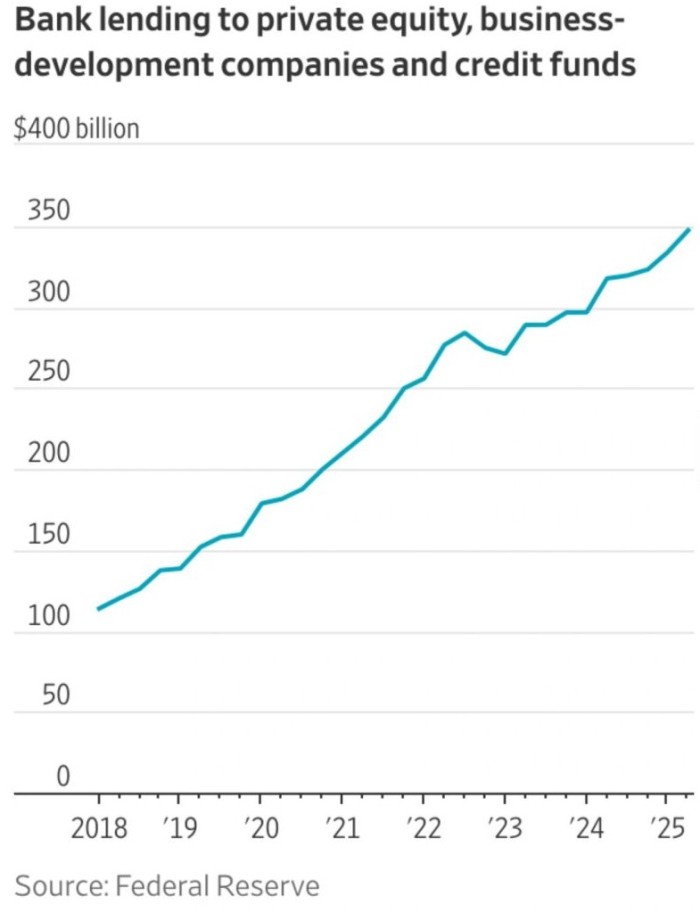
Here too, banks are not sitting idly by. They compete where necessary (on larger and more liquid deals) and also collaborate by financing private credit funds or jointly structuring deals. As a result, their role is shifting partly from direct lender to financier of the private credit ecosystem. The chart below shows the rise in ‘bank lending’ to private credit funds. Any problems in private credit, such as those we are currently seeing, therefore also have an impact on the banks.
Stablecoins
Stablecoins potentially pose the most fundamental threat to banks, as they strike at the very heart of the banking model: attracting cheap deposits. Essentially, stablecoin issuers do exactly what banks do — they take in money, invest it (in safe assets such as government bonds) and earn interest on it — but (for the time being) without sharing that return with the customer. Now comes the crux: there are an increasing number of parties wishing to issue so-called ‘yield-bearing stablecoins’.
This is precisely where the systemic impact lies: savings can shift from bank balance sheets to tokenised forms of money with a single click, which erodes banks’ funding base. It is not surprising that banks are fiercely opposed to this. In the US debate surrounding the CLARITY Act, they are explicitly lobbying to prevent stablecoins from paying interest, out of fear of large-scale ‘deposit outflows’. At the same time, some banks are trying to adapt by developing tokenised deposits themselves.
Artificial intelligence
AI is disrupting the banking model not by replacing a single product, but by eroding banks’ cost structure and information advantage. Traditionally, banks rely on their ability to assess risk — credit analysis, pricing, monitoring — and this translates into margins. However, AI makes that knowledge scalable and cheap: credit assessment, fraud detection and even financial advice are becoming increasingly commoditised and thus accessible to non-banks.
At the same time, competition is shifting to the front end: whoever owns the customer relationship (think of platforms or neobanks with AI-driven interfaces) wins, whilst the bank risks being relegated to a background role as a balance sheet provider. Banks can, however, arm themselves against this too, for example by using AI proactively: not just to cut costs, but to leverage their data advantage in better risk models and personalised services.
Finally, a closing thought
Four forces — fintech, private credit, stablecoins and AI — are eroding the foundations of the banking model. Harvey describes these dynamics sharply and convincingly. Yet his analysis underestimates the counterforces. Banks are not passive losers, but are investing in technology and increasingly collaborating with their own ‘disruptors’. At the same time, they successfully defend their dominant position through lobbying and a regulatory environment that rewards stability rather than disruption.
Political interests also play a role. Banks act as transmission mechanisms for government and monetary policy. For instance, they perform the gatekeeper function (including to prevent money laundering and terrorist financing). Banks are also crucial when it comes to unconventional policies, such as QE: central banks can create liquidity, but rely on banks to channel it into the real economy through lending. Furthermore, banks translate central banks’ interest rate policies into savings rates, mortgage rates and lending terms. ‘The banking sector has become an insider business’.
But all protection has an expiry date. History teaches us that technology ultimately triumphs over friction and institutional inertia. The question is therefore not whether, but how the banking model will change. My previously stated forecast remains unchanged: banks will eventually be absorbed into broader ecosystems, in which Big Tech dominates customer relations and the interface, and banks become regulated balance sheet and infrastructure providers. Not the end of banks, then, but certainly the end of the bank as we know it today.
This article contains a personal opinion by Harry Geels