
DPAM: Going green without the trade-off
DPAM: Going green without the trade-off

Heatwaves and wildfires are recurring economic shocks, yet much of traditional fixed income still lacks direct environmental impact. Meanwhile, green bonds look increasingly compelling.
By Ronald Van Steenweghen, Fondsbeheerder, DPAM
Europe’s summer of 2026 showed how quickly climate risk can move from a background issue to economic fact. Successive heatwaves strained hospitals, power grids and water systems, while wildfires triggered evacuations in France and Spain.1 EDHEC describes this new pattern as DIRE: longer in Duration, stronger in Intensity, more frequent in Recurrence and Earlier in onset.2
The economic effects are broad. Extreme heat lowers labour productivity, disrupts transport, raises cooling demand, weakens agricultural output and can constrain power generation just as electricity demand rises.3 Triodos estimates that the 2026 heat shock could reduce EU GDP by around 1%.4 Berkeley Earth notes that July 2026 was the first month this year to exceed 1.5°C above the pre-industrial average, while a strengthening El Niño could further intensify temperature extremes in the months ahead.5
For investors, the difficulty lies less in identifying climate risk than in pricing it. Its effects do not map straightforwardly into bond spreads. Some effects are immediate, but many build gradually through weaker output, higher operating costs, supply-chain stress and wider insurance gaps.6 Markets recognise the issue but still struggle to reflect it consistently. For now, however, bond investors appear more focused on rising long-term government bond yields, geopolitical tensions, the AI capex cycle and doubts about central banks’ ability to finish the job on inflation.
Against that backdrop, the case for green bonds deserves a fresh look. Traditional fixed income benchmarks still provide broad market exposure, but in many cases generate little to no direct environmental impact. For years, the objections to shifting part of that exposure into green bonds were familiar: higher active risk, lower expected returns and weaker diversification. Today, those arguments look much less convincing.
In euro fixed income markets, green bond issuance has broadened, deepened and become more diversified
A closer, more quantitative look shows why. In euro fixed income markets, green bond issuance has broadened, deepened and become more diversified. More importantly, the ex-ante tracking error versus conventional benchmarks has fallen sharply. As Figure 1 shows, active risk has fallen from more than 4% in 2020 to close to zero by 2026. This broad-based decline suggests that, over a one-year horizon, the expected performance difference between green and conventional benchmarks is now very limited when measured through an advanced risk factor model.
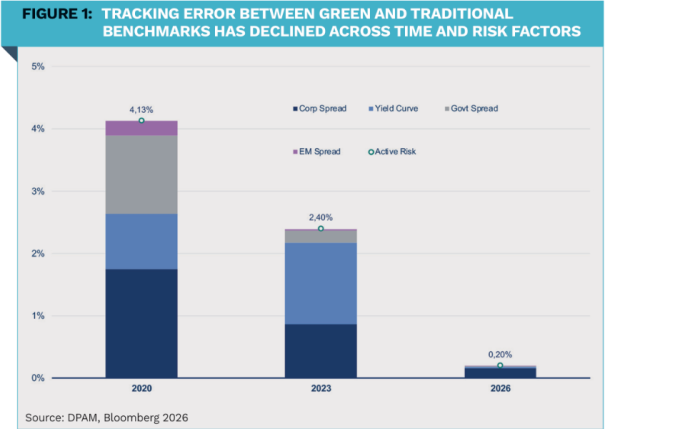
The implication is straightforward: the risk-return characteristics of green bond allocations now look increasingly similar to those of standard benchmarks. The duration profile has become less distortive and issuer diversification has improved. At the same time, the so-called greenium – the premium investors accept when green bonds price at slightly lower yields than comparable conventional bonds in secondary markets – has faded to near zero in many market segments. In other words, greenifying a fixed income portfolio may now involve less of a trade-off than before.
Market conditions strengthen the case further. Today, green bonds exhibit very similar risk and return characteristics. The difference is not large, but it matters. It means investors can add environmental purpose without materially altering the overall portfolio profile and may, for now, also benefit from a modest carry advantage.
As the market has broadened and diversified, active management can increasingly be applied within the green bond universe itself
Active management, moreover, remains essential. Fixed income portfolio outcomes still depend on issuer selection, sector positioning, duration and credit discipline. That is no less true for green bonds. As the market has broadened and diversified, active management can increasingly be applied within the green bond universe itself. Investors do not have to choose between staying active and going green.
There is also a medium-term credit argument. Companies that invest seriously in climate adaptation, energy efficiency, cleaner production and more resilient assets are likely to be better positioned as climate pressures intensify. Over time, such investments may support revenue generation, reduce earnings volatility and strengthen business continuity. As more sectors begin to feel the operational effects of heat, water stress and disruption, issuers with better preparation may see their risk profile improve relative to peers that delay adjustment.
What lies ahead? US technology issuers, now a dominant force in financial headlines and increasingly part of corporate bond indices, make limited use of green bond financing. If concerns grow around the credit implications of the AI investment cycle, that absence may become a relative support rather than a drawback. At the same time, the green bond market continues to broaden, with growing participation from hard-to-abate sectors that were once seen as difficult to finance through labelled issuance. That not only improves diversification but also strengthens the market’s role in financing the transition where capital is needed most.
The wider point is that climate risk is becoming easier to observe than to price. In light of this, green bonds increasingly offer something that was once harder to achieve: a way to shift capital from traditional fixed income into assets with clearer environmental purpose, without giving up benchmark-like risk and return characteristics. With lower ex-ante tracking error, a much smaller greenium and currently slightly more attractive carry characteristics, that switch looks more attractive to us.
|
SUMMARY Climate shocks are becoming more visible in economic data. Markets still struggle to price physical climate risk consistently. Green bonds now show lower ex-ante tracking error versus standard benchmarks. The market currently offers slightly higher yield and spread with a little less duration. Active fixed income management remains possible within the green bond universe. |
Read the report in the digital magazine