
Allspring: Climate investing, a challenge of implementation
Allspring: Climate investing, a challenge of implementation

Climate investing has endured a difficult few years. Performance has been challenged, fund flows have reversed and investor attention has shifted elsewhere.
By John Campbell, Head of Systematic Core Equity, and Sophie Scott, Senior Portfolio Specialist, Head of International Portfolio Specialists, both at Allspring Global Investments
According to Morningstar Sustainalytics¹, net flows into global sustainable funds peaked at around $ 650 billion in 2021. Since then, flows have declined sharply, with 2025 marking the first year of net outflows at around $ 84 billion.
This shift is not surprising. Since 2022, markets have navigated elevated inflation, aggressive monetary tightening, geopolitical uncertainty, and the emergence of generative artificial intelligence, which has transformed market leadership and contributed to extreme index concentration.
Against this backdrop, overall performance for climate-orientated strategies has been challenged. For example, over the last five years, approximately 70% of constituents within the eVestment Global Equity ESGFocused universe underperformed the broad-based MSCI ACWI.
Those figures are often cited as evidence that climate investing has failed. The reality, however, is more nuanced.
The last five years have been difficult for active equity managers more broadly. Around 66% of constituents in the eVestment Global All Cap Core Equity universe also underperformed the MSCI ACWI over the same period. Climate strategies have faced headwinds, but they have not been alone.
The question is less about how to fix climate-focused funds and more about how to build portfolios that can meet their objectives whilst navigating increasingly complex market dynamics. Our belief is that a systematic approach can help. A laser focus on portfolio construction is critical, and when it comes to implementing climate objectives, a pragmatic and forward-looking mindset helps achieve investors’ sustainable and financial goals.
A systematic approach
Systematic investing harnesses large datasets and advanced technology. When thoughtfully combined with experienced human oversight, it can deliver disciplined portfolios designed to help achieve investor objectives.
A key advantage of systematic investing is the ability to assess every company within an investment universe against a variety of metrics daily, from profitability, valuation and return on equity to factors such as sentiment, revisions and momentum. Companies can also be assessed through multiple lenses, including geography, sector, life cycle stage and overall business maturity.
This breadth of analysis is particularly relevant in climate investing. Investors increasingly need to assess companies across a growing range of financial and sustainability-related considerations. A systematic framework allows these considerations to be incorporated consistently across thousands of companies whilst maintaining a focus on long-term return potential.
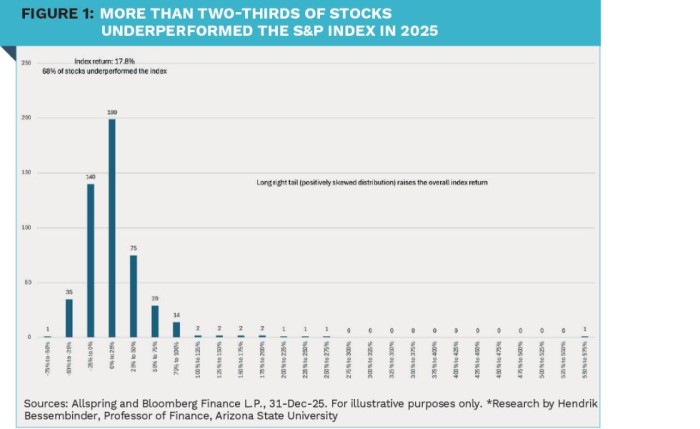
Why is this important? Research² has shown that long-term equity wealth creation has been driven by a relatively small number of stocks, while many listed companies fail to outperform the broader market. Index performance can therefore mask significant dispersion at the stock level (see Figure 1). By evaluating the full investment universe, systematic strategies can help identify long-term winners whilst avoiding persistent underperformers.
Although systematic investing is grounded in fundamental principles, incorporating a final stage of human validation helps address the challenge that no model can capture every material data point all the time. A final stage of human validation helps address material events that may not yet be reflected in the data and provides a vital risk control. This combination of scale, advanced technology and experienced judgement provides a robust framework for resilient portfolios.
Portfolio construction
In an increasingly complex world, portfolio construction is more important than ever. Climate investing is often viewed primarily through the lens of sustainability objectives, but in practice many of the challenges lie within portfolio construction. Excluding companies, reducing exposure to carbonintensive sectors or imposing decarbonisation targets can all create unintended sector, style and factor biases.
Similar challenges exist in traditional portfolios, where style biases and position limits can create significant benchmark divergences. Extreme market concentration, driven by mega-cap technology stocks and passive flows, has amplified these risks and increased the importance of active risk management.
Investors should consider how risk management is incorporated into portfolio construction. Our belief is that no risk model is complete and therefore multiple lenses should be used to measure and monitor risk within a portfolio. Blending traditional risk models that capture fundamental and macroeconomic risks with thematic models that seek to identify emerging risks can help build more resilient portfolios. For example, underweight exposures to energy companies or mega-cap technology stocks can be more deliberately managed by identifying suitable substitute positions that help neutralise unintended exposures.
A pragmatic approach to climate
To help balance investors’ sustainable and financial goals, we believe a pragmatic and forward-looking approach is required. Many traditional environmental, social and governance and climate metrics provide a useful snapshot of a company’s current position but offer limited insight into where that company is heading and can result in blind exclusions. Forward-looking measures, such as implied temperature rise assessments and analyses of future decarbonisation pathways, provide a more complete picture of transition progress and future risks.
The transition to a lower-carbon economy will not follow a smooth or predictable path. Many climate benchmarks require portfolios to meet a fixed annual decarbonisation schedule. Real-world transitions rarely evolve so neatly. Companies may experience periods of rapid progress followed by temporary setbacks, so investment processes need sufficient flexibility to distinguish between structural deterioration and short-term disruption.
Rather than forcing annual reductions in portfolio emissions regardless of the circumstances, a more pragmatic approach is to allow for temporary fluctuations whilst maintaining adherence to a long-term decarbonisation trajectory.
Conclusion
Climate investing remains a complex challenge, but many of the issues facing climate-focused portfolios are not unique. Recent market conditions have tested investor conviction across active management and highlighted the importance of implementation.
Successful climate investing requires more than simply applying exclusions or targeting portfolio-level emissions reductions. It requires investment processes capable of handling growing data complexity, portfolio construction frameworks designed to manage unintended risks, and a practical approach that recognises the realities of corporate and economic transitions.
As the industry continues to evolve, the distinction between successful and unsuccessful climate strategies may depend less on the ambition of their objectives and more on the effectiveness with which those objectives are translated into portfolios. The same may be true of active management more broadly.
|
SUMMARY Climate investing has faced performance headwinds, but active management broadly has struggled in recent years, making these challenges far from unique. A systematic approach can help investors navigate growing financial and sustainability data complexity whilst identifying long-term opportunities. Effective portfolio construction is critical to managing unintended risks and benchmark biases. A pragmatic, forward-looking climate framework can better balance sustainability objectives with long-term financial outcomes. |
- Morningstar Sustainalytics, Global Sustainable Fund Flows: Q4 and Full-Year 2025 in Review
- Research by Hendrik Bessembinder, Professor of Finance, Arizona State University.
Read the full article in Financial Investigator magazine