
Payden & Rygel: EMD, an entry point in the making
Payden & Rygel: EMD, an entry point in the making

In the face of volatility, the maturity of EMD and its unique diversification qualities are currently on full display. Investors looking to allocate should view recent events as an opportunity.
By Kristin Johnson Ceva
EMD is one of the most underappreciated sectors in public markets. We believe investors should have a structural allocation to the asset class. The current outbreak of geopolitical risk serves as a moment for investors to grow their EMD allocations. For one, it strengthens the argument for diversification. The US has become a key source of policy instability at a moment when US fiscal and political risks are poised to remain elevated. Questions about US equity valuations and private market sustainability persist. While the USD has seen a degree of support from the ‘flight to safety’ effect of the war, its strength has been relatively mild and follows more than a year of weakening versus most crosses. Since the conflict began, we observe that on days when war and energy risks are less pronounced, the USD is quick to weaken. Overall, we have seen a recent shift in asset class correlation patterns.
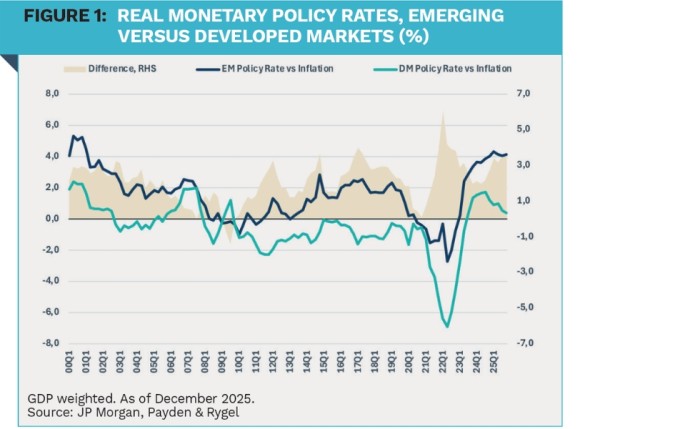
While the war’s effect on energy prices cannot be ignored, EMD as a whole should demonstrate resilience. EM economic fundamentals have been improving for three years, as evidenced by a preponderance of credit rating upgrades. Coming into the conflict, inflation was contained, real rates were firmly positive, and financial conditions were loosening. As a result, the energy impact – which should be temporary – can likely be absorbed without the need for major policy adjustments, allowing favorable EM trends to resume once the dust settles. The market reaction to events has been orderly and capital is being allocated rationally based on the potential fundamental impacts to each country and credit. Within EMD, active managers are able to navigate between issuers that benefit from higher energy prices, and those that may face pressure. Credit spreads, local rates and currency movements have been measured and proportionate.
A further supportive element is that EMD was not a ‘crowded’ trade coming into this risk event. Positioning across global fixed income remains skewed toward developed markets, suggesting that even modest reallocations into EMD could provide meaningful support to the asset class. This creates a favorable technical backdrop alongside improving fundamentals. Flows into EMD were tentatively improving over the past year, but only after the largest three-year outflow on record. As a result, even if flows pause, we see plenty of scope for investors to resume adding to EMD in the months ahead.
Even modest reallocations into EMD could provide meaningful support, given improving fundamentals and stilllight positioning.
It is worth remembering that EM debt is not a monolithic asset class, but rather a collection of distinct countries, each with an expanding universe of fixed income and local market opportunities. For investors who prefer to be invested in dollars or euros, EM sovereign, hardcurrency focused strategies can provide access to government-issued bonds in about 80 different countries. For those who like hardcurrency bonds but prefer corporates, EM corporatefocused funds can invest in more than 60 countries and 700 corporate bond issuers, across all global sectors. In the current cycle, investors will likely have interest in exposures outside the US dollar or euro. Local market-focused EM debt funds provide compelling carry across roughly 30 different countries and currencies. Increasingly, investors are opting for ‘blends’ of these segments. EM debt is also not defined by credit quality. The sector includes issuers with ‘AA’ rated quality all the way to the lower end of the rating spectrum. The average credit quality of EM debt indices sits above that of US high yield.
With a compelling combination of income, diversification and, importantly, liquidity on offer, EMD should remain a valuable strategic allocation in the years to come.
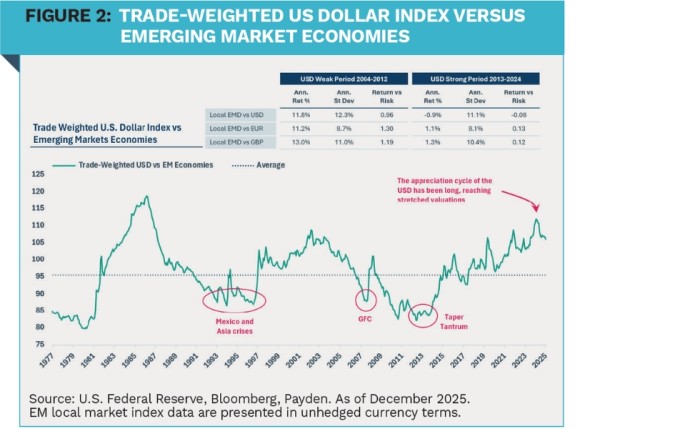
One of the top risk factors for investors is persistent appreciation of the US dollar against EM currencies, which served as a headwind for EM economies for much of the last decade. More recently, these dynamics have changed. The USD has been shifting away from a long cycle of strength, as metrics were pointing to high dollar and high US asset valuations relative to much of the rest of the world. In this context, one opportunity for investors is the potential medium-term appreciation of EM currencies. History shows that the dollar can depreciate meaningfully over a multiyear cycle, without jeopardizing its role as a global reserve currency. EM currency appreciation serves to boost EM economies by contributing to lower inflation and lower policy rates, supporting consumption and improving access to liquidity. This, in turn, attracts further capital flows and creates a ‘virtuous cycle’. Once the current market uncertainty passes, we expect this trend to resume.
EM debt has now existed for over 30 years and has matured as a sector. We have been active in the asset class since its inception. Borrowers are more communicative and transparent, while information quality and data availability have improved. The investor base is predominantly institutional, seasoned and sophisticated. The trading environment is vibrant, as the range of funds and strategies has expanded. Investors within EM countries, including banks, pensions, insurance and fund managers are playing an increasing role, as governments shift toward domestic markets for financing.
As global markets continue to navigate a complex macro and geopolitical backdrop, investors are increasingly seeking sources of income that are both durable and diversified. With a compelling combination of income, diversification and, importantly, liquidity on offer, we believe that EMD should remain a valuable strategic allocation in the years to come.
|
SUMMARY Capital allocations to US assets are historically elevated, and investors should consider broader geographic exposure. Income generation is the backbone of long-run EMD returns. Taking advantage of buying opportunities has been a good strategy over time. The potential for EM local markets to perform over the medium term adds to the attractiveness of the asset class. |
Read the full article in Financial Investigator magazine